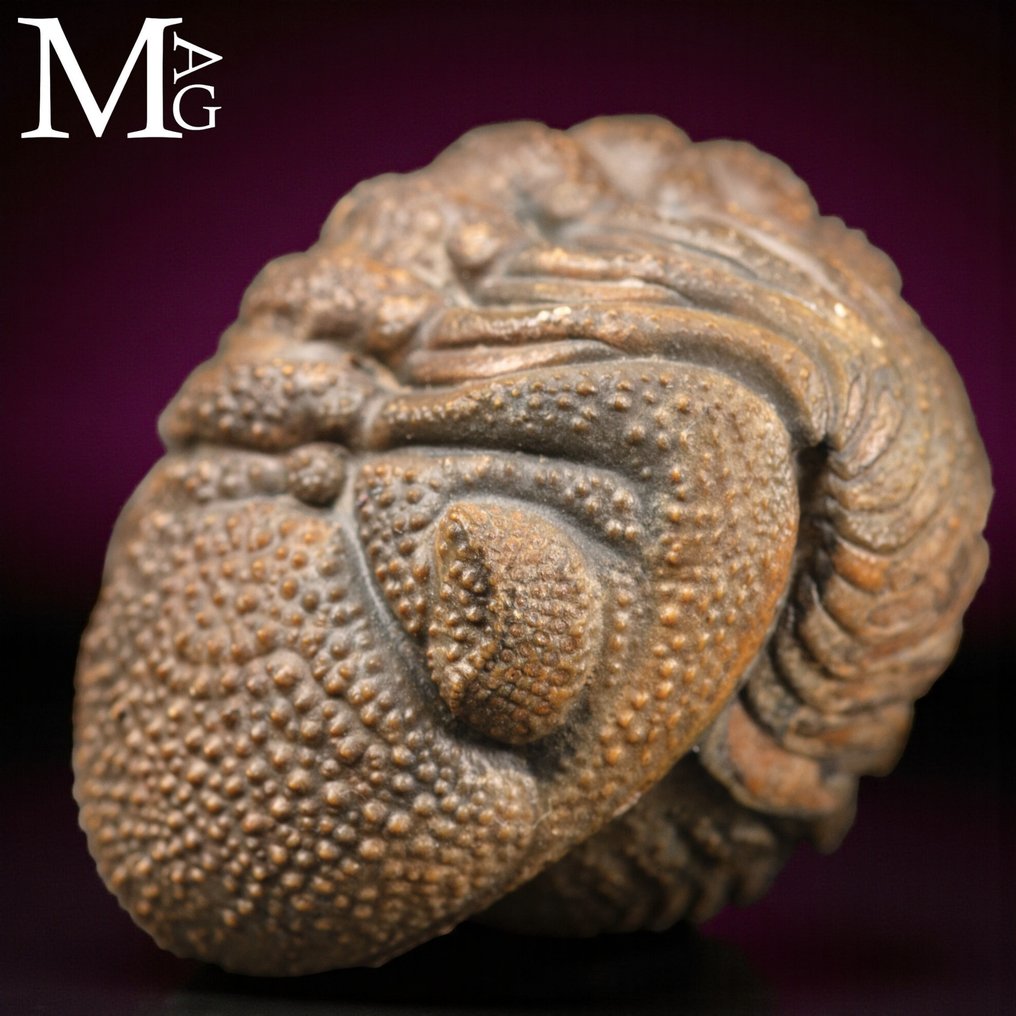
Fossil Trilobites: Silent Witnesses of the Dawn of Life Trilobite Gerastos granulosus – Enrollment - Height: 30 mm - Width: 27 mm- 22 g


Opens tomorrow
Starting bid
€ 1
Add to your favourites to get an alert when the auction starts.

Expert
Selected by Jonas Rathaj
Has worked with taxidermy since childhood and gained retailer experience.
Estimate € 180 - € 200
Catawiki Buyer Protection
Your payment’s safe with us until you receive your object.View details
Trustpilot 4.4 | 123113 reviews
Rated Excellent on Trustpilot.
Description from the seller
This specimen belongs to the species Gerastos granulosus, a trilobite from the family Phacopidae, which lived during the Middle Devonian (approximately 393–383 million years ago). Originating from the fossiliferous formations of the Moroccan Anti-Atlas, it is found in an enrollment position, the defensive curling typical of trilobites, which allowed them to protect the most vulnerable parts of their body.
Morphological characteristics
Rounded and granular cephalon: the surface of the glabella is covered with dense pustules and elevations, a distinctive feature of the species (granulosus indeed means 'granular'). Small schizocroal eyes, composed of tiny lenses, are less prominent compared to those of other Phacopidae like Drotops. The thorax is short and compact, mostly hidden by the curled-up position. The pygidium is solid, completing the rounded shape of the specimen. Enrolling is not just an aesthetic trait but represents a crucial evolutionary adaptation: trilobites could close themselves up, protecting their soft abdomen with the cephalic shield and pygidium, much like armadillos or crustaceans do today. The genus Gerastos is well represented in the Devonian faunas of North Africa, where calcareous sedimentation conditions have favored extraordinary three-dimensional fossilization. Compared to more elongated or spiny trilobites, Gerastos granulosus stands out for its compact and robust forms, a morphology that likely reflects survival strategies based on passive defense.
Main data
Species: Gerastos granulosus
Age: Middle Devonian (393–383 Ma)
Class: Trilobita
Family: Phacopidae
Origin: Anti-Atlante, Morocco
A fossil that combines scientific rigor and natural charm: the perfectly preserved coiling, combined with the granular texture of the cefalon, makes this specimen of Gerastos granulosus a true little paleontological jewel, ideal for high-quality natural history collections.
Seller's Story
The Mineral Art Gallery offers minerals, fossils, shells and natural elements.
Born in Italy in 2017, today she collaborates with international galleries and collectors, she is a direct importer of large minerals and naturalistic collectible elements; deals with the processing to insert them inside the living space. A section of the gallery was dedicated to the Wunderkammer, "chamber of wonders or cabinet of curiosities" in which Mirabilia elements are presented: naturalia and italiania, a union between "the present is the past".
All lots are shipped via DHL Express and Fercam couriers, with insured parcel and tracking.
Translated by Google TranslateThis specimen belongs to the species Gerastos granulosus, a trilobite from the family Phacopidae, which lived during the Middle Devonian (approximately 393–383 million years ago). Originating from the fossiliferous formations of the Moroccan Anti-Atlas, it is found in an enrollment position, the defensive curling typical of trilobites, which allowed them to protect the most vulnerable parts of their body.
Morphological characteristics
Rounded and granular cephalon: the surface of the glabella is covered with dense pustules and elevations, a distinctive feature of the species (granulosus indeed means 'granular'). Small schizocroal eyes, composed of tiny lenses, are less prominent compared to those of other Phacopidae like Drotops. The thorax is short and compact, mostly hidden by the curled-up position. The pygidium is solid, completing the rounded shape of the specimen. Enrolling is not just an aesthetic trait but represents a crucial evolutionary adaptation: trilobites could close themselves up, protecting their soft abdomen with the cephalic shield and pygidium, much like armadillos or crustaceans do today. The genus Gerastos is well represented in the Devonian faunas of North Africa, where calcareous sedimentation conditions have favored extraordinary three-dimensional fossilization. Compared to more elongated or spiny trilobites, Gerastos granulosus stands out for its compact and robust forms, a morphology that likely reflects survival strategies based on passive defense.
Main data
Species: Gerastos granulosus
Age: Middle Devonian (393–383 Ma)
Class: Trilobita
Family: Phacopidae
Origin: Anti-Atlante, Morocco
A fossil that combines scientific rigor and natural charm: the perfectly preserved coiling, combined with the granular texture of the cefalon, makes this specimen of Gerastos granulosus a true little paleontological jewel, ideal for high-quality natural history collections.
Seller's Story
The Mineral Art Gallery offers minerals, fossils, shells and natural elements.
Born in Italy in 2017, today she collaborates with international galleries and collectors, she is a direct importer of large minerals and naturalistic collectible elements; deals with the processing to insert them inside the living space. A section of the gallery was dedicated to the Wunderkammer, "chamber of wonders or cabinet of curiosities" in which Mirabilia elements are presented: naturalia and italiania, a union between "the present is the past".
All lots are shipped via DHL Express and Fercam couriers, with insured parcel and tracking.
Translated by Google TranslateDetails
Main Mineral
Fossil Trilobites: Silent Witnesses of the Dawn of Life
Mineral Form
Trilobite Gerastos granulosus – Enrollment
Weight
22 g
Country of Origin
Morocco
Height
30 mm
Width
27 mm
Depth
24 mm
Sold by