Tiny Esveld - Charles Schneider - 1997


00
days
07
hours
08
minutes
51
seconds
Current bid
€ 20
No reserve price

Expert
Selected by Michel Karis
Art historian with extensive experience working at various auction houses in antiques.
Estimate € 120 - € 170
24 other people are watching this object
 Bidder 1654 Bidder 1654 | €20 | |
|---|---|---|
 Bidder 1479 Bidder 1479 | €15 | |
| Bidder 1654 | €10 | |
Catawiki Buyer Protection
Your payment’s safe with us until you receive your object.View details
Trustpilot 4.4 | 121899 reviews
Rated Excellent on Trustpilot.
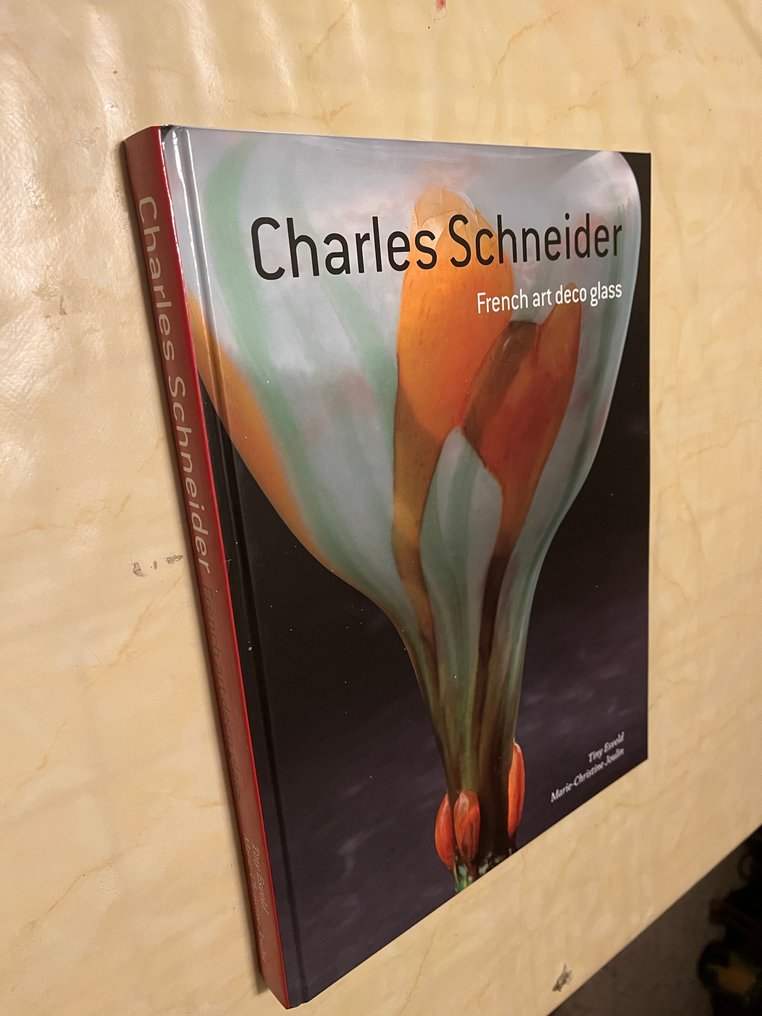
Charles Schneider is a hardback English-language monograph by Tiny Esveld, first edition, published in 1997, comprising 288 pages, measuring 30 × 22 cm and weighing 1.732 kg, with a booklet containing a French translation.
AI-assisted summary
Description from the seller
Charles Schneider - French Art Deco Glass
288 pages
Magnificent color photos
Hardcover
30 x 22 cm
1,732 kg
English & added a booklet with French translation
This beautiful luxury publication is informative, easy to read and features a wealth of color illustrations. Almost 300 pages counting the life, times and oeuvre of Charles Schneider (1881-1953): a pioneer who ushered with the shapes and colors of his glass creations and his modern expressivity in Art Deco.
A brief biography brings to life Schneider's early years and artistic ambitions, his design work for Daum and his predilection for engraving medals and semi-precious stones, an art which proved very useful in later life.
A short history presents the Verreries Schneider S.A., where his brother Ernest played an important role as financial director. The firm had two production lines: Schneider and Le Verre Français. The technique of glass etching and engraving, as well as the use of colored powder, marquetry and luster glass are explained. The artistic experiments and constant search for new techniques in the laboratory are fascinating. And of course the authors discuss style, the development from Art Nouveau to Art Deco with its austere lines, patterns and decorations.
This biographical and technical tale is illustrated by period photographs of the family and the factory as well as many original designs. All the designs are by Schneider's hand, as he himself drew all the glass shapes and flower and fauna for his objects.
The authors were especially privileged in being allowed to research the family archives and thus discover new information. For instance, the hitherto unknown design and pictures of Schneider's Salon de la Société des Artistes Français entry: La Toilette, a bronze medal and a cameo assembled in a frame. But the highlight of the book is obviously the hundreds of beautiful color photographs of these desirable objects, each with a caption explaining what makes the object so special.
Charles Schneider - French Art Deco Glass
288 pages
Magnificent color photos
Hardcover
30 x 22 cm
1,732 kg
English & added a booklet with French translation
This beautiful luxury publication is informative, easy to read and features a wealth of color illustrations. Almost 300 pages counting the life, times and oeuvre of Charles Schneider (1881-1953): a pioneer who ushered with the shapes and colors of his glass creations and his modern expressivity in Art Deco.
A brief biography brings to life Schneider's early years and artistic ambitions, his design work for Daum and his predilection for engraving medals and semi-precious stones, an art which proved very useful in later life.
A short history presents the Verreries Schneider S.A., where his brother Ernest played an important role as financial director. The firm had two production lines: Schneider and Le Verre Français. The technique of glass etching and engraving, as well as the use of colored powder, marquetry and luster glass are explained. The artistic experiments and constant search for new techniques in the laboratory are fascinating. And of course the authors discuss style, the development from Art Nouveau to Art Deco with its austere lines, patterns and decorations.
This biographical and technical tale is illustrated by period photographs of the family and the factory as well as many original designs. All the designs are by Schneider's hand, as he himself drew all the glass shapes and flower and fauna for his objects.
The authors were especially privileged in being allowed to research the family archives and thus discover new information. For instance, the hitherto unknown design and pictures of Schneider's Salon de la Société des Artistes Français entry: La Toilette, a bronze medal and a cameo assembled in a frame. But the highlight of the book is obviously the hundreds of beautiful color photographs of these desirable objects, each with a caption explaining what makes the object so special.
Details
Number of Books
1
Subject
Art history
Book Title
Charles Schneider
Author/ Illustrator
Tiny Esveld
Condition
As new
Publication year oldest item
1997
Height
30 cm
Edition
1st Edition
Width
22 cm
Language
English
Original language
Yes
Publisher
Tiny esveld
Number of pages
288
Sold by