Spinosaur - Fossil tooth - 9 cm - 2.7 cm (No Reserve Price)



05
days
06
hours
54
minutes
21
seconds

No bids placed
Catawiki Buyer Protection
Your payment’s safe with us until you receive your object.View details
Trustpilot 4.4 | 121899 reviews
Rated Excellent on Trustpilot.
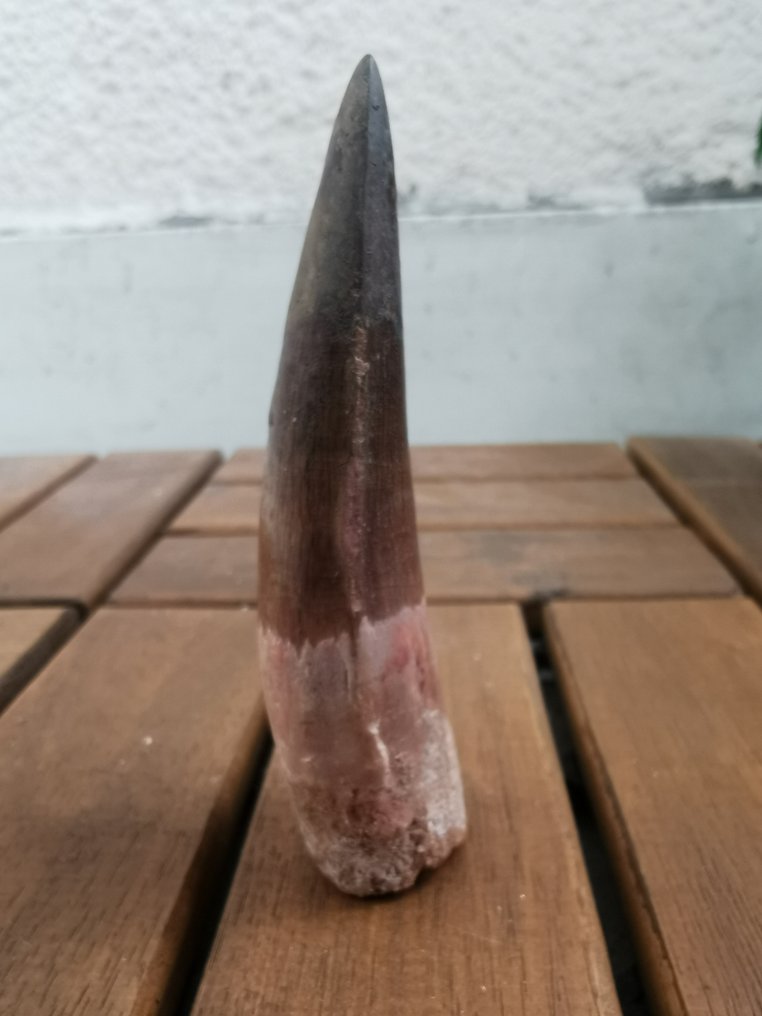
Scientific name Spinosaurus; Specimen Spinosaur; Geological Period Upper Cretaceous; Treatment Conserved; Condition Natural; Dimensions 9 cm high by 2.7 cm wide; Origin Morocco.
AI-assisted summary
Description from the seller
→9 cm long
→ 2.7 cm width at widest point
It is a beautiful, long and and nicely curved Spinosaurus teeth with good feel of solidness to it when held in hand reminding of the iconic Spinosaurus.
This teeth also shows natural wear on the tip of the teeth probably due to feeding usage by the Spinosaurus before it was probably shed and replaced with a new teeth. The underside of the teeth gives the idea about the thickness of the teeth bone itself and the circular profile of the teeth at the attachment. The presence of sand in root attachment as shown in photo gives an idea about the dynamics of fossilization process which is very cool in its own.
Spinosaurus teeth does not have serrations but shiny enamel which is prominent at the tip and gradually tapers towards the root and it feature light longitudinal ridges & these feature are also visible on the provided teeth. These longitudinal ridges are called longitudinal striations in technical terms. Scientistic believe 2 to 3 different types of Spinosaurus lived in Africa based on the those longitudinal striations and the teeth morphology in general.
This teeth is likely at the front on the mouth because its more curved, which is important to properly hold onto prey while the teeth is gets pierced through the prey like fish or turtle.
The overall teeth is in excellent shape and is professionally conserved as well.
Detailed photos have been provided for reference.
→9 cm long
→ 2.7 cm width at widest point
It is a beautiful, long and and nicely curved Spinosaurus teeth with good feel of solidness to it when held in hand reminding of the iconic Spinosaurus.
This teeth also shows natural wear on the tip of the teeth probably due to feeding usage by the Spinosaurus before it was probably shed and replaced with a new teeth. The underside of the teeth gives the idea about the thickness of the teeth bone itself and the circular profile of the teeth at the attachment. The presence of sand in root attachment as shown in photo gives an idea about the dynamics of fossilization process which is very cool in its own.
Spinosaurus teeth does not have serrations but shiny enamel which is prominent at the tip and gradually tapers towards the root and it feature light longitudinal ridges & these feature are also visible on the provided teeth. These longitudinal ridges are called longitudinal striations in technical terms. Scientistic believe 2 to 3 different types of Spinosaurus lived in Africa based on the those longitudinal striations and the teeth morphology in general.
This teeth is likely at the front on the mouth because its more curved, which is important to properly hold onto prey while the teeth is gets pierced through the prey like fish or turtle.
The overall teeth is in excellent shape and is professionally conserved as well.
Detailed photos have been provided for reference.
Details
Number of items
1
Specimen
Spinosaur
Country of Origin
Morocco
Geological Period
Cretaceous, Upper (100.5 - 66 million years)
Condition
Natural
Treatment
Conserved
Height
9 cm
Width
2.7 cm
Sold by