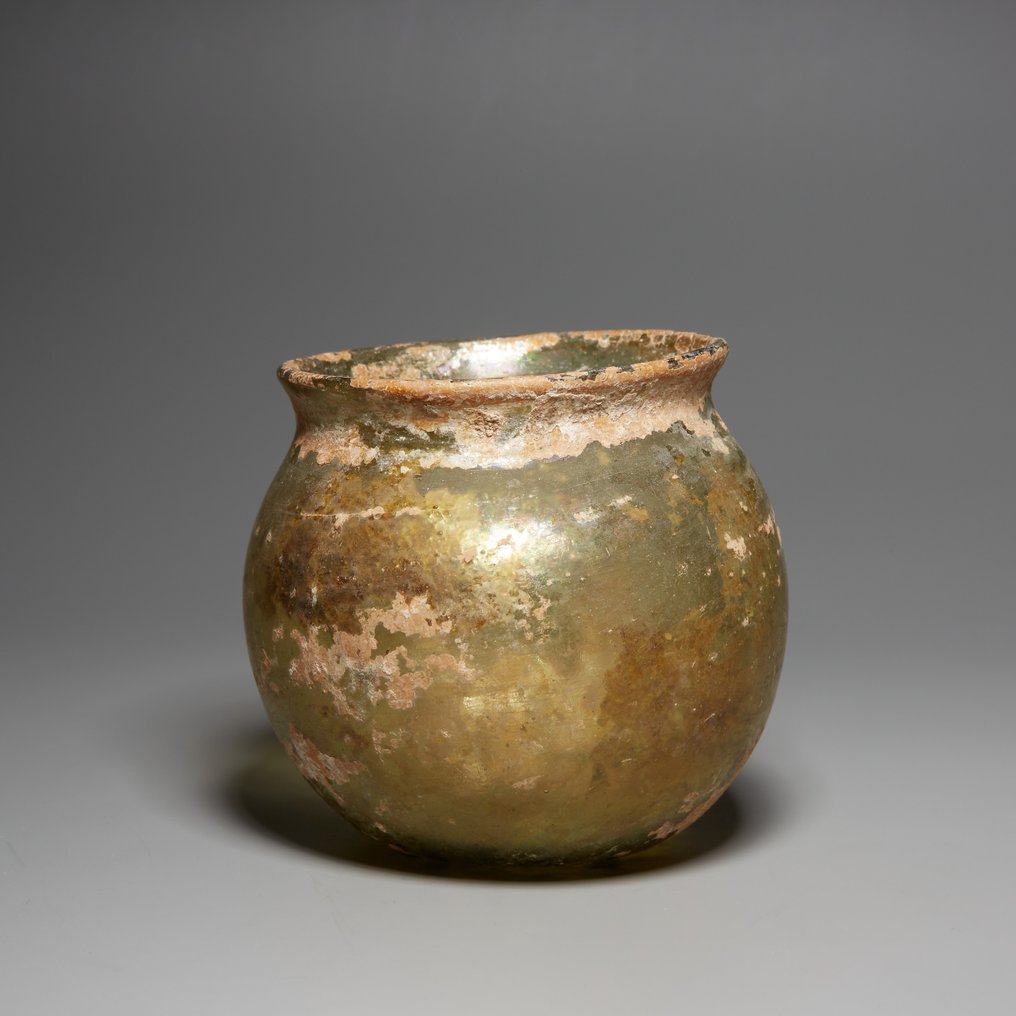
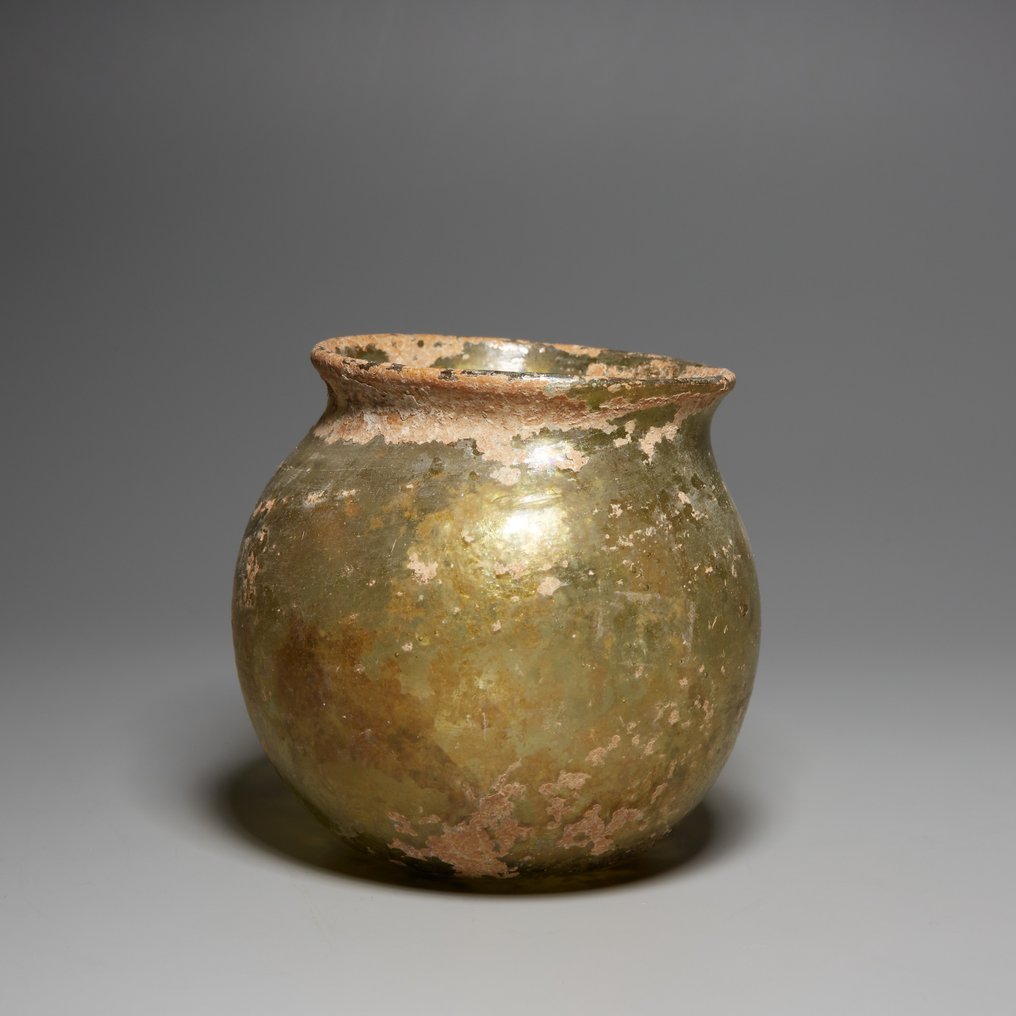
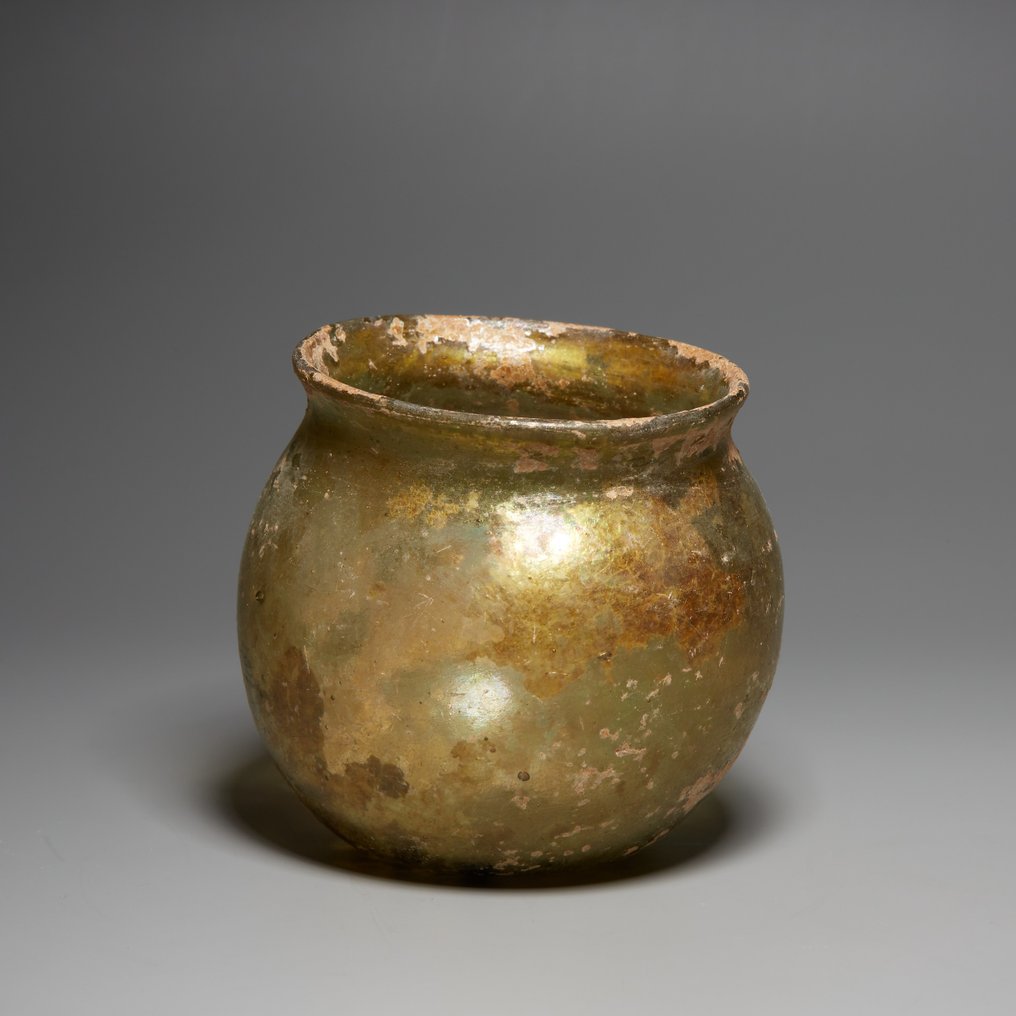
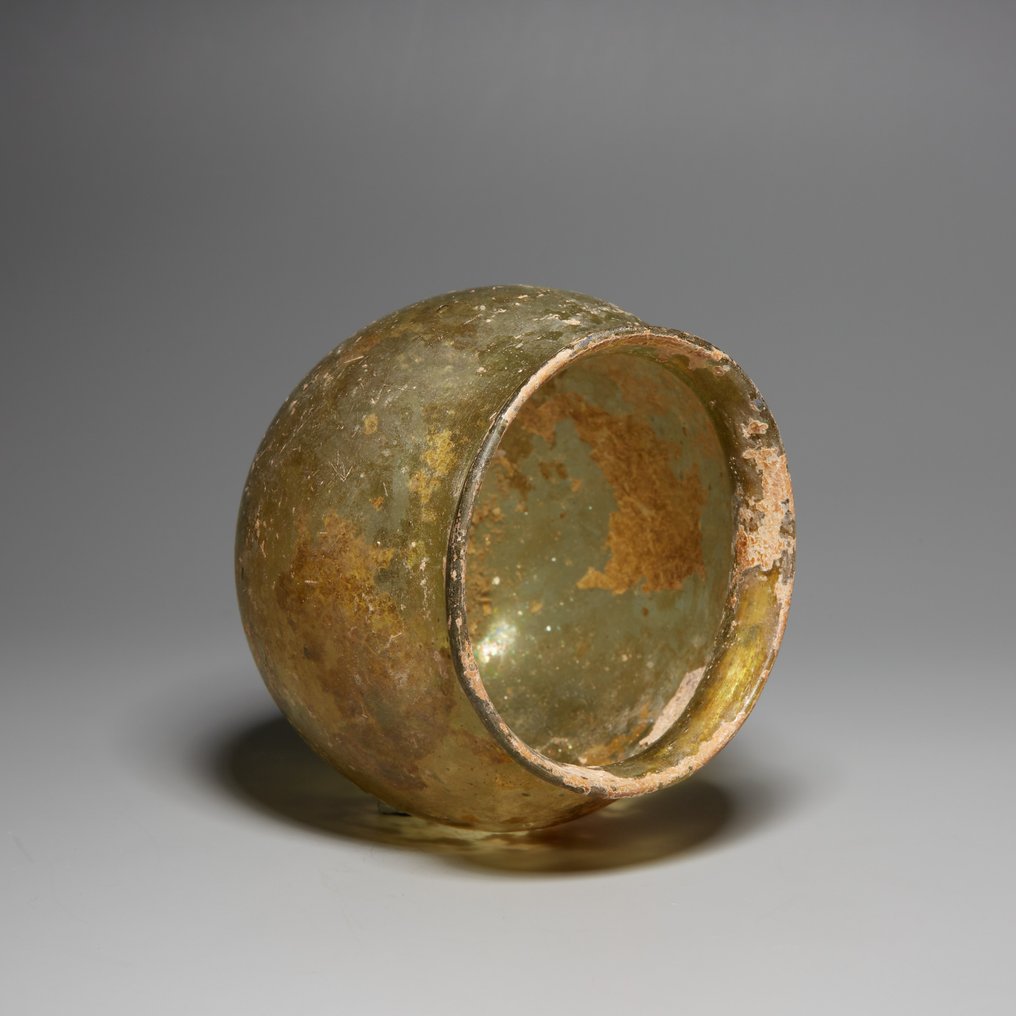
Ancient Roman Glass Flask. 1st-3rd century AD. 7.4 cm height.

15
days
20
hours
10
minutes
05
seconds
Current bid
€ 1
Reserve price not met

Expert
Selected by Ruth Garrido Vila
Directed the Ifergan Collection Museum, specialising in Phoenician and Mediterranean archaeology.
Estimate € 700 - € 800
1 other person has their eye on this
 Bidder 5840 Bidder 5840 | €1 |
|---|
Catawiki Buyer Protection
Your payment’s safe with us until you receive your object.View details
Trustpilot 4.4 | 121899 reviews
Rated Excellent on Trustpilot.
Ancient Roman glass flask, 7.4 cm high, dating to the 1st–3rd century AD, in good condition.
AI-assisted summary
Description from the seller
Flask.
Ancient Roman, 1st-3rd century AD.
Glass.
7.4 cm height.
PROVENANCE: Private collection, France. Acquired before 1980.
CONDITION: Good condition.
DESCRIPTION:
Big and small sized bottles of various shapes (more or less globular body, tall or low flared neck, ribbed or plain handles, etc.) and blown in different colors (aubergine, blue, yellow, transparent, green, etc.) were very popular from the 1st to the 4th century A.D.: they were part of the most frequently used toiletry tools. Their success certainly encouraged glassworkers to be highly inventive in order to create new versions, even more attractive to the public.
Towards the end of the Hellenistic period, glass definitely supplanted terracotta as a raw material for the manufacture of containers in all areas of daily life: this event, which occurred gradually, shall be regarded as a major technical revolution in antiquity, made easier, in early Roman times, by the invention and quick spread of the blowpipe, and by the conception of furnaces resisting to higher and higher temperatures.
With a versatility like no other known material in Roman times, abundant availability, lightness and ease of use, glass enabled the imitation of a wide range of other materials (especially precious metals), whether in the form, the design or the color. Furthermore, the ancients certainly knew that glass is a chemically neutral substance, what makes it particularly suitable for the storage of cosmetics or pharmaceutical products, as well as food and liquids.
Just about all Roman burials contain clear or greenish glass vessels covered with an iridescent patina due to the action of humidity and air. These flasks, when made in narrow forms, are often called unguentaria or lacrimaria by collectors, but were only used to contain oils and perfumes in the tombs, not to be containers for tears.
The Romans also perfected the art of working figures in relief on the glass vessels with the addition of another layer of glass of a different colour, or one of enamel, along with moulding, cutting or engraving of the glass, with the result that the surfaces of the containers looked like worked cameos.
BIBLIOGRAPHY:
- ARVEILLER-DULONG, Véronique. NENNA, Marie-Dominique. Les verres antiques au museé du Louvre. Tomo II. Museé du Louvre. 2006.
- FLEMING, Stuart J. Roman Glass: Reflections on Cultural Change. University of Pennsylvania Museum of Archaeology and Anthropology. 1999.
Notes:
- The piece includes authenticity certificate.
- The piece includes Spanish Export License (Passport for European Union) - If the piece is destined outside the European Union a substitution of the export permit should be requested, can take between 1-2 weeks maximum.
- The seller guarantees that he acquired this piece according to all national and international laws related to the ownership of cultural property. Provenance statement seen by Catawiki.
Seller's Story
Gallery of Ancient Art - Archeology based in Barcelona with more than fifteen years of experience. Specialized in classical art, Egyptian art, Asian art and pre-Columbian art. It guarantees the authenticity of all its pieces. It participates in the most important art fairs in Spain, such as Feriarte, as well as in fairs abroad, BRAFA, Parcours des Mondes, Cultures Brussels.
All the pieces are sent with an Export Permit issued by the Spanish Ministry of Culture.
We are quick to ship via DHL Express or Direct Art Transport.
Translated by Google TranslateFlask.
Ancient Roman, 1st-3rd century AD.
Glass.
7.4 cm height.
PROVENANCE: Private collection, France. Acquired before 1980.
CONDITION: Good condition.
DESCRIPTION:
Big and small sized bottles of various shapes (more or less globular body, tall or low flared neck, ribbed or plain handles, etc.) and blown in different colors (aubergine, blue, yellow, transparent, green, etc.) were very popular from the 1st to the 4th century A.D.: they were part of the most frequently used toiletry tools. Their success certainly encouraged glassworkers to be highly inventive in order to create new versions, even more attractive to the public.
Towards the end of the Hellenistic period, glass definitely supplanted terracotta as a raw material for the manufacture of containers in all areas of daily life: this event, which occurred gradually, shall be regarded as a major technical revolution in antiquity, made easier, in early Roman times, by the invention and quick spread of the blowpipe, and by the conception of furnaces resisting to higher and higher temperatures.
With a versatility like no other known material in Roman times, abundant availability, lightness and ease of use, glass enabled the imitation of a wide range of other materials (especially precious metals), whether in the form, the design or the color. Furthermore, the ancients certainly knew that glass is a chemically neutral substance, what makes it particularly suitable for the storage of cosmetics or pharmaceutical products, as well as food and liquids.
Just about all Roman burials contain clear or greenish glass vessels covered with an iridescent patina due to the action of humidity and air. These flasks, when made in narrow forms, are often called unguentaria or lacrimaria by collectors, but were only used to contain oils and perfumes in the tombs, not to be containers for tears.
The Romans also perfected the art of working figures in relief on the glass vessels with the addition of another layer of glass of a different colour, or one of enamel, along with moulding, cutting or engraving of the glass, with the result that the surfaces of the containers looked like worked cameos.
BIBLIOGRAPHY:
- ARVEILLER-DULONG, Véronique. NENNA, Marie-Dominique. Les verres antiques au museé du Louvre. Tomo II. Museé du Louvre. 2006.
- FLEMING, Stuart J. Roman Glass: Reflections on Cultural Change. University of Pennsylvania Museum of Archaeology and Anthropology. 1999.
Notes:
- The piece includes authenticity certificate.
- The piece includes Spanish Export License (Passport for European Union) - If the piece is destined outside the European Union a substitution of the export permit should be requested, can take between 1-2 weeks maximum.
- The seller guarantees that he acquired this piece according to all national and international laws related to the ownership of cultural property. Provenance statement seen by Catawiki.
Seller's Story
Gallery of Ancient Art - Archeology based in Barcelona with more than fifteen years of experience. Specialized in classical art, Egyptian art, Asian art and pre-Columbian art. It guarantees the authenticity of all its pieces. It participates in the most important art fairs in Spain, such as Feriarte, as well as in fairs abroad, BRAFA, Parcours des Mondes, Cultures Brussels.
All the pieces are sent with an Export Permit issued by the Spanish Ministry of Culture.
We are quick to ship via DHL Express or Direct Art Transport.
Translated by Google TranslateDetails
Culture
Ancient Roman
Century/ Timeframe
1st-3rd century AD
Name of object
Flask. 1st-3rd century AD. 7.4 cm height.
Acquired from
Auction house
Year acquired
2025
Material
Glass
Country acquired from
France
Condition
Good
Previous owner acquired from
Private collection
Previous owner - year acquired
1970
Previous owner - country acquired from
France
I verify that I have obtained this object legally and that I am allowed to sell it
Yes
Disclaimer
The seller was informed by Catawiki about documentation requirements and guarantees the following: - the object was legally obtained, - the seller has the right to sell and/or export the object, as relevant, - the seller will provide the necessary provenance information and arrange required documentation and permits/licenses, as applicable and as per local laws, - the seller will notify the buyer of any delays in obtaining permits/licenses. By bidding, you acknowledge that import documentation may be required depending on your country of residence and that obtaining permits/licenses may cause delays in the delivery of your object.
The seller was informed by Catawiki about documentation requirements and guarantees the following: - the object was legally obtained, - the seller has the right to sell and/or export the object, as relevant, - the seller will provide the necessary provenance information and arrange required documentation and permits/licenses, as applicable and as per local laws, - the seller will notify the buyer of any delays in obtaining permits/licenses. By bidding, you acknowledge that import documentation may be required depending on your country of residence and that obtaining permits/licenses may cause delays in the delivery of your object.
