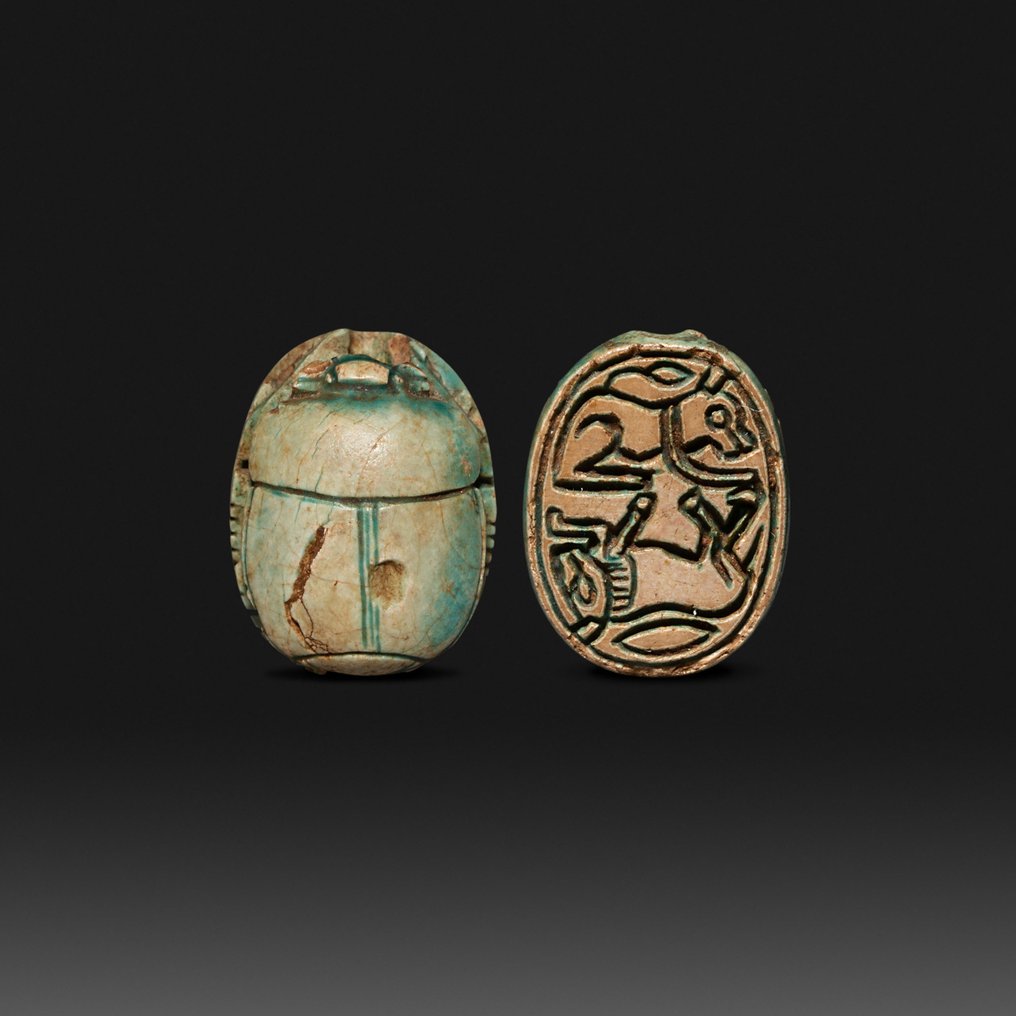
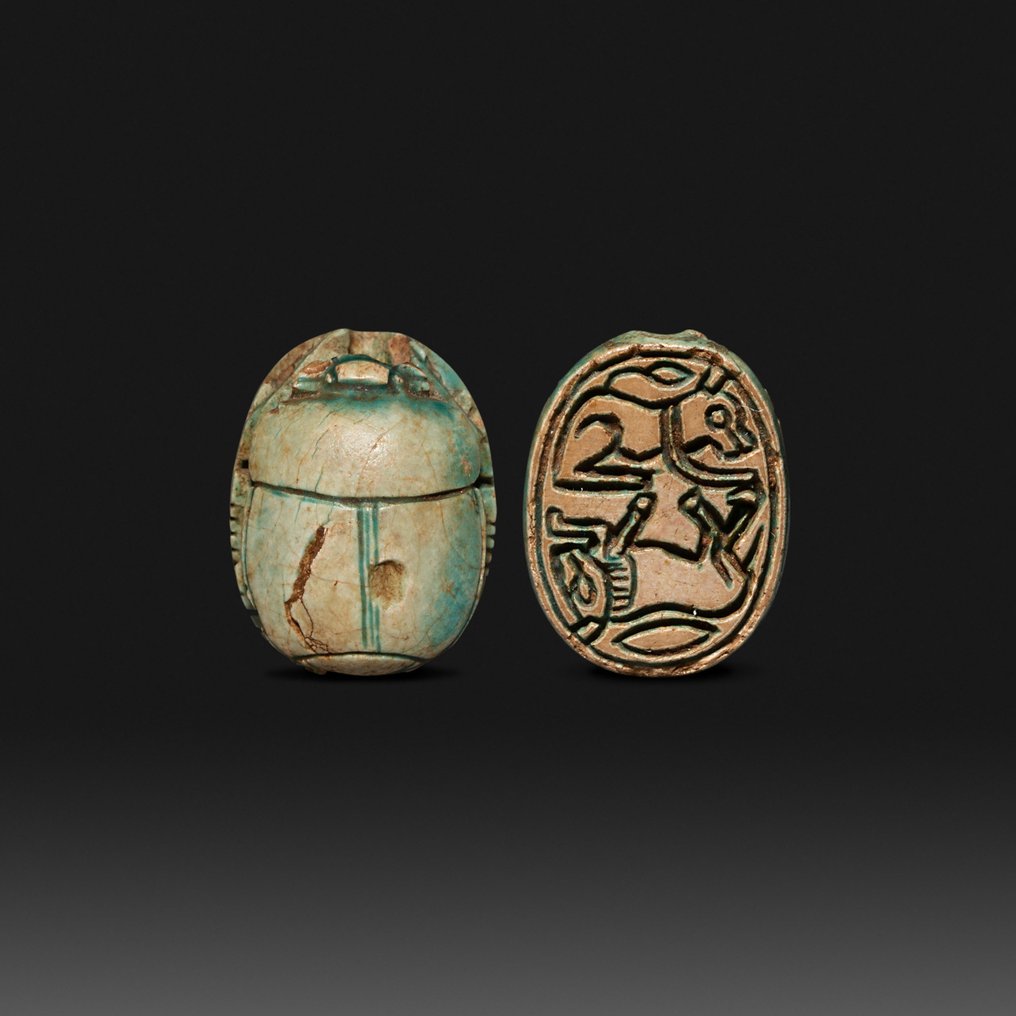
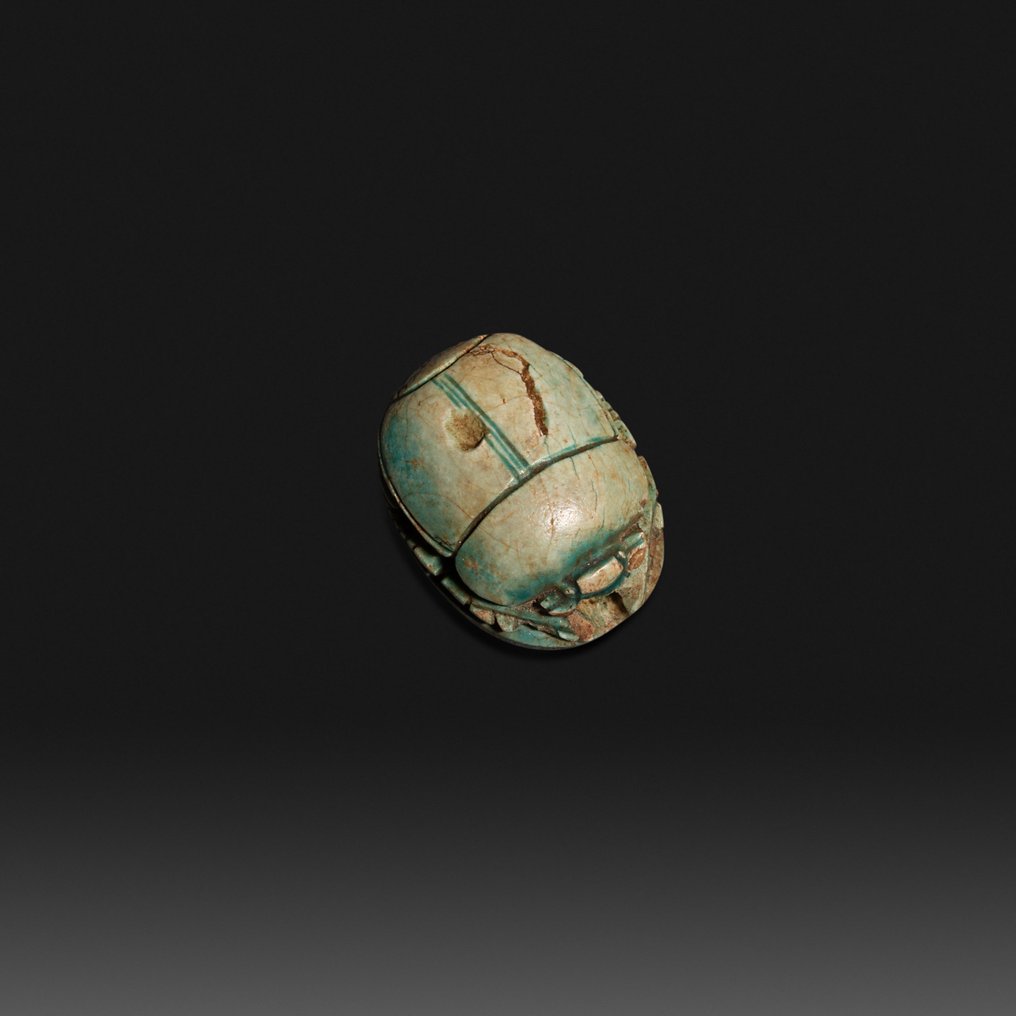
Ancient Egyptian Glassed Steatite Scarab. Second Intermediate Period or New Empire, 1640 - 1070 BC. 1.9 cm height.
02
days
02
hours
09
minutes
57
seconds
Current bid
€ 150
Reserve price not met

Expert
Selected by Ruth Garrido Vila
Directed the Ifergan Collection Museum, specialising in Phoenician and Mediterranean archaeology.
Estimate € 2,800 - € 3,200
26 other people are watching this object
 Bidder 4708 Bidder 4708 | €150 | |
|---|---|---|
 Bidder 4098 Bidder 4098 | €7 | |
| Bidder 4708 | €6 | |
Catawiki Buyer Protection
Your payment’s safe with us until you receive your object.View details
Trustpilot 4.4 | 122290 reviews
Rated Excellent on Trustpilot.
Ancient Egyptian scarab amulet, glassed steatite, 1.9 cm long, dating to the Second Intermediate Period or New Empire (1640–1070 BC), in very good condition, acquired from a private collection.
AI-assisted summary
Description from the seller
Scarab.
Ancient Egypt, Second Intermediate Period or New Empire, 1640 - 1070 BC.
Glassed Steatite.
1.9 cm length.
PROVENANCE:
- Private collection, Albert Dubus (1846 – 1917), France.
Albert Dubus was a founding member of the French Prehistoric Society and vice-president of the Norman Society for Prehistoric Studies.
CONDITION: Intact.
DESCRIPTION:
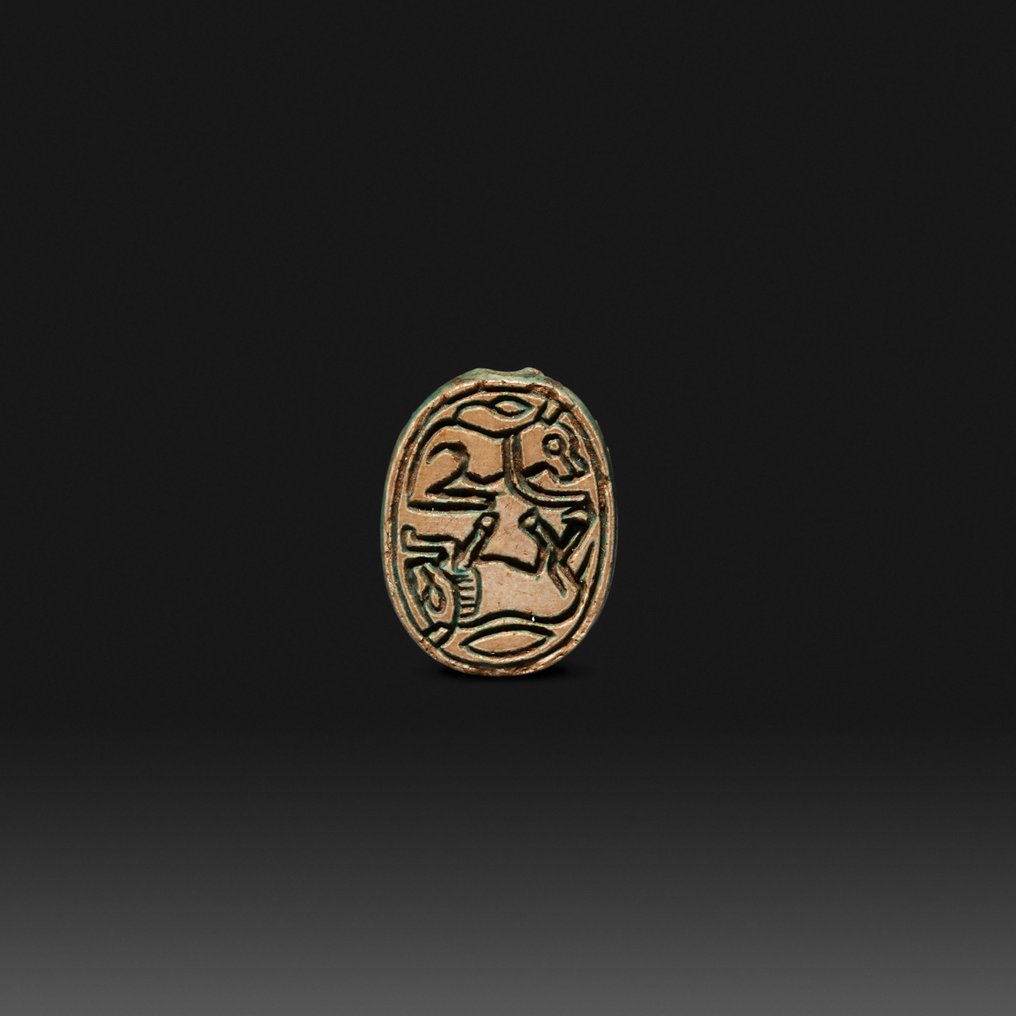
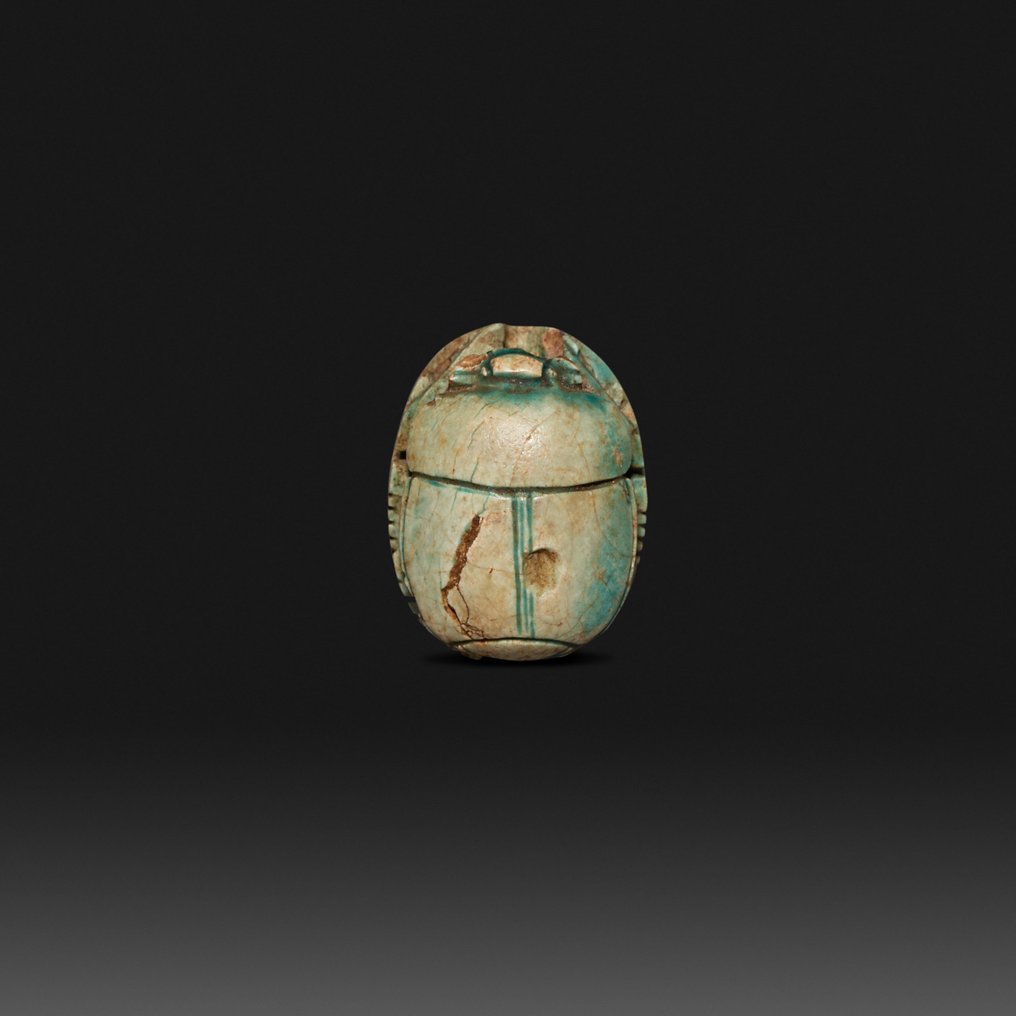
Amulet in the shape of a scarab, called a scarab, carved in soapstone and glazed in a translucent green tone. The upper part represents the animal in a remarkably naturalistic way, with the elytra differentiated and the head and legs reflected in great detail, including the characteristic serrated edges of the limbs. The scarab is placed on a flat base, decorated by incisions with the title of the Name of Nesut-Bity above and the Sema-tauy below, the space framed by a simple oval line. The scarab is perforated longitudinally, which would allow it to be held with a cord or attached to a ring.
The Name of Nesut-Bity or Throne Name was one of the five royal names of the pharaohs. It literally means "the one of the bee and the reed", and would be translated as Lord of the Two Lands, given that the hieroglyphs that compose it allude to the bee, symbol of Lower Egypt, and the reed, of Upper Egypt. The title has its origins in the pharaoh Den of the I dynasty, and from the IV it replaced the name of Horus as the pharaoh's main title. The set of hieroglyphs that make up the Name of Nesut-Bity appears in various contexts, representing supreme authority or direct connection to the pharaoh, either through administrative means or through family ties.
For its part, the Sema-tauy was a symbol that represented the union of Upper and Lower Egypt, and is composed of the two heraldic plants of both regions - the lotus flower and the papyrus, respectively - linked by the hieroglyph sema, which symbolizes union and represents the trachea and lungs. The Sema-tauy has, therefore, the same geographical, non-religious, meaning as the Name of Nesut-Bity, alluding to the two territories subject to the authority of the pharaoh. However, the Sema-tauy often includes the representation of two deities performing the act of tying the two plants together—uniting the two kingdoms. It was also born in the times of Pharaoh Den, although its use was not so closely linked to the figure of the Pharaoh. Although it often appears linked to his figure, it was also used as a funerary amulet, placed on the body of the deceased to prevent it from disintegrating on its way to the Hereafter.
Together, the Name of Nesut-Bity and the Sema-tauy symbol have clear royal connotations. Both refer to the association of royalty and State, as well as Creation as a whole. The amulet that shows them together should provide its owner with royal support and a stable, well-organized environment. Likewise, the sign of unification also has renewing connotations. Although the appearance of the Sema-tauy sign is relatively frequent (fig. 1), as is the use in certain contexts of the Name of Nesut-Bity (fig. 2), the union of both is rare. A similar scarab is currently preserved in the Walters Art Museum in Baltimore (fig. 3).
The scarab, a scarab-shaped amulet, is the most widespread form of Egyptian amulets both in the funerary context and in daily life. The oldest found, made of ivory, dates from the VI dynasty (c. 2345-2171 BC). The scarabs were represented in various materials: soapstone, basalt, granite and in precious stones such as lapis lazuli, amethyst, carnelian, and even in metals such as gold. In this case, in green jasper. They are generally small and pierced to allow them to be attached to a necklace, and at the base they carry a brief inscription or mythological, human or animal figures.
Symbol of the cycle of constant transformation of life, the scarab was linked to the god Jepri, form of Ra as the rising sun. The Egyptians believed that Jepri transported the Sun every day after its disappearance on the horizon, through the underground world or Duat, to make it reborn again the next day. The scarab was therefore an amulet of life and power, a representation of the rising Sun and a fundamental symbol of protection. Its importance has determined that numerous examples reach our days, which have allowed it to be studied in depth. In life, the scarab provided protection against visible and invisible evil, and daily granted strength and power to its possessor. In death, it granted the possibility of resurrection in the Afterlife and achieving eternal life.
In this funeral context, the so-called heart scarab stands out, which was placed on the chest of the deceased to protect his heart and even replace this organ if it was damaged in the mummification process. Used from the Middle Kingdom onwards, it soon became one of the most important amulets in the mummification process and funerary rituals. Starting at the end of the New Kingdom, when the heart scarab reached its greatest popularity, it began to be represented with wings, which symbolize the protection it offers. Other smaller scarabs were used in life individually or in groups, inserted in a pectoral collar structure, with the same protective function although not necessarily of a funerary type. These small scarabs also appear very frequently in rings of solar symbology, linked to the god Ra. On the other hand, a multitude of them have been found with the names of pharaohs inscribed on their base, often linked to the funerary temples of the characters they allude to but also used as protective amulets, which invoked the power of deified deceased pharaohs.
The use of amulets has been documented in Egypt as early as the Predynastic period, in the Badarian Neolithic culture (c. 4400-3800 BC). Inscribed lists have been found such as that of the Temple of Dendera or that of the so-called McGregor papyrus, where some 75 different models of amulets are cited with their form, function, meaning and signifier. They were symbolic objects that gave their possessor protection or power in the face of the world of chaos and in the journey to the Beyond. Through the word - key in ancient Egyptian culture - and appropriate rituals, the amulets were imbued with magical powers that gave them their protective function; They were therefore subjected to a kind of act of consecration that gave an inanimate object divine characteristics.
BIBLIOGRAPHY:
- ANDREWS, C. Amulets of Ancient Egypt. British Museum Press. 1994.
- BUDGE, W. (ed.). The Egyptian Book of the Dead. Penguin Classics. 2008.
- DAVID, R. Religion and Magic in Ancient Egypt. Penguin. 2002.
- TEETER, E. Religion and Ritual in Ancient Egypt. Cambridge University Press. 2011.
PARALLELS:
Fig. 1 Scarab with monkey on the base. Egypt, Middle Kingdom, 12th-17th Dynasties, ca. 1991-555 BC. Glazed steatite, 1.88 cm long. Los Angeles County Museum of Art (USA), inv. 50.4.7.11.
Fig. 2 Scarab with bird on the base. Egypt, Second Intermediate Period, ca. 1640 - 1550 BC. Glazed steatite, 1.40 cm long. British Museum, London, inv. EA3681.
Fig. 2 Scarab with bird on the base. Egypt, Second Intermediate Period, ca. 1640 - 1550 BC. Glazed steatite, 1.40 cm long. British Museum, London, inv. EA3681.
Fig. 2 Scarab with bird on the base. Egypt, Second Intermediate Period, ca. 1640 - 1550 BC. Glazed steatite, 1.40 cm long. British Museum, London, inv. EA3681.
Fig. 3 Scarab with vulture at the base. Egypt, New Kingdom, 18th Dynasty, ca. 1575-1295 BC. Glazed steatite, 1.40 cm long. British Museum, London, inv. EA3595.
Fig. 3 Scarab with vulture at the base. Egypt, New Kingdom, 18th Dynasty, ca. 1575-1295 BC. Glazed steatite, 1.40 cm long. British Museum, London, inv. EA3595.
Fig. 3 Scarab with vulture at the base. Egypt, New Kingdom, 18th Dynasty, ca. 1575-1295 BC. Glazed steatite, 1.40 cm long. British Museum, London, inv. EA3595.
Notes:
- The piece includes authenticity certificate.
- The piece includes Spanish Export License.
- The seller guarantees that he acquired this piece according to all national and international laws related to the ownership of cultural property. Provenance statement seen by Catawiki.
Seller's Story
Gallery of Ancient Art - Archeology based in Barcelona with more than fifteen years of experience. Specialized in classical art, Egyptian art, Asian art and pre-Columbian art. It guarantees the authenticity of all its pieces. It participates in the most important art fairs in Spain, such as Feriarte, as well as in fairs abroad, BRAFA, Parcours des Mondes, Cultures Brussels.
All the pieces are sent with an Export Permit issued by the Spanish Ministry of Culture.
We are quick to ship via DHL Express or Direct Art Transport.
Translated by Google TranslateScarab.
Ancient Egypt, Second Intermediate Period or New Empire, 1640 - 1070 BC.
Glassed Steatite.
1.9 cm length.
PROVENANCE:
- Private collection, Albert Dubus (1846 – 1917), France.
Albert Dubus was a founding member of the French Prehistoric Society and vice-president of the Norman Society for Prehistoric Studies.
CONDITION: Intact.
DESCRIPTION:
Amulet in the shape of a scarab, called a scarab, carved in soapstone and glazed in a translucent green tone. The upper part represents the animal in a remarkably naturalistic way, with the elytra differentiated and the head and legs reflected in great detail, including the characteristic serrated edges of the limbs. The scarab is placed on a flat base, decorated by incisions with the title of the Name of Nesut-Bity above and the Sema-tauy below, the space framed by a simple oval line. The scarab is perforated longitudinally, which would allow it to be held with a cord or attached to a ring.
The Name of Nesut-Bity or Throne Name was one of the five royal names of the pharaohs. It literally means "the one of the bee and the reed", and would be translated as Lord of the Two Lands, given that the hieroglyphs that compose it allude to the bee, symbol of Lower Egypt, and the reed, of Upper Egypt. The title has its origins in the pharaoh Den of the I dynasty, and from the IV it replaced the name of Horus as the pharaoh's main title. The set of hieroglyphs that make up the Name of Nesut-Bity appears in various contexts, representing supreme authority or direct connection to the pharaoh, either through administrative means or through family ties.
For its part, the Sema-tauy was a symbol that represented the union of Upper and Lower Egypt, and is composed of the two heraldic plants of both regions - the lotus flower and the papyrus, respectively - linked by the hieroglyph sema, which symbolizes union and represents the trachea and lungs. The Sema-tauy has, therefore, the same geographical, non-religious, meaning as the Name of Nesut-Bity, alluding to the two territories subject to the authority of the pharaoh. However, the Sema-tauy often includes the representation of two deities performing the act of tying the two plants together—uniting the two kingdoms. It was also born in the times of Pharaoh Den, although its use was not so closely linked to the figure of the Pharaoh. Although it often appears linked to his figure, it was also used as a funerary amulet, placed on the body of the deceased to prevent it from disintegrating on its way to the Hereafter.
Together, the Name of Nesut-Bity and the Sema-tauy symbol have clear royal connotations. Both refer to the association of royalty and State, as well as Creation as a whole. The amulet that shows them together should provide its owner with royal support and a stable, well-organized environment. Likewise, the sign of unification also has renewing connotations. Although the appearance of the Sema-tauy sign is relatively frequent (fig. 1), as is the use in certain contexts of the Name of Nesut-Bity (fig. 2), the union of both is rare. A similar scarab is currently preserved in the Walters Art Museum in Baltimore (fig. 3).
The scarab, a scarab-shaped amulet, is the most widespread form of Egyptian amulets both in the funerary context and in daily life. The oldest found, made of ivory, dates from the VI dynasty (c. 2345-2171 BC). The scarabs were represented in various materials: soapstone, basalt, granite and in precious stones such as lapis lazuli, amethyst, carnelian, and even in metals such as gold. In this case, in green jasper. They are generally small and pierced to allow them to be attached to a necklace, and at the base they carry a brief inscription or mythological, human or animal figures.
Symbol of the cycle of constant transformation of life, the scarab was linked to the god Jepri, form of Ra as the rising sun. The Egyptians believed that Jepri transported the Sun every day after its disappearance on the horizon, through the underground world or Duat, to make it reborn again the next day. The scarab was therefore an amulet of life and power, a representation of the rising Sun and a fundamental symbol of protection. Its importance has determined that numerous examples reach our days, which have allowed it to be studied in depth. In life, the scarab provided protection against visible and invisible evil, and daily granted strength and power to its possessor. In death, it granted the possibility of resurrection in the Afterlife and achieving eternal life.
In this funeral context, the so-called heart scarab stands out, which was placed on the chest of the deceased to protect his heart and even replace this organ if it was damaged in the mummification process. Used from the Middle Kingdom onwards, it soon became one of the most important amulets in the mummification process and funerary rituals. Starting at the end of the New Kingdom, when the heart scarab reached its greatest popularity, it began to be represented with wings, which symbolize the protection it offers. Other smaller scarabs were used in life individually or in groups, inserted in a pectoral collar structure, with the same protective function although not necessarily of a funerary type. These small scarabs also appear very frequently in rings of solar symbology, linked to the god Ra. On the other hand, a multitude of them have been found with the names of pharaohs inscribed on their base, often linked to the funerary temples of the characters they allude to but also used as protective amulets, which invoked the power of deified deceased pharaohs.
The use of amulets has been documented in Egypt as early as the Predynastic period, in the Badarian Neolithic culture (c. 4400-3800 BC). Inscribed lists have been found such as that of the Temple of Dendera or that of the so-called McGregor papyrus, where some 75 different models of amulets are cited with their form, function, meaning and signifier. They were symbolic objects that gave their possessor protection or power in the face of the world of chaos and in the journey to the Beyond. Through the word - key in ancient Egyptian culture - and appropriate rituals, the amulets were imbued with magical powers that gave them their protective function; They were therefore subjected to a kind of act of consecration that gave an inanimate object divine characteristics.
BIBLIOGRAPHY:
- ANDREWS, C. Amulets of Ancient Egypt. British Museum Press. 1994.
- BUDGE, W. (ed.). The Egyptian Book of the Dead. Penguin Classics. 2008.
- DAVID, R. Religion and Magic in Ancient Egypt. Penguin. 2002.
- TEETER, E. Religion and Ritual in Ancient Egypt. Cambridge University Press. 2011.
PARALLELS:
Fig. 1 Scarab with monkey on the base. Egypt, Middle Kingdom, 12th-17th Dynasties, ca. 1991-555 BC. Glazed steatite, 1.88 cm long. Los Angeles County Museum of Art (USA), inv. 50.4.7.11.
Fig. 2 Scarab with bird on the base. Egypt, Second Intermediate Period, ca. 1640 - 1550 BC. Glazed steatite, 1.40 cm long. British Museum, London, inv. EA3681.
Fig. 2 Scarab with bird on the base. Egypt, Second Intermediate Period, ca. 1640 - 1550 BC. Glazed steatite, 1.40 cm long. British Museum, London, inv. EA3681.
Fig. 2 Scarab with bird on the base. Egypt, Second Intermediate Period, ca. 1640 - 1550 BC. Glazed steatite, 1.40 cm long. British Museum, London, inv. EA3681.
Fig. 3 Scarab with vulture at the base. Egypt, New Kingdom, 18th Dynasty, ca. 1575-1295 BC. Glazed steatite, 1.40 cm long. British Museum, London, inv. EA3595.
Fig. 3 Scarab with vulture at the base. Egypt, New Kingdom, 18th Dynasty, ca. 1575-1295 BC. Glazed steatite, 1.40 cm long. British Museum, London, inv. EA3595.
Fig. 3 Scarab with vulture at the base. Egypt, New Kingdom, 18th Dynasty, ca. 1575-1295 BC. Glazed steatite, 1.40 cm long. British Museum, London, inv. EA3595.
Notes:
- The piece includes authenticity certificate.
- The piece includes Spanish Export License.
- The seller guarantees that he acquired this piece according to all national and international laws related to the ownership of cultural property. Provenance statement seen by Catawiki.
Seller's Story
Gallery of Ancient Art - Archeology based in Barcelona with more than fifteen years of experience. Specialized in classical art, Egyptian art, Asian art and pre-Columbian art. It guarantees the authenticity of all its pieces. It participates in the most important art fairs in Spain, such as Feriarte, as well as in fairs abroad, BRAFA, Parcours des Mondes, Cultures Brussels.
All the pieces are sent with an Export Permit issued by the Spanish Ministry of Culture.
We are quick to ship via DHL Express or Direct Art Transport.
Translated by Google TranslateDetails
Culture
Ancient Egyptian
Century/ Timeframe
Second Intermediate Period or New Empire, 1640 - 1070 BC.
Name of object
Scarab. Second Intermediate Period or New Empire, 1640 - 1070 BC. 1.9 cm height.
Acquired from
Private collection
Material
Glassed Steatite
Condition
Very good
Disclaimer
The seller was informed by Catawiki about documentation requirements and guarantees the following: - the object was legally obtained, - the seller has the right to sell and/or export the object, as relevant, - the seller will provide the necessary provenance information and arrange required documentation and permits/licenses, as applicable and as per local laws, - the seller will notify the buyer of any delays in obtaining permits/licenses. By bidding, you acknowledge that import documentation may be required depending on your country of residence and that obtaining permits/licenses may cause delays in the delivery of your object.
The seller was informed by Catawiki about documentation requirements and guarantees the following: - the object was legally obtained, - the seller has the right to sell and/or export the object, as relevant, - the seller will provide the necessary provenance information and arrange required documentation and permits/licenses, as applicable and as per local laws, - the seller will notify the buyer of any delays in obtaining permits/licenses. By bidding, you acknowledge that import documentation may be required depending on your country of residence and that obtaining permits/licenses may cause delays in the delivery of your object.
