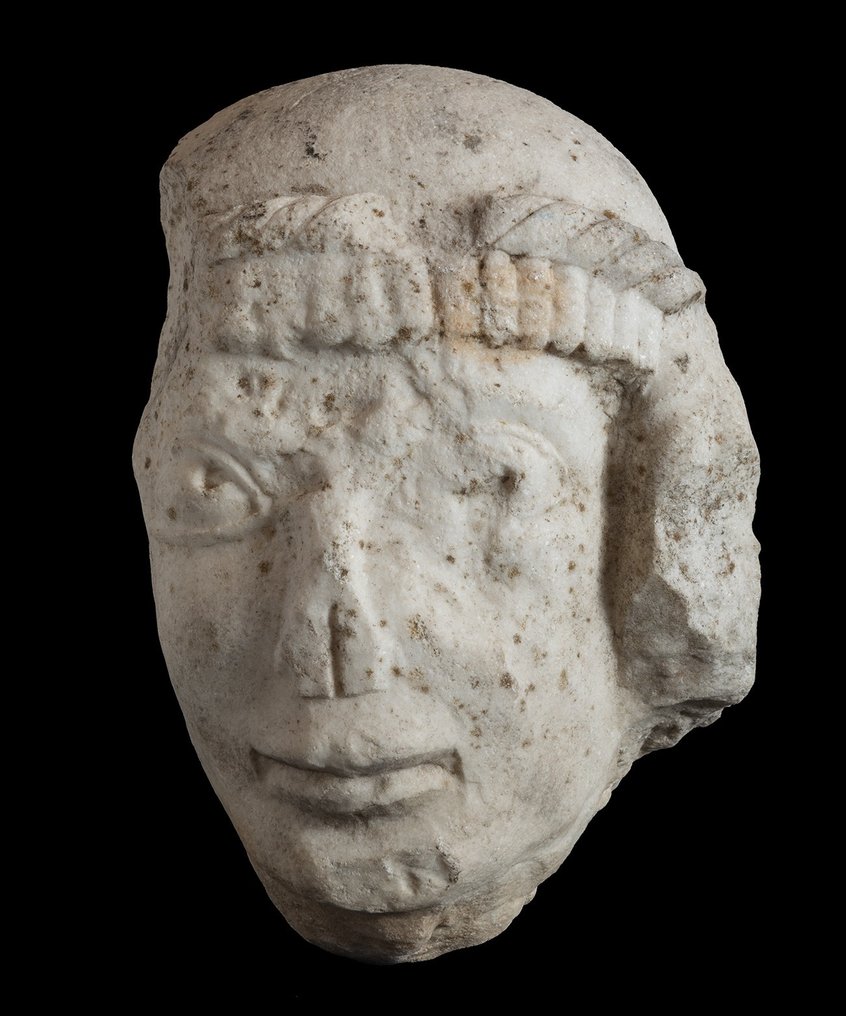
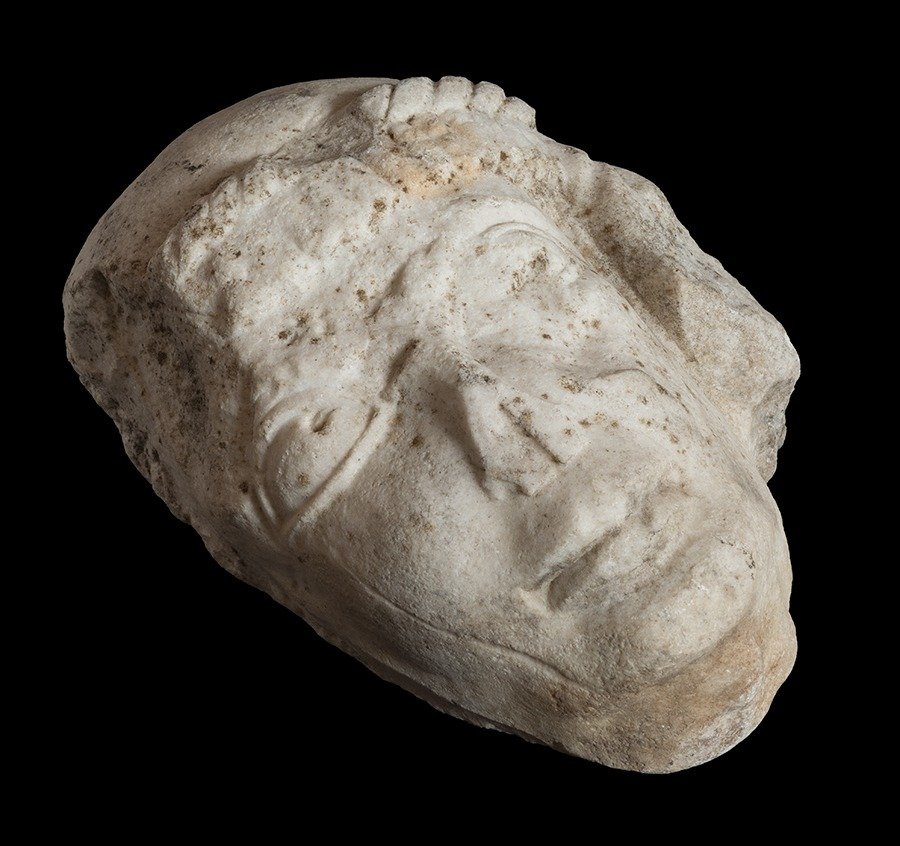
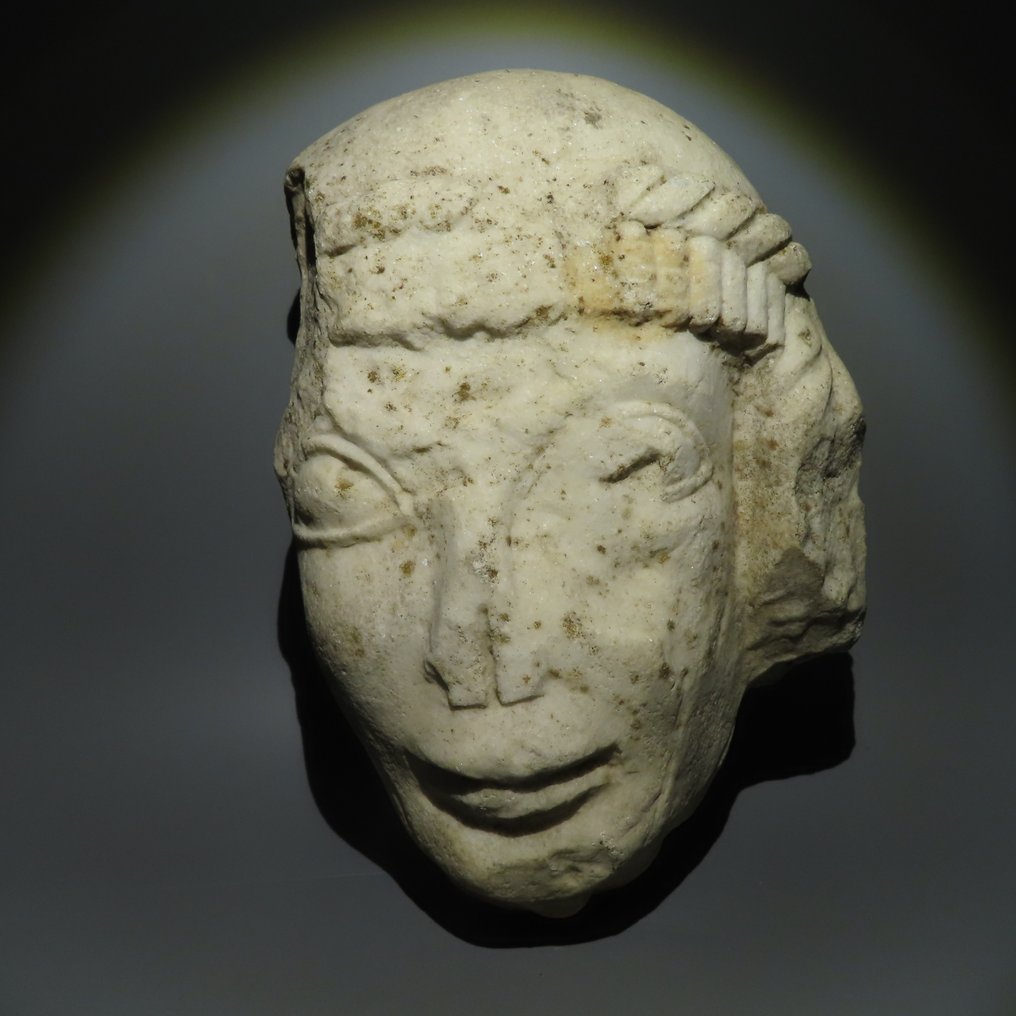
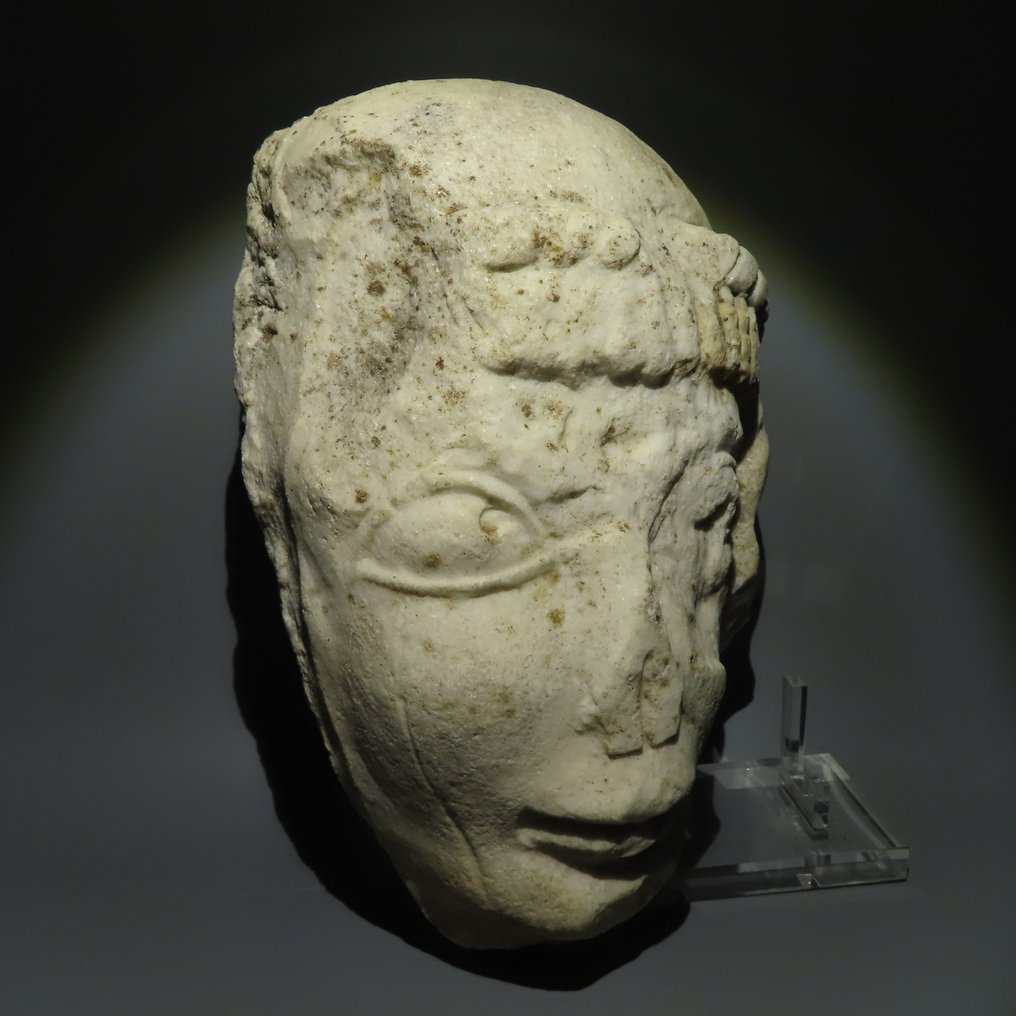
Ancient Roman Marble Theatrical mask. 29 cm H. Huge and Important. Spanish Export License.
05
days
02
hours
02
minutes
16
seconds
Current bid
€ 200
Reserve price not met

Expert
Selected by Ruth Garrido Vila
Directed the Ifergan Collection Museum, specialising in Phoenician and Mediterranean archaeology.
Estimate € 8,000 - € 8,800
8 other people are watching this object
 Bidder 7591 Bidder 7591 | €200 | |
|---|---|---|
| Bidder 1868 | €2 | |
| Bidder 7182 | €1 |
Catawiki Buyer Protection
Your payment’s safe with us until you receive your object.View details
Trustpilot 4.4 | 123878 reviews
Rated Excellent on Trustpilot.
Theatrical marble mask from Ancient Rome, dated 1st century B.C.–2nd century A.D., measuring 29 × 20 cm, from a private collection (Bengt Söderbergh) in Cannes, in good condition with no restorations, with an authenticity certificate and a Spanish export license.
AI-assisted summary
Description from the seller
Theatrical mask.
Roman Empire, 1st century B.C. - 2nd century AD.
Material: Marble.
Provenance: Private Collection of Bengt Söderbergh (1925-2019), Cannes, France.
Without restorations.
Measures: 29 x 20 cm.
Theater mask with markedly archaic features, an aspect appreciable in the large almond-shaped eyes, in the hieratism of the face and in the headdress that the personage wears. The ethnologists place the birth of the mask in the moment in which the self-consciousness is produced. Its use dates back to the most distant antiquity, being found among the Egyptians, Greeks and Romans. The Greeks used them in the Dionysian festivities; the Romans during the Lupercal and Saturnalia and also in the scenic representations.
The Romans brought two important innovations to the world of sculpture: the portrait and the historical relief, neither of which existed in the Greek world. However, they followed the Greek models for a large part of their sculptural production, a base that in Rome was combined with the Etruscan tradition. After the first contacts with the Greece of classicism through the colonies of Magna Graecia, the Romans conquered Syracuse in 212 BC, a rich and important Greek colony located in Sicily, adorned with a large number of Hellenistic works. The city was sacked and its artistic treasures taken to Rome, where the new style of these works soon replaced the Etruscan-Roman tradition that had prevailed until then. Cato himself denounced the sacking and decoration of Rome with Hellenistic works, which he considered a dangerous influence on native culture, and deplored the Romans' applauding of statues from Corinth and Athens, while ridiculing the decorative terracotta tradition of ancient Roman temples. However, these oppositional reactions were in vain; Greek art had subdued Etruscan-Roman art in general, to the point that Greek statues were among the most coveted prizes of war, being displayed during the triumphal procession of the conquering generals.
NOTES:
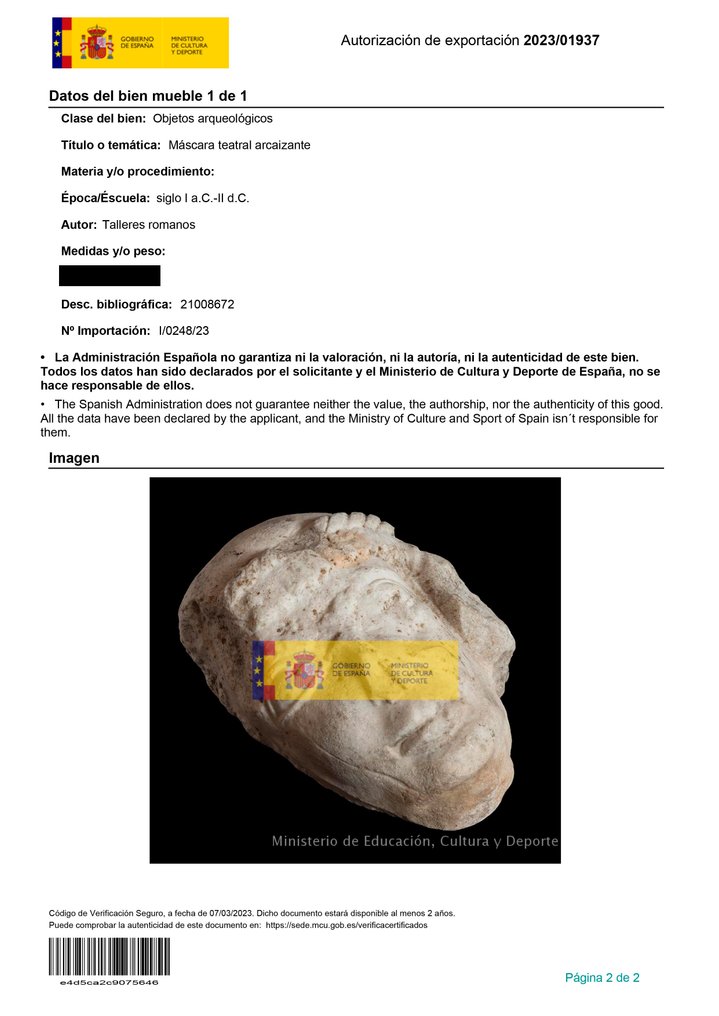
- The piece includes authenticity certificate.
- The piece includes Spanish Export License.
- The seller guarantees that he acquired this piece according to all national and international laws related to the ownership of cultural property. Provenance statement seen by Catawiki.
THE MINISTRY OF CULTURE FROM SPAIN ASKS ALL SELLERS FOR INVOICES OR OTHER DOCUMENTATION ABLE TO PROVE THE LEGALITY OF EACH ITEM BEFORE PROVIDING AN IMPORT OR EXPORT LICENSE.
#ancientolympics
Seller's Story
Gallery of Ancient Art - Archeology based in Barcelona with more than fifteen years of experience. Specialized in classical art, Egyptian art, Asian art and pre-Columbian art. It guarantees the authenticity of all its pieces. It participates in the most important art fairs in Spain, such as Feriarte, as well as in fairs abroad, BRAFA, Parcours des Mondes, Cultures Brussels.
All the pieces are sent with an Export Permit issued by the Spanish Ministry of Culture.
We are quick to ship via DHL Express or Direct Art Transport.
Translated by Google TranslateTheatrical mask.
Roman Empire, 1st century B.C. - 2nd century AD.
Material: Marble.
Provenance: Private Collection of Bengt Söderbergh (1925-2019), Cannes, France.
Without restorations.
Measures: 29 x 20 cm.
Theater mask with markedly archaic features, an aspect appreciable in the large almond-shaped eyes, in the hieratism of the face and in the headdress that the personage wears. The ethnologists place the birth of the mask in the moment in which the self-consciousness is produced. Its use dates back to the most distant antiquity, being found among the Egyptians, Greeks and Romans. The Greeks used them in the Dionysian festivities; the Romans during the Lupercal and Saturnalia and also in the scenic representations.
The Romans brought two important innovations to the world of sculpture: the portrait and the historical relief, neither of which existed in the Greek world. However, they followed the Greek models for a large part of their sculptural production, a base that in Rome was combined with the Etruscan tradition. After the first contacts with the Greece of classicism through the colonies of Magna Graecia, the Romans conquered Syracuse in 212 BC, a rich and important Greek colony located in Sicily, adorned with a large number of Hellenistic works. The city was sacked and its artistic treasures taken to Rome, where the new style of these works soon replaced the Etruscan-Roman tradition that had prevailed until then. Cato himself denounced the sacking and decoration of Rome with Hellenistic works, which he considered a dangerous influence on native culture, and deplored the Romans' applauding of statues from Corinth and Athens, while ridiculing the decorative terracotta tradition of ancient Roman temples. However, these oppositional reactions were in vain; Greek art had subdued Etruscan-Roman art in general, to the point that Greek statues were among the most coveted prizes of war, being displayed during the triumphal procession of the conquering generals.
NOTES:
- The piece includes authenticity certificate.
- The piece includes Spanish Export License.
- The seller guarantees that he acquired this piece according to all national and international laws related to the ownership of cultural property. Provenance statement seen by Catawiki.
THE MINISTRY OF CULTURE FROM SPAIN ASKS ALL SELLERS FOR INVOICES OR OTHER DOCUMENTATION ABLE TO PROVE THE LEGALITY OF EACH ITEM BEFORE PROVIDING AN IMPORT OR EXPORT LICENSE.
#ancientolympics
Seller's Story
Gallery of Ancient Art - Archeology based in Barcelona with more than fifteen years of experience. Specialized in classical art, Egyptian art, Asian art and pre-Columbian art. It guarantees the authenticity of all its pieces. It participates in the most important art fairs in Spain, such as Feriarte, as well as in fairs abroad, BRAFA, Parcours des Mondes, Cultures Brussels.
All the pieces are sent with an Export Permit issued by the Spanish Ministry of Culture.
We are quick to ship via DHL Express or Direct Art Transport.
Translated by Google TranslateDetails
Culture
Ancient Roman
Century/ Timeframe
1st century B.C - 2nd century AD.
Name of object
Theatrical mask. 29 cm H. Huge and Important. Spanish Export License.
Acquired from
Private collection
Material
Marble
Condition
Good
Disclaimer
The seller was informed by Catawiki about documentation requirements and guarantees the following: - the object was legally obtained, - the seller has the right to sell and/or export the object, as relevant, - the seller will provide the necessary provenance information and arrange required documentation and permits/licenses, as applicable and as per local laws, - the seller will notify the buyer of any delays in obtaining permits/licenses. By bidding, you acknowledge that import documentation may be required depending on your country of residence and that obtaining permits/licenses may cause delays in the delivery of your object.
The seller was informed by Catawiki about documentation requirements and guarantees the following: - the object was legally obtained, - the seller has the right to sell and/or export the object, as relevant, - the seller will provide the necessary provenance information and arrange required documentation and permits/licenses, as applicable and as per local laws, - the seller will notify the buyer of any delays in obtaining permits/licenses. By bidding, you acknowledge that import documentation may be required depending on your country of residence and that obtaining permits/licenses may cause delays in the delivery of your object.
