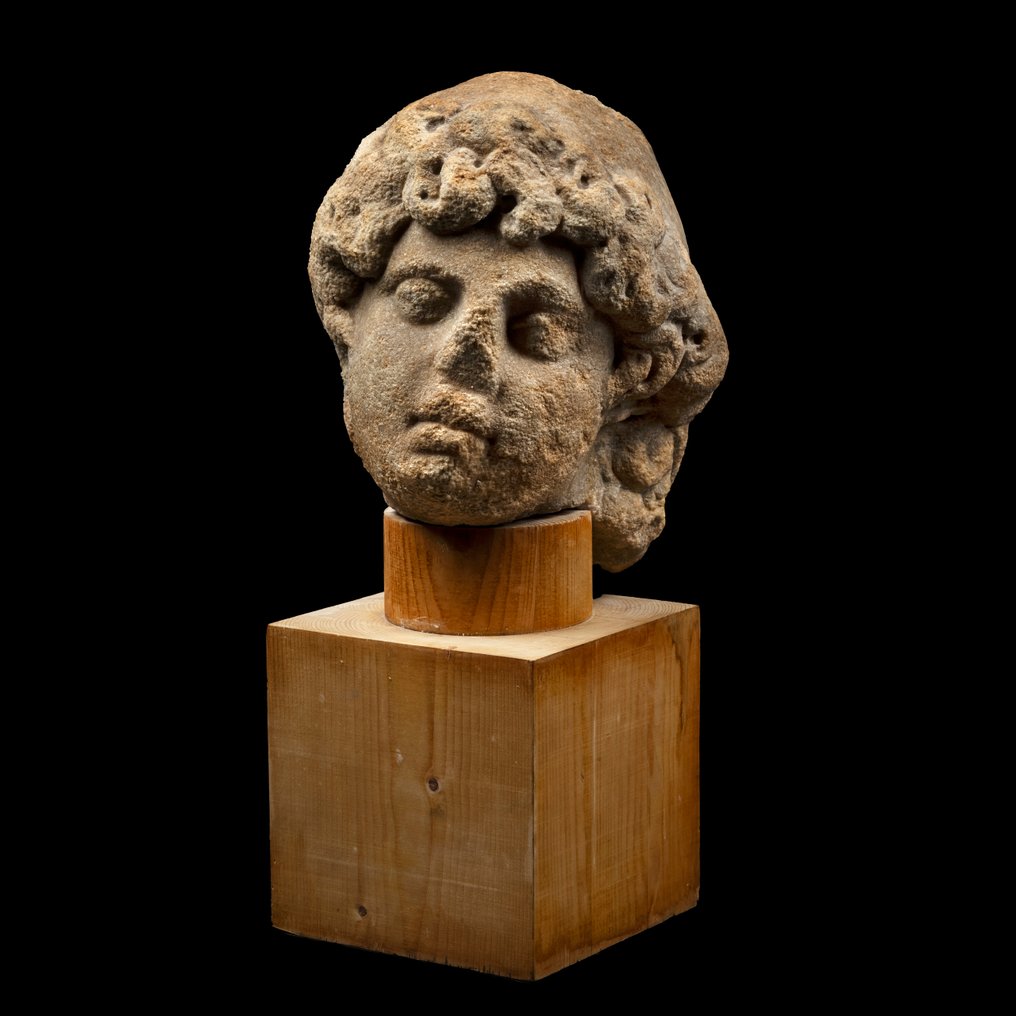
Ancient Roman Marble Head of Attis. 2nd-3rd century AD. 22 cm height.




Opens 11:00
Starting bid
€ 1
Add to your favourites to get an alert when the auction starts.

Expert
Selected by Ruth Garrido Vila
Directed the Ifergan Collection Museum, specialising in Phoenician and Mediterranean archaeology.
Estimate € 11,000 - € 14,000
Catawiki Buyer Protection
Your payment’s safe with us until you receive your object.View details
Trustpilot 4.4 | 121798 reviews
Rated Excellent on Trustpilot.
Description from the seller
Attis Head Figure.
Ancient Roman, 2nd-3rd century AD.
Marble.
22 cm height.
Condition: Good state of preservation, shows erosion on the marble surface.
Provenance: Private collection, France. Acquired before the 1970's.
Description:
Carved marble head in the round, belonging to a smaller-than-life-size sculpture. It represents Attis, the Phrygian god of nature linked to the cult of Demeter, who was very popular in the late Roman Empire. The face is youthful, almost childlike, with its full cheekbones, rounded jaw, and small chin. The eyes are almond-shaped and stand out with their two raised eyelids. The nose is straight and short, and the mouth is closed, small, and has thick lips. The god gently tilts his head to his left, in a melancholic gesture characteristic of his iconography. He is shown wearing a conical Phrygian cap with ear flaps turned up. His long, wild-looking hair, worked into thick, curled strands, escapes from the cap, framing the face and almost completely obscuring the ears, leaving only the lobes visible. Two wide curls fall over the right side of the neck, resting on the shoulder. The sculptural work on the hair stands out for its pronounced volumetric sense, combining traditional carving with trepanning for greater light contrast. A somewhat smaller head of Attis, carved in calcite, is preserved in Ephesus. It seems to follow a similar model to the piece under study, characterized by a sweet face with soft features, large eyes, and voluminous, worked hair (fig. 1).
Atis was a vegetation god of Phrygian origin who achieved notable popularity in the late Roman period. His cult originated in Anatolia (Turkey) around 1250 BC, and reached Greece in the 4th century BC, linked to that of Cybele. The myth tells of him as a Phrygian shepherd who, driven mad by love for the goddess, castrated himself and consecrated himself to her service, becoming an emblem of a love that is both sacrifice and abstinence. The sacred drama of Cybele and Attis is, above all, the drama of nature reflected by human emotions. Although the young man commits the sin of hubris and must therefore pay for it, his punishment ultimately ends in an eternal agreement between gods and men: Attis sleeps and dies, only to rise triumphantly, thanks to the mystery wrought through Cybele, Mother of the Gods.
Greek and Latin authors paid little attention to Attis's birth. However, the theocracy of Pesinus (Phrygia, present-day Turkey), the official center of the cult of Attis and Cybele, explains that he is a descendant of the Great Mother, a figure identified with Mount Agdus and, in turn, with Cybele. Zeus unsuccessfully attempted to force himself on her while she slept, but spilled his seed on the earth: the goddess being the mountain itself, she became pregnant against her will and gave birth to Agdistis, a hermaphroditic being born from the rock itself. Frightened by his power, given that he was capable of creating life on his own, the gods castrated him by cutting off his male genitals. From the falling blood, a pomegranate or almond tree grows, which eventually bears fruit that causes a second virginal pregnancy, that of Nana, the daughter of the river Sangarius. Nana will give birth to Attis, whom Cybele will save from her grandfather's wrath by giving him to a goat, and who will eventually become a beautiful shepherd.
Regarding Cybele's passion for Attis, the Pessinus version simply states that the Great Mother/Agdistis loved the beautiful youth. In the classical Greco-Roman context, Cybele binds Attis to her through an eternal, priestly love and makes him promise to always remain pure. In both cases, the story focuses on Attis's castration and death, which would have occurred as a result of his engagement to the daughter of the king of Pessinus or his love for the nymph Sagaritis. Particular emphasis is placed on Cybele's induction of a Dionysian frenzy in Attis, which leads him to self-mutilate under a sacred pine tree on the banks of the Gallus River, where he eventually bleeds to death. Ovid writes that he was turned into an evergreen pine tree, so he never died, but Pausanias, Arnobius, and Servius insist on his death. It was Cybele who brought him back to life, with the help of Zeus in some versions, by giving him a pine branch laden with pine cones that would allow him to return from the underworld. Attis, then purified, consecrated his life to the service of the goddess, as a servant and chaste consort.
The self-mutilation, death, and resurrection of Attis symbolically represent the fruits of the earth, the cycle of death and rebirth of vegetation throughout the year. Their cult accompanied the orgiastic cult of Cybele, which began in Pesinus and was later adopted in the Hellenistic kingdom of Pergamon, from where it reached Republican Rome, spreading especially from the first century AD onwards. The priests of Cybele and Attis, the Galli, ruled the theocracy of Pesinus, where the goddess's original temple was located. They were ritually castrated eunuchs in service to her, in imitation of Attis himself. Although Emperor Flavius eventually prohibited their castration, they continued to occupy a prominent place in the cults and celebrations dedicated to both gods. Historiography has analyzed how the Phrygian Galli subverted Roman gender norms; they castrated themselves and dressed as women, leading to their interpretation as transgender men. It has also been suggested that they may have constituted a third gender within Roman society. In any case, as foreigners and transgressors of traditional Roman gender norms, the hostility toward them on the part of Roman writers, mostly men and citizens, is palpable.
The Romans celebrated the festival dedicated to Cybele and Attis from the time of the Principate. Around the March equinox, the Tristia and Hilaria took place, festivities that reenacted the story of both gods, celebrating and simultaneously promoting the periodic resurrection of vegetation. During the first part of the festival, the Tristia, the death of Attis was reenacted and mourned. At the moment of the god's emasculation, the Galli, immersed in an ecstatic dance, castrated themselves. At night, Attis was ritually buried, and he was reborn the following day on the day of joy (Hilaria). In his elegy to Cybele, the Emperor Julian called this ritual castration of Cybele's followers a "sacred harvest," alluding to the symbolic significance of the religious drama.
In art, Attis is depicted in two forms, parallel to the two moments of his drama. Attis Tristis, common in funerary contexts, is characterized by his pensive or melancholic attitude and is dressed like a Phrygian with a tight-fitting manicata tunic, trousers, and a conical cap. He usually crosses his left leg over his right and his left arm across his abdomen, while resting his chin on his right hand (fig. 2). Attis Hilaris, on the other hand, is depicted dancing in ecstasy. Sometimes winged, like the Erotes of Hellenism, he can appear as a youth or a child (fig. 3), and even with clearly feminine features, such as breasts. This image has been interpreted as the ecstatic dance preceding his castration, a celebration of his resurrection, or even as a dance of love for Cybele.
The most important known image of Attis is a life-size sculpture discovered in Ostia Antica (fig. 4), from the sanctuary of Cybele. It shows the god triumphing over death, with an androgynous body, soft muscles, and his characteristic melancholic face. His figure was also a popular votive offering, and numerous examples of his image have been found in small formats, mainly in terracotta and bronze, with a great iconographic diversity that emphasizes the various facets of Attis and his cult. When he is depicted with Cybele, he always occupies a secondary place to her, and never expresses carnal love but rather sacred devotion.
The representation of Attis also offers the opportunity to represent a very specific ideal of male beauty: adolescent, with extremely handsome, soft features, and even androgynous in some cases. Although there are examples that, because they derive from Greek models of early Classicism, show him with a timeless face, young and beardless but undoubtedly adult (figs. 5 and 6), in Roman works inspired by Hellenistic examples, naturalism is accentuated and the delicate, almost childlike beauty of Attis is expressed (fig. 7). An exceptional case is the bust of the god in the British Museum (fig. 8), which has been identified with a portrait of Antinous, Hadrian's lover who was deified after his death and transformed into the epitome of adolescent male beauty.
Bibliography:
- BREMMER, J.N. “Atis: A Greek God in Anatolian Pessinous and Catullan Rome”, in Mnemosyne: A Journal of Classical Studies, 4 (56), pp. 534-573. 2004.
- LAMBRECHT, P. Atis: Van Herdersknaap tot God. Vlaamse Akademie. 1962.
- VERMASEREN, M.J. The Legend of Attis in Greek and Roman Art. Classical Studies Cluj-Napoca. 1966.
- VERMASEREN, M.J. Cybele and Atis. Thames & Hudson. 1977.
Parallels:
Fig. 1 Head of Attis. Roman Empire, 2nd century AD. Calcite, 16 cm high. Ephesus Archaeological Museum, Turkey.
Fig. 2 Atis Tristis. Roman Empire, s. II AD Phrygian marble, 82 cm high. Galleria Borghese, Rome, inv. LIX.
Fig. 3 Statuette of Atis Hilaris. Roman Empire, s. II AD Marble. Chiaramonti Museum, Musei Vaticani, inv. 1656.
Fig. 4 Reclining Attis. Roman Empire, Hadrian period, 117-138 AD. Marble, 112 x 150 x 80 cm. Museo Gregoriano Profano, Musei Vaticani, inv. 10785.
Fig. 5 Head of Attis. Roman Empire, s. II AD Marble. Gregorian Profane Museum, Musei Vaticani, inv. 10261.
Fig. 6 Head of Attis. Roman Empire, s. II AD Marble. National Archaeological Museum of Egnazia.
Fig. 7 Head of Attis. Roman Empire, s. II AD Paros marble. Musée de la Bibliotheque Nationale de France, Paris.
Fig. 8 Head of Attis, on a modern bust. Roman Empire, 2nd century AD. Marble, 29.21 cm high. British Museum, London, inv. 1805.0703.72.
Notes:
- The piece includes authenticity certificate.
- The piece includes Spanish Export License (Passport for European Union) - If the piece is destined outside the European Union a substitution of the export permit should be requested, can take between 1-2 weeks maximum.
- The seller guarantees that he acquired this piece according to all national and international laws related to the ownership of cultural property. Provenance statement seen by Catawiki.
Seller's Story
Gallery of Ancient Art - Archeology based in Barcelona with more than fifteen years of experience. Specialized in classical art, Egyptian art, Asian art and pre-Columbian art. It guarantees the authenticity of all its pieces. It participates in the most important art fairs in Spain, such as Feriarte, as well as in fairs abroad, BRAFA, Parcours des Mondes, Cultures Brussels.
All the pieces are sent with an Export Permit issued by the Spanish Ministry of Culture.
We are quick to ship via DHL Express or Direct Art Transport.
Translated by Google TranslateAttis Head Figure.
Ancient Roman, 2nd-3rd century AD.
Marble.
22 cm height.
Condition: Good state of preservation, shows erosion on the marble surface.
Provenance: Private collection, France. Acquired before the 1970's.
Description:
Carved marble head in the round, belonging to a smaller-than-life-size sculpture. It represents Attis, the Phrygian god of nature linked to the cult of Demeter, who was very popular in the late Roman Empire. The face is youthful, almost childlike, with its full cheekbones, rounded jaw, and small chin. The eyes are almond-shaped and stand out with their two raised eyelids. The nose is straight and short, and the mouth is closed, small, and has thick lips. The god gently tilts his head to his left, in a melancholic gesture characteristic of his iconography. He is shown wearing a conical Phrygian cap with ear flaps turned up. His long, wild-looking hair, worked into thick, curled strands, escapes from the cap, framing the face and almost completely obscuring the ears, leaving only the lobes visible. Two wide curls fall over the right side of the neck, resting on the shoulder. The sculptural work on the hair stands out for its pronounced volumetric sense, combining traditional carving with trepanning for greater light contrast. A somewhat smaller head of Attis, carved in calcite, is preserved in Ephesus. It seems to follow a similar model to the piece under study, characterized by a sweet face with soft features, large eyes, and voluminous, worked hair (fig. 1).
Atis was a vegetation god of Phrygian origin who achieved notable popularity in the late Roman period. His cult originated in Anatolia (Turkey) around 1250 BC, and reached Greece in the 4th century BC, linked to that of Cybele. The myth tells of him as a Phrygian shepherd who, driven mad by love for the goddess, castrated himself and consecrated himself to her service, becoming an emblem of a love that is both sacrifice and abstinence. The sacred drama of Cybele and Attis is, above all, the drama of nature reflected by human emotions. Although the young man commits the sin of hubris and must therefore pay for it, his punishment ultimately ends in an eternal agreement between gods and men: Attis sleeps and dies, only to rise triumphantly, thanks to the mystery wrought through Cybele, Mother of the Gods.
Greek and Latin authors paid little attention to Attis's birth. However, the theocracy of Pesinus (Phrygia, present-day Turkey), the official center of the cult of Attis and Cybele, explains that he is a descendant of the Great Mother, a figure identified with Mount Agdus and, in turn, with Cybele. Zeus unsuccessfully attempted to force himself on her while she slept, but spilled his seed on the earth: the goddess being the mountain itself, she became pregnant against her will and gave birth to Agdistis, a hermaphroditic being born from the rock itself. Frightened by his power, given that he was capable of creating life on his own, the gods castrated him by cutting off his male genitals. From the falling blood, a pomegranate or almond tree grows, which eventually bears fruit that causes a second virginal pregnancy, that of Nana, the daughter of the river Sangarius. Nana will give birth to Attis, whom Cybele will save from her grandfather's wrath by giving him to a goat, and who will eventually become a beautiful shepherd.
Regarding Cybele's passion for Attis, the Pessinus version simply states that the Great Mother/Agdistis loved the beautiful youth. In the classical Greco-Roman context, Cybele binds Attis to her through an eternal, priestly love and makes him promise to always remain pure. In both cases, the story focuses on Attis's castration and death, which would have occurred as a result of his engagement to the daughter of the king of Pessinus or his love for the nymph Sagaritis. Particular emphasis is placed on Cybele's induction of a Dionysian frenzy in Attis, which leads him to self-mutilate under a sacred pine tree on the banks of the Gallus River, where he eventually bleeds to death. Ovid writes that he was turned into an evergreen pine tree, so he never died, but Pausanias, Arnobius, and Servius insist on his death. It was Cybele who brought him back to life, with the help of Zeus in some versions, by giving him a pine branch laden with pine cones that would allow him to return from the underworld. Attis, then purified, consecrated his life to the service of the goddess, as a servant and chaste consort.
The self-mutilation, death, and resurrection of Attis symbolically represent the fruits of the earth, the cycle of death and rebirth of vegetation throughout the year. Their cult accompanied the orgiastic cult of Cybele, which began in Pesinus and was later adopted in the Hellenistic kingdom of Pergamon, from where it reached Republican Rome, spreading especially from the first century AD onwards. The priests of Cybele and Attis, the Galli, ruled the theocracy of Pesinus, where the goddess's original temple was located. They were ritually castrated eunuchs in service to her, in imitation of Attis himself. Although Emperor Flavius eventually prohibited their castration, they continued to occupy a prominent place in the cults and celebrations dedicated to both gods. Historiography has analyzed how the Phrygian Galli subverted Roman gender norms; they castrated themselves and dressed as women, leading to their interpretation as transgender men. It has also been suggested that they may have constituted a third gender within Roman society. In any case, as foreigners and transgressors of traditional Roman gender norms, the hostility toward them on the part of Roman writers, mostly men and citizens, is palpable.
The Romans celebrated the festival dedicated to Cybele and Attis from the time of the Principate. Around the March equinox, the Tristia and Hilaria took place, festivities that reenacted the story of both gods, celebrating and simultaneously promoting the periodic resurrection of vegetation. During the first part of the festival, the Tristia, the death of Attis was reenacted and mourned. At the moment of the god's emasculation, the Galli, immersed in an ecstatic dance, castrated themselves. At night, Attis was ritually buried, and he was reborn the following day on the day of joy (Hilaria). In his elegy to Cybele, the Emperor Julian called this ritual castration of Cybele's followers a "sacred harvest," alluding to the symbolic significance of the religious drama.
In art, Attis is depicted in two forms, parallel to the two moments of his drama. Attis Tristis, common in funerary contexts, is characterized by his pensive or melancholic attitude and is dressed like a Phrygian with a tight-fitting manicata tunic, trousers, and a conical cap. He usually crosses his left leg over his right and his left arm across his abdomen, while resting his chin on his right hand (fig. 2). Attis Hilaris, on the other hand, is depicted dancing in ecstasy. Sometimes winged, like the Erotes of Hellenism, he can appear as a youth or a child (fig. 3), and even with clearly feminine features, such as breasts. This image has been interpreted as the ecstatic dance preceding his castration, a celebration of his resurrection, or even as a dance of love for Cybele.
The most important known image of Attis is a life-size sculpture discovered in Ostia Antica (fig. 4), from the sanctuary of Cybele. It shows the god triumphing over death, with an androgynous body, soft muscles, and his characteristic melancholic face. His figure was also a popular votive offering, and numerous examples of his image have been found in small formats, mainly in terracotta and bronze, with a great iconographic diversity that emphasizes the various facets of Attis and his cult. When he is depicted with Cybele, he always occupies a secondary place to her, and never expresses carnal love but rather sacred devotion.
The representation of Attis also offers the opportunity to represent a very specific ideal of male beauty: adolescent, with extremely handsome, soft features, and even androgynous in some cases. Although there are examples that, because they derive from Greek models of early Classicism, show him with a timeless face, young and beardless but undoubtedly adult (figs. 5 and 6), in Roman works inspired by Hellenistic examples, naturalism is accentuated and the delicate, almost childlike beauty of Attis is expressed (fig. 7). An exceptional case is the bust of the god in the British Museum (fig. 8), which has been identified with a portrait of Antinous, Hadrian's lover who was deified after his death and transformed into the epitome of adolescent male beauty.
Bibliography:
- BREMMER, J.N. “Atis: A Greek God in Anatolian Pessinous and Catullan Rome”, in Mnemosyne: A Journal of Classical Studies, 4 (56), pp. 534-573. 2004.
- LAMBRECHT, P. Atis: Van Herdersknaap tot God. Vlaamse Akademie. 1962.
- VERMASEREN, M.J. The Legend of Attis in Greek and Roman Art. Classical Studies Cluj-Napoca. 1966.
- VERMASEREN, M.J. Cybele and Atis. Thames & Hudson. 1977.
Parallels:
Fig. 1 Head of Attis. Roman Empire, 2nd century AD. Calcite, 16 cm high. Ephesus Archaeological Museum, Turkey.
Fig. 2 Atis Tristis. Roman Empire, s. II AD Phrygian marble, 82 cm high. Galleria Borghese, Rome, inv. LIX.
Fig. 3 Statuette of Atis Hilaris. Roman Empire, s. II AD Marble. Chiaramonti Museum, Musei Vaticani, inv. 1656.
Fig. 4 Reclining Attis. Roman Empire, Hadrian period, 117-138 AD. Marble, 112 x 150 x 80 cm. Museo Gregoriano Profano, Musei Vaticani, inv. 10785.
Fig. 5 Head of Attis. Roman Empire, s. II AD Marble. Gregorian Profane Museum, Musei Vaticani, inv. 10261.
Fig. 6 Head of Attis. Roman Empire, s. II AD Marble. National Archaeological Museum of Egnazia.
Fig. 7 Head of Attis. Roman Empire, s. II AD Paros marble. Musée de la Bibliotheque Nationale de France, Paris.
Fig. 8 Head of Attis, on a modern bust. Roman Empire, 2nd century AD. Marble, 29.21 cm high. British Museum, London, inv. 1805.0703.72.
Notes:
- The piece includes authenticity certificate.
- The piece includes Spanish Export License (Passport for European Union) - If the piece is destined outside the European Union a substitution of the export permit should be requested, can take between 1-2 weeks maximum.
- The seller guarantees that he acquired this piece according to all national and international laws related to the ownership of cultural property. Provenance statement seen by Catawiki.
Seller's Story
Gallery of Ancient Art - Archeology based in Barcelona with more than fifteen years of experience. Specialized in classical art, Egyptian art, Asian art and pre-Columbian art. It guarantees the authenticity of all its pieces. It participates in the most important art fairs in Spain, such as Feriarte, as well as in fairs abroad, BRAFA, Parcours des Mondes, Cultures Brussels.
All the pieces are sent with an Export Permit issued by the Spanish Ministry of Culture.
We are quick to ship via DHL Express or Direct Art Transport.
Translated by Google TranslateDetails
Culture
Ancient Roman
Century/ Timeframe
2nd-3rd century AD
Name of object
Head of Attis. 2nd-3rd century AD. 22 cm height.
Acquired from
Private collection
Year acquired
2024
Material
Marble
Country acquired from
France
Condition
Good
Previous owner acquired from
Private collection
Previous owner - year acquired
1970
Previous owner - country acquired from
France
I verify that I have obtained this object legally and that I am allowed to sell it
Yes
Disclaimer
The seller was informed by Catawiki about documentation requirements and guarantees the following: - the object was legally obtained, - the seller has the right to sell and/or export the object, as relevant, - the seller will provide the necessary provenance information and arrange required documentation and permits/licenses, as applicable and as per local laws, - the seller will notify the buyer of any delays in obtaining permits/licenses. By bidding, you acknowledge that import documentation may be required depending on your country of residence and that obtaining permits/licenses may cause delays in the delivery of your object.
The seller was informed by Catawiki about documentation requirements and guarantees the following: - the object was legally obtained, - the seller has the right to sell and/or export the object, as relevant, - the seller will provide the necessary provenance information and arrange required documentation and permits/licenses, as applicable and as per local laws, - the seller will notify the buyer of any delays in obtaining permits/licenses. By bidding, you acknowledge that import documentation may be required depending on your country of residence and that obtaining permits/licenses may cause delays in the delivery of your object.
