Japan. - 4 Hansatsu 藩札 Late Edo to Bakumatsu (c.1800–1868) (No Reserve Price)



02
days
20
hours
30
minutes
32
seconds

28 other people are watching this object
 Bidder 8141 Bidder 8141 | €20 | |
|---|---|---|
 Bidder 7692 Bidder 7692 | €15 | |
| Bidder 8141 | €12 | |
Catawiki Buyer Protection
Your payment’s safe with us until you receive your object.View details
Trustpilot 4.4 | 122190 reviews
Rated Excellent on Trustpilot.
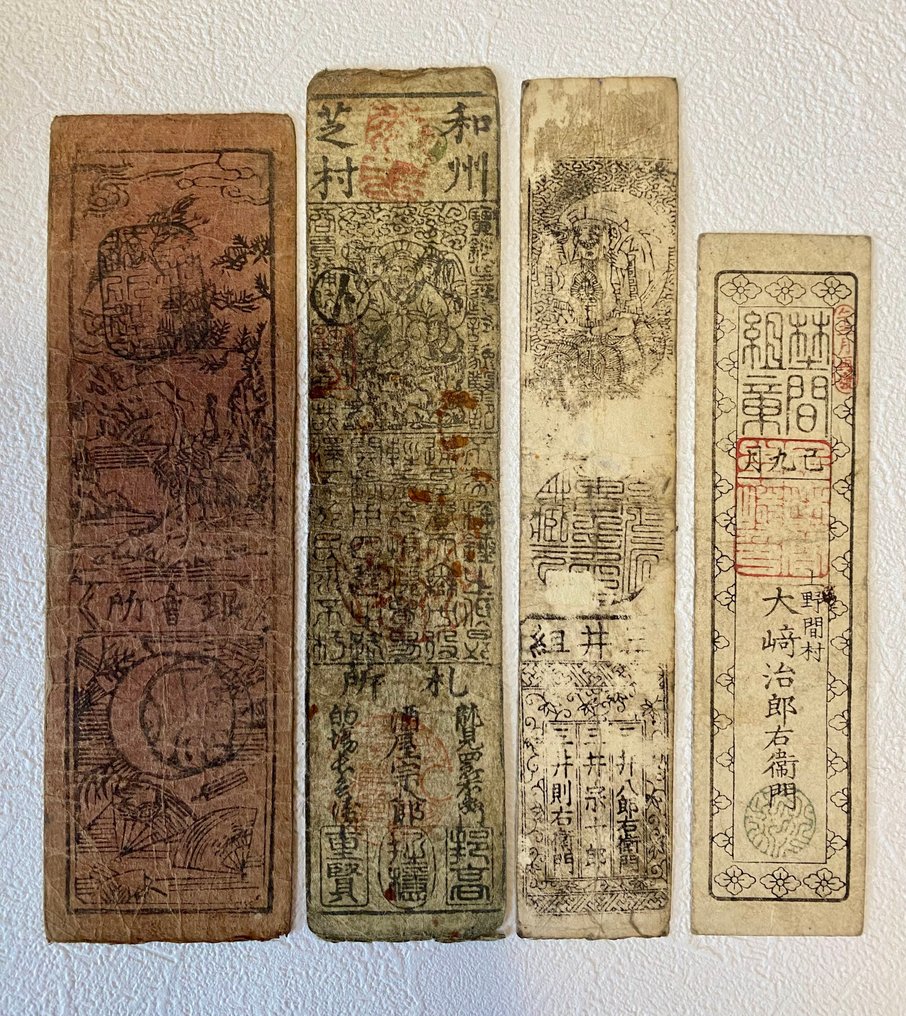
Set of four original Edo–Bakumatsu Hansatsu (domain- and village-issued paper money) from Bungo, Yamato, Ise, and Owari Provinces, circa 1800–1868, printed on handmade washi with seals, each about 16–21 cm, in age-typical folds and minor wear but overall well preserved.
AI-assisted summary
Description from the seller
Set of 4 Original Edo–Bakumatsu Japanese Domain Notes (Hansatsu, 1800–1868)
A rare and historically important collection of four original Japanese hansatsu (domain-issued and village-issued paper money) from the late Edo to Bakumatsu period (circa 1800–1868), representing four different issuing authorities including daimyō domains and rural village credit systems.
Each note was woodblock-printed on handmade washi paper and bears multiple official red seals.
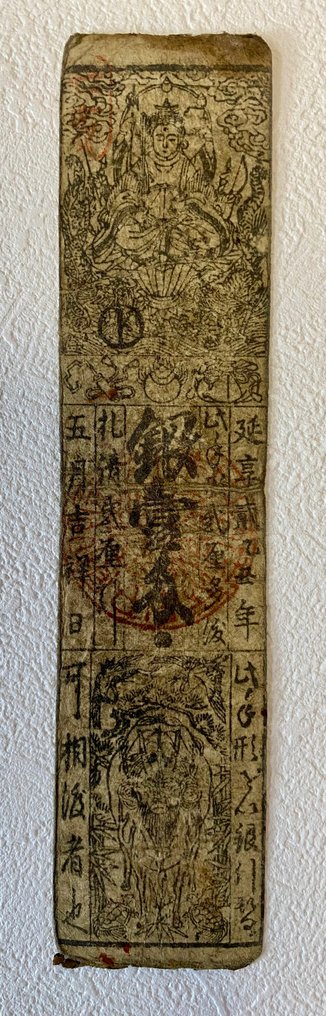
Motifs include Buddhist deity figures, cranes, traditional border patterns, wave designs, and distinctive calligraphy, reflecting the artistic and economic culture of regional Japan before the Meiji monetary reforms.
Details
Type: Hansatsu (Domain-issued & village-issued paper money)
Period: Late Edo to Bakumatsu (c.1800–1868)
Material: Handmade Japanese washi paper, woodblock print, red & black seals
Quantity: 4 pieces
Size: approx. 16–21 cm (see photos).
Condition:
There are age-related folds, toning, small tears, light staining, and minor wormholes typical of Edo-period paper currency.
Despite these natural signs of aging, the calligraphy, seals, and deity motifs remain clear.
Overall, the notes are well-preserved and stable.
Contents (the exact 4 notes in this lot)
1. Bungo Province – Okada (Okajō / Nakagawa Clan) Domain Note (銀五匁)
A daimyō-issued hansatsu from Bungo Province (present-day Ōita Prefecture).
Denomination: Silver 5 momme (五匁).
Features dense calligraphy, official seals, and a classical border design.
2. Yamato Province – Shibamura (芝村藩 / Oda Clan) Domain Note (銀壱匁)
A large-format daimyō hansatsu issued by Shibamura Domain of the Oda Clan.
Denomination: Silver 1 momme (壱匁).
The front includes a Buddhist deity illustration, several red seals, and detailed woodblock printing typical of Shibamura issues.
3. Ise Province – Kuwana Domain (桑名藩 / Matsudaira Clan) Note (銀壱匁)
An Edo-period hansatsu from Kuwana Domain in Ise Province, ruled by the Matsudaira clan.
Denomination: Silver 1 momme (壱匁).
Features include a crane motif at the top, multiple vermilion seals, and official exchange authorization text.
4. Owari Province – Noma-gumi / Village-Issued Private Note (喜多札)
A village-issued private hansatsu (私札) from Noma District in Owari Province (present-day Aichi Pref.).
Issued by a local headman (大崎治郎右衛門).
Features elegant decorative borders, a “福” (good fortune) crest, and clean calligraphy.
These village-credit notes circulated locally and survive in far smaller numbers than domain-issued hansatsu.
Historical Background
Before Japan unified its currency in 1871 (Meiji 4), each domain and many villages issued their own hansatsu to supplement shortages of gold, silver, or copper coinage.
These notes circulated only within the issuing region and were often backed by rice, silver, or local guild guarantees.
Hansatsu reflect the economic autonomy of Japan’s domains and are valued today for their historical significance and their intricate woodblock-printed designs—unique to the final century of the samurai era.
Shipping
The exact notes shown in the photos will be shipped.
Each note is stored in a protective sleeve and will be carefully packed for safe international delivery.
Shipping costs may vary depending on destination due to customs procedures or handling requirements.
Import taxes, VAT, or customs fees may apply depending on your country; these are the buyer’s responsibility.
All shipments include protective packaging, insurance (when available), and careful handling to ensure safe arrival.
In rare cases, customs inspections or extended transit may cause delays—your understanding is appreciated.
Set of 4 Original Edo–Bakumatsu Japanese Domain Notes (Hansatsu, 1800–1868)
A rare and historically important collection of four original Japanese hansatsu (domain-issued and village-issued paper money) from the late Edo to Bakumatsu period (circa 1800–1868), representing four different issuing authorities including daimyō domains and rural village credit systems.
Each note was woodblock-printed on handmade washi paper and bears multiple official red seals.
Motifs include Buddhist deity figures, cranes, traditional border patterns, wave designs, and distinctive calligraphy, reflecting the artistic and economic culture of regional Japan before the Meiji monetary reforms.
Details
Type: Hansatsu (Domain-issued & village-issued paper money)
Period: Late Edo to Bakumatsu (c.1800–1868)
Material: Handmade Japanese washi paper, woodblock print, red & black seals
Quantity: 4 pieces
Size: approx. 16–21 cm (see photos).
Condition:
There are age-related folds, toning, small tears, light staining, and minor wormholes typical of Edo-period paper currency.
Despite these natural signs of aging, the calligraphy, seals, and deity motifs remain clear.
Overall, the notes are well-preserved and stable.
Contents (the exact 4 notes in this lot)
1. Bungo Province – Okada (Okajō / Nakagawa Clan) Domain Note (銀五匁)
A daimyō-issued hansatsu from Bungo Province (present-day Ōita Prefecture).
Denomination: Silver 5 momme (五匁).
Features dense calligraphy, official seals, and a classical border design.
2. Yamato Province – Shibamura (芝村藩 / Oda Clan) Domain Note (銀壱匁)
A large-format daimyō hansatsu issued by Shibamura Domain of the Oda Clan.
Denomination: Silver 1 momme (壱匁).
The front includes a Buddhist deity illustration, several red seals, and detailed woodblock printing typical of Shibamura issues.
3. Ise Province – Kuwana Domain (桑名藩 / Matsudaira Clan) Note (銀壱匁)
An Edo-period hansatsu from Kuwana Domain in Ise Province, ruled by the Matsudaira clan.
Denomination: Silver 1 momme (壱匁).
Features include a crane motif at the top, multiple vermilion seals, and official exchange authorization text.
4. Owari Province – Noma-gumi / Village-Issued Private Note (喜多札)
A village-issued private hansatsu (私札) from Noma District in Owari Province (present-day Aichi Pref.).
Issued by a local headman (大崎治郎右衛門).
Features elegant decorative borders, a “福” (good fortune) crest, and clean calligraphy.
These village-credit notes circulated locally and survive in far smaller numbers than domain-issued hansatsu.
Historical Background
Before Japan unified its currency in 1871 (Meiji 4), each domain and many villages issued their own hansatsu to supplement shortages of gold, silver, or copper coinage.
These notes circulated only within the issuing region and were often backed by rice, silver, or local guild guarantees.
Hansatsu reflect the economic autonomy of Japan’s domains and are valued today for their historical significance and their intricate woodblock-printed designs—unique to the final century of the samurai era.
Shipping
The exact notes shown in the photos will be shipped.
Each note is stored in a protective sleeve and will be carefully packed for safe international delivery.
Shipping costs may vary depending on destination due to customs procedures or handling requirements.
Import taxes, VAT, or customs fees may apply depending on your country; these are the buyer’s responsibility.
All shipments include protective packaging, insurance (when available), and careful handling to ensure safe arrival.
In rare cases, customs inspections or extended transit may cause delays—your understanding is appreciated.
Details
Era
1400-1900
Grade (Certified notes)
Various grades
Over 200 years old
No
Country/province
Japan
Year/Period and Variation
Late Edo to Bakumatsu (c.1800–1868)
Quantity x nominal value
- 4 Hansatsu 藩札
Number of items
4
Sold by