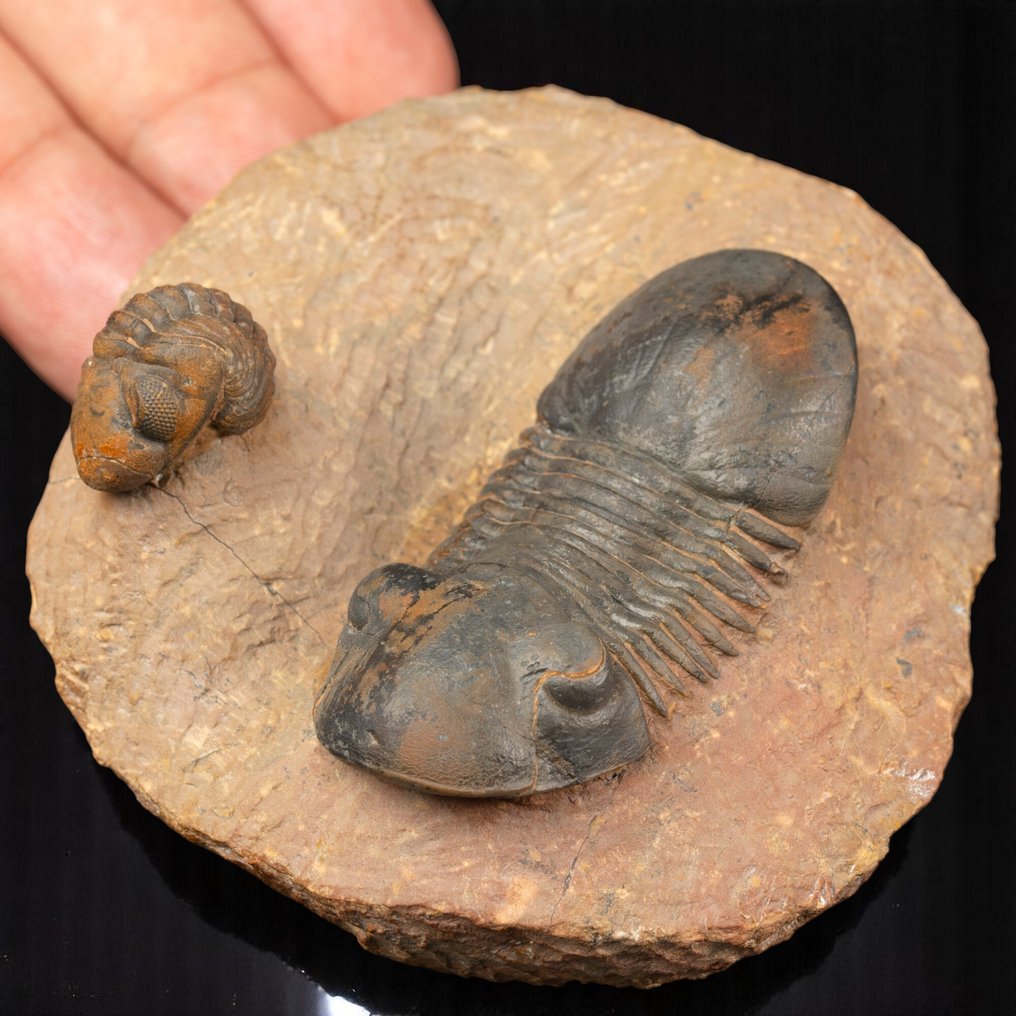
2 trilobites on a single original matrix Carapace - Trilobites Paralejurus sp. and Reedops sp. - 85 mm - 81 mm - 39 mm


05
days
07
hours
21
minutes
26
seconds
Current bid
€ 1
Reserve price not met

Expert
Selected by Jonas Rathaj
Has worked with taxidermy since childhood and gained retailer experience.
Estimate € 330 - € 380
3 other people are watching this object
 Bidder 7990 Bidder 7990 | €1 |
|---|
Catawiki Buyer Protection
Your payment’s safe with us until you receive your object.View details
Trustpilot 4.4 | 122910 reviews
Rated Excellent on Trustpilot.
Description from the seller
This fossil matrix combines two distinct trilobites on a single original matrix from the famous formations of Djebel Issoumour, in the Alnif area, southeast Morocco.
Both date back to the Middle Devonian, about 390 million years ago, when this region was submerged under the warm waters of the ancient Rheic Ocean.
The main trilobite is a Paralejurus sp., characterized by a smooth and compact body, with a large rounded pygidium and reduced dorsal segmentation. This appearance gives Paralejurus an aerodynamic shape, typical of benthic organisms adapted to live partially embedded in marine sediments.
The second trilobite, smaller and rolled up, belongs to the genus Reedops sp., easily recognizable by its well-developed schizocra eyes (composed of lenses visible to the naked eye) and a more sculpted glabella. Reedops was an active trilobite that probably moved agilely across the seabed, ready to defend itself by rolling up in case of danger.
The red sedimentary rock matrix preserves the natural surface intact and shows slight natural cracks (which can be clearly seen in the photo).
The preservation is excellent: the morphological details, such as the thoracic ridges, the granulation of the eyes, and the cephalic structure, are sharp and well-defined.
These fossils are highly representative of Devonian benthic fauna and testify to the exceptional biodiversity of ancient Paleozoic seas.
Age: Middle Devonian (about 390 million years ago)
Species: Paralejurus sp. (large) and Reedops sp. (small).
Order: Proetida (both)
Origin: Djebel Issoumour, Alnif, Morocco
Measurement of the Paralejurus (without matrix): 62 mm.
Reedops measurement: 20 mm
Condition: Authentic fossils on original matrix. Light localized conservation retouches (typical in the preparation of Moroccan trilobites).
Seller's Story
The Mineral Art Gallery offers minerals, fossils, shells and natural elements.
Born in Italy in 2017, today she collaborates with international galleries and collectors, she is a direct importer of large minerals and naturalistic collectible elements; deals with the processing to insert them inside the living space. A section of the gallery was dedicated to the Wunderkammer, "chamber of wonders or cabinet of curiosities" in which Mirabilia elements are presented: naturalia and italiania, a union between "the present is the past".
All lots are shipped via DHL Express and Fercam couriers, with insured parcel and tracking.
Translated by Google TranslateThis fossil matrix combines two distinct trilobites on a single original matrix from the famous formations of Djebel Issoumour, in the Alnif area, southeast Morocco.
Both date back to the Middle Devonian, about 390 million years ago, when this region was submerged under the warm waters of the ancient Rheic Ocean.
The main trilobite is a Paralejurus sp., characterized by a smooth and compact body, with a large rounded pygidium and reduced dorsal segmentation. This appearance gives Paralejurus an aerodynamic shape, typical of benthic organisms adapted to live partially embedded in marine sediments.
The second trilobite, smaller and rolled up, belongs to the genus Reedops sp., easily recognizable by its well-developed schizocra eyes (composed of lenses visible to the naked eye) and a more sculpted glabella. Reedops was an active trilobite that probably moved agilely across the seabed, ready to defend itself by rolling up in case of danger.
The red sedimentary rock matrix preserves the natural surface intact and shows slight natural cracks (which can be clearly seen in the photo).
The preservation is excellent: the morphological details, such as the thoracic ridges, the granulation of the eyes, and the cephalic structure, are sharp and well-defined.
These fossils are highly representative of Devonian benthic fauna and testify to the exceptional biodiversity of ancient Paleozoic seas.
Age: Middle Devonian (about 390 million years ago)
Species: Paralejurus sp. (large) and Reedops sp. (small).
Order: Proetida (both)
Origin: Djebel Issoumour, Alnif, Morocco
Measurement of the Paralejurus (without matrix): 62 mm.
Reedops measurement: 20 mm
Condition: Authentic fossils on original matrix. Light localized conservation retouches (typical in the preparation of Moroccan trilobites).
Seller's Story
The Mineral Art Gallery offers minerals, fossils, shells and natural elements.
Born in Italy in 2017, today she collaborates with international galleries and collectors, she is a direct importer of large minerals and naturalistic collectible elements; deals with the processing to insert them inside the living space. A section of the gallery was dedicated to the Wunderkammer, "chamber of wonders or cabinet of curiosities" in which Mirabilia elements are presented: naturalia and italiania, a union between "the present is the past".
All lots are shipped via DHL Express and Fercam couriers, with insured parcel and tracking.
Translated by Google TranslateDetails
Era
Before 1400
Specimen
2 trilobites on a single original matrix
Scientific Name
Trilobites Paralejurus sp. and Reedops sp.
Country of Origin
Djebel Issoumour formations, Alnif - Morocco.
Condition
Good condition
Year
2024
Weight
327 g
Height
85 mm
Width
81 mm
Depth
39 mm
Sold by