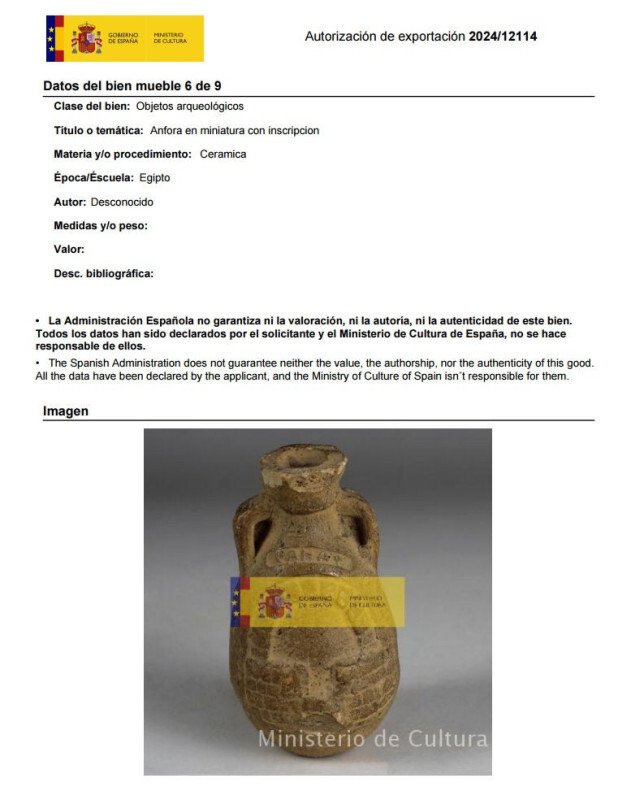
Ancient Egypt, Greco–Roman Period Terracotta Flask with baker's oven and inscription above 'PANAT'. Spanish Export License


Opens Sunday
Starting bid
€ 1
Add to your favourites to get an alert when the auction starts.

Expert
Selected by Ruth Garrido Vila
Directed the Ifergan Collection Museum, specialising in Phoenician and Mediterranean archaeology.
Estimate € 900 - € 1,100
Catawiki Buyer Protection
Your payment’s safe with us until you receive your object.View details
Trustpilot 4.4 | 121798 reviews
Rated Excellent on Trustpilot.
Description from the seller
ITEM: Flask with baker's oven and inscription above 'PANAT'
MATERIAL: Pottery
CULTURE: Egyptian
PERIOD: 2nd - 1st Century B.C
DIMENSIONS: 69 mm x 37 mm
CONDITION: Good condition
PROVENANCE: Ex U.S Gallery, Ex American private collection, acquired before 2000s
Miniature amphoras from the Egyptian Hellenistic period (c. 4th–1st century BCE) were small ceramic vessels that often served as votive offerings, perfume containers, or symbolic representations of larger transport amphoras. These miniature vessels reflect the blending of Greek and Egyptian artistic traditions following Alexander the Great’s conquest and the establishment of the Ptolemaic dynasty. Unlike their full-sized counterparts used for storing wine, oil, or grain, these tiny amphoras were more decorative or ritualistic in function. Their production and distribution across Egypt, particularly in Alexandria and other key trade centers, highlight their role in both domestic and religious contexts.
One intriguing variation of these miniature amphoras features iconography depicting a baker’s oven, a motif associated with sustenance, prosperity, and daily life. The presence of such imagery suggests that these vessels may have been dedicated to deities linked to nourishment and abundance, such as Demeter, the Greek goddess of grain and agriculture, or Isis, who was revered for her protective and nurturing aspects. Bakers and grain merchants may have used these amphoras as offerings in temples or shrines, seeking divine favor for their trade. The imagery of ovens, often stylized in relief or painted onto the vessels, serves as a rare glimpse into the importance of bread production in the Hellenistic economy of Egypt.
Archaeological finds of these miniature amphoras in both temple sites and domestic settings indicate their widespread cultural significance. Some were discovered in funerary contexts, suggesting that they may have played a role in ensuring the deceased’s sustenance in the afterlife. Others were found in association with workshops or market areas, reinforcing their connection to trade and daily commerce. Today, these delicate artifacts, housed in museum collections, provide valuable insights into the intersection of Greek and Egyptian artistic traditions and the economic and religious life of Hellenistic Egypt.
Comes with Certificate of Authenticity and Export license
If you bid outside the European Union and win the item, we will have to apply for an export licence for your country and shipping will take 3 to 5 weeks.
Seller's Story
Your Antiquarian offers ancient art and ancient coins. Our main objective is to offer the highest quality at the best price respecting and strictly complying with the laws of heritage protection and UNESCO heritage norms. Therefore, all the pieces that are published come from private collections in which the provenance can be checked or international auctions. All our antiquities and coins are accompanied by their Certificate of Authenticity. We have a no quibble 90 day return policy. At Your Antiquarian we are committed to helping disadvantaged groups and for this reason a portion of each purchase is donated to charities to help people in need.
Translated by Google TranslateITEM: Flask with baker's oven and inscription above 'PANAT'
MATERIAL: Pottery
CULTURE: Egyptian
PERIOD: 2nd - 1st Century B.C
DIMENSIONS: 69 mm x 37 mm
CONDITION: Good condition
PROVENANCE: Ex U.S Gallery, Ex American private collection, acquired before 2000s
Miniature amphoras from the Egyptian Hellenistic period (c. 4th–1st century BCE) were small ceramic vessels that often served as votive offerings, perfume containers, or symbolic representations of larger transport amphoras. These miniature vessels reflect the blending of Greek and Egyptian artistic traditions following Alexander the Great’s conquest and the establishment of the Ptolemaic dynasty. Unlike their full-sized counterparts used for storing wine, oil, or grain, these tiny amphoras were more decorative or ritualistic in function. Their production and distribution across Egypt, particularly in Alexandria and other key trade centers, highlight their role in both domestic and religious contexts.
One intriguing variation of these miniature amphoras features iconography depicting a baker’s oven, a motif associated with sustenance, prosperity, and daily life. The presence of such imagery suggests that these vessels may have been dedicated to deities linked to nourishment and abundance, such as Demeter, the Greek goddess of grain and agriculture, or Isis, who was revered for her protective and nurturing aspects. Bakers and grain merchants may have used these amphoras as offerings in temples or shrines, seeking divine favor for their trade. The imagery of ovens, often stylized in relief or painted onto the vessels, serves as a rare glimpse into the importance of bread production in the Hellenistic economy of Egypt.
Archaeological finds of these miniature amphoras in both temple sites and domestic settings indicate their widespread cultural significance. Some were discovered in funerary contexts, suggesting that they may have played a role in ensuring the deceased’s sustenance in the afterlife. Others were found in association with workshops or market areas, reinforcing their connection to trade and daily commerce. Today, these delicate artifacts, housed in museum collections, provide valuable insights into the intersection of Greek and Egyptian artistic traditions and the economic and religious life of Hellenistic Egypt.
Comes with Certificate of Authenticity and Export license
If you bid outside the European Union and win the item, we will have to apply for an export licence for your country and shipping will take 3 to 5 weeks.
Seller's Story
Your Antiquarian offers ancient art and ancient coins. Our main objective is to offer the highest quality at the best price respecting and strictly complying with the laws of heritage protection and UNESCO heritage norms. Therefore, all the pieces that are published come from private collections in which the provenance can be checked or international auctions. All our antiquities and coins are accompanied by their Certificate of Authenticity. We have a no quibble 90 day return policy. At Your Antiquarian we are committed to helping disadvantaged groups and for this reason a portion of each purchase is donated to charities to help people in need.
Translated by Google TranslateDetails
Culture
Ancient Egypt, Greco–Roman Period
Century/ Timeframe
2nd - 1st Century B.C
Name of object
Flask with baker's oven and inscription above 'PANAT'. Spanish Export License
Acquired from
Private collection
Year acquired
2024
Material
Terracotta
Country acquired from
United States
Condition
Good
Previous owner acquired from
Antique market
Previous owner - year acquired
2000
Previous owner - country acquired from
United States
I verify that I have obtained this object legally and that I am allowed to sell it
Yes
Sold by
Disclaimer
The seller was informed by Catawiki about documentation requirements and guarantees the following: - the object was legally obtained, - the seller has the right to sell and/or export the object, as relevant, - the seller will provide the necessary provenance information and arrange required documentation and permits/licenses, as applicable and as per local laws, - the seller will notify the buyer of any delays in obtaining permits/licenses. By bidding, you acknowledge that import documentation may be required depending on your country of residence and that obtaining permits/licenses may cause delays in the delivery of your object.
The seller was informed by Catawiki about documentation requirements and guarantees the following: - the object was legally obtained, - the seller has the right to sell and/or export the object, as relevant, - the seller will provide the necessary provenance information and arrange required documentation and permits/licenses, as applicable and as per local laws, - the seller will notify the buyer of any delays in obtaining permits/licenses. By bidding, you acknowledge that import documentation may be required depending on your country of residence and that obtaining permits/licenses may cause delays in the delivery of your object.
