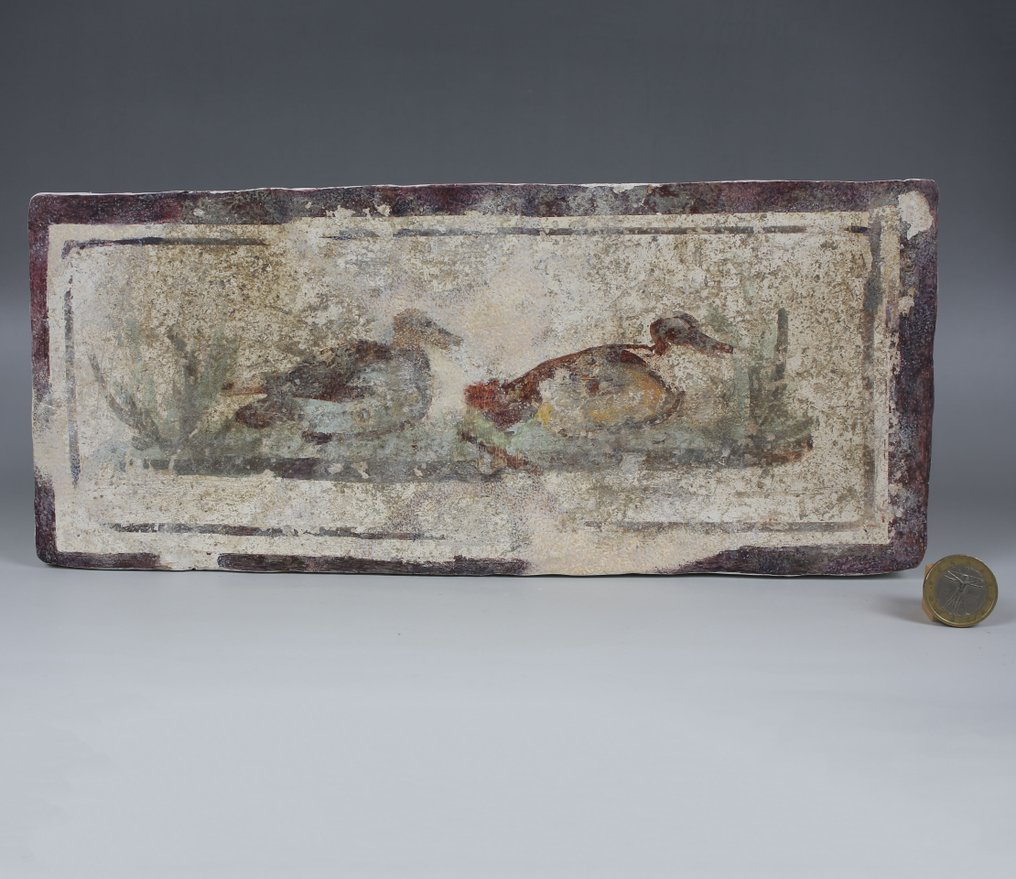
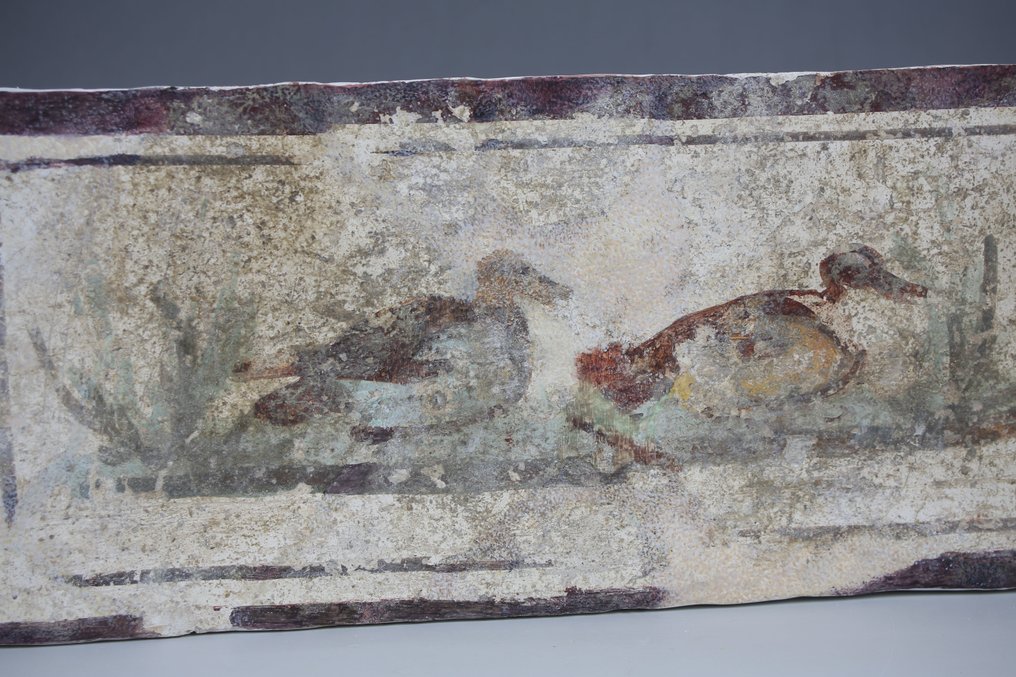
Ancient Roman, Empire Lime plaster with dry powder pigment Fragment of a wall painting with ducks - 317 mm



15
days
12
hours
39
minutes
44
seconds
Starting bid
€ 1
Reserve price not met

Expert
Selected by Ruth Garrido Vila
Directed the Ifergan Collection Museum, specialising in Phoenician and Mediterranean archaeology.
Estimate € 4,900 - € 6,000
No bids placed
Catawiki Buyer Protection
Your payment’s safe with us until you receive your object.View details
Trustpilot 4.4 | 121899 reviews
Rated Excellent on Trustpilot.
Fragment of a wall painting with ducks, a 1st Century A.D. Roman artefact, lime plaster with dry powder pigment, dimensions 135 mm × 317 mm × 32 mm, in good condition and professionally restored, acquired from a French private collection (Chevallier-Verel, Paris) with a Certificate of Authenticity and export license.
AI-assisted summary
Description from the seller
ITEM: Fragment of a wall painting with ducks
MATERIAL: Lime plaster with dry powder pigment
CULTURE: Roman
PERIOD: 1st Century A.D
DIMENSIONS: 135 mm x 317 mm x 32 mm
CONDITION: Good condition, professionally restored
PROVENANCE: Ex French private collection, Chevallier-Verel Collection, Paris, acquired at the beginning of the 20th century
PARALLEL: Fountain Frieze Ducks fresco House of the Bear Pompeii,Hauser in Pompeji Volume 2: Casa dell' Orso (1988) & Maiuri A., 1955. Una Nuova Pittura Nilotica a Pompei. Roma: Acc. Nazionale dei Lincei, Tav. II, 2.
Comes with Certificate of Authenticity and Export license.
If you bid outside the European Union and win the item, we will have to apply for an export licence for your country and shipping will take 3 to 5 weeks.
Ducks and other waterfowl were a common and celebrated motif in Roman decorative art, frequently appearing in the vibrant wall paintings and mosaics recovered from sites like Pompeii and Herculaneum. These depictions often formed part of larger landscape scenes, especially the popular "Nilotic scenes" which evoked the exotic wildlife of the Egyptian Nile River. In these elaborate compositions, ducks might be seen swimming among water lilies, reeds, and other flora, often alongside frogs, fish, and even crocodiles or pygmies in a vivid, naturalistic tableau. This decorative choice served to transport the viewer to a distant, lush environment, creating an illusion of space and natural beauty that counteracted the often dark and windowless interiors of Roman homes.
The appearance of ducks in Roman wall paintings was not purely aesthetic; it also carried cultural and symbolic weight. Waterfowl were considered "characterful" creatures in the Greco-Roman world, sometimes associated with themes of wisdom or resourcefulness, and were also a well-known food source. In still-life paintings, known as xenia (guest offerings), birds like ducks and geese were meticulously rendered alongside fruit and other provisions to illustrate the host's wealth and generous hospitality to visitors. Furthermore, ducks were sometimes incorporated into mythological subjects, such as in the ubiquitous artistic depictions of Leda and the Swan, a story where the god Zeus takes the form of a swan, a close relative of the duck, underscoring the species' place in high culture.
The style of these decorations varied according to the "Pompeian Styles" of painting. In the later, more ornamental styles, ducks and other birds could appear as smaller, highly detailed elements nestled within intricate decorative borders or as framed vignettes on the vast, monochromatic wall panels. A well-preserved example, like the frescoed duck from the Villa di Arianna at Stabiae, showcases the Roman painter’s talent for naturalism, capturing the bird's form and color with remarkable detail. Whether part of a grand Nilotic vista or a small, isolated bird on a thin architectural framework, the recurring motif of the duck enriched Roman domestic interiors, blending elements of the natural world, social status, and cultural appreciation for the exotic.
Seller's Story
Your Antiquarian offers ancient art and ancient coins. Our main objective is to offer the highest quality at the best price respecting and strictly complying with the laws of heritage protection and UNESCO heritage norms. Therefore, all the pieces that are published come from private collections in which the provenance can be checked or international auctions. All our antiquities and coins are accompanied by their Certificate of Authenticity. We have a no quibble 90 day return policy. At Your Antiquarian we are committed to helping disadvantaged groups and for this reason a portion of each purchase is donated to charities to help people in need.
Translated by Google TranslateITEM: Fragment of a wall painting with ducks
MATERIAL: Lime plaster with dry powder pigment
CULTURE: Roman
PERIOD: 1st Century A.D
DIMENSIONS: 135 mm x 317 mm x 32 mm
CONDITION: Good condition, professionally restored
PROVENANCE: Ex French private collection, Chevallier-Verel Collection, Paris, acquired at the beginning of the 20th century
PARALLEL: Fountain Frieze Ducks fresco House of the Bear Pompeii,Hauser in Pompeji Volume 2: Casa dell' Orso (1988) & Maiuri A., 1955. Una Nuova Pittura Nilotica a Pompei. Roma: Acc. Nazionale dei Lincei, Tav. II, 2.
Comes with Certificate of Authenticity and Export license.
If you bid outside the European Union and win the item, we will have to apply for an export licence for your country and shipping will take 3 to 5 weeks.
Ducks and other waterfowl were a common and celebrated motif in Roman decorative art, frequently appearing in the vibrant wall paintings and mosaics recovered from sites like Pompeii and Herculaneum. These depictions often formed part of larger landscape scenes, especially the popular "Nilotic scenes" which evoked the exotic wildlife of the Egyptian Nile River. In these elaborate compositions, ducks might be seen swimming among water lilies, reeds, and other flora, often alongside frogs, fish, and even crocodiles or pygmies in a vivid, naturalistic tableau. This decorative choice served to transport the viewer to a distant, lush environment, creating an illusion of space and natural beauty that counteracted the often dark and windowless interiors of Roman homes.
The appearance of ducks in Roman wall paintings was not purely aesthetic; it also carried cultural and symbolic weight. Waterfowl were considered "characterful" creatures in the Greco-Roman world, sometimes associated with themes of wisdom or resourcefulness, and were also a well-known food source. In still-life paintings, known as xenia (guest offerings), birds like ducks and geese were meticulously rendered alongside fruit and other provisions to illustrate the host's wealth and generous hospitality to visitors. Furthermore, ducks were sometimes incorporated into mythological subjects, such as in the ubiquitous artistic depictions of Leda and the Swan, a story where the god Zeus takes the form of a swan, a close relative of the duck, underscoring the species' place in high culture.
The style of these decorations varied according to the "Pompeian Styles" of painting. In the later, more ornamental styles, ducks and other birds could appear as smaller, highly detailed elements nestled within intricate decorative borders or as framed vignettes on the vast, monochromatic wall panels. A well-preserved example, like the frescoed duck from the Villa di Arianna at Stabiae, showcases the Roman painter’s talent for naturalism, capturing the bird's form and color with remarkable detail. Whether part of a grand Nilotic vista or a small, isolated bird on a thin architectural framework, the recurring motif of the duck enriched Roman domestic interiors, blending elements of the natural world, social status, and cultural appreciation for the exotic.
Seller's Story
Your Antiquarian offers ancient art and ancient coins. Our main objective is to offer the highest quality at the best price respecting and strictly complying with the laws of heritage protection and UNESCO heritage norms. Therefore, all the pieces that are published come from private collections in which the provenance can be checked or international auctions. All our antiquities and coins are accompanied by their Certificate of Authenticity. We have a no quibble 90 day return policy. At Your Antiquarian we are committed to helping disadvantaged groups and for this reason a portion of each purchase is donated to charities to help people in need.
Translated by Google TranslateDetails
Culture
Ancient Roman, Empire
Century/ Timeframe
1st Century A.D
Name of object
Fragment of a wall painting with ducks
Acquired from
Private collection
Year acquired
2024
Material
Lime plaster with dry powder pigment
Country acquired from
France
Condition
Good
Previous owner acquired from
Antique market
Height
317 mm
Previous owner - year acquired
1900
Previous owner - country acquired from
France
I verify that I have obtained this object legally and that I am allowed to sell it
Yes
Sold by
Disclaimer
The seller was informed by Catawiki about documentation requirements and guarantees the following: - the object was legally obtained, - the seller has the right to sell and/or export the object, as relevant, - the seller will provide the necessary provenance information and arrange required documentation and permits/licenses, as applicable and as per local laws, - the seller will notify the buyer of any delays in obtaining permits/licenses. By bidding, you acknowledge that import documentation may be required depending on your country of residence and that obtaining permits/licenses may cause delays in the delivery of your object.
The seller was informed by Catawiki about documentation requirements and guarantees the following: - the object was legally obtained, - the seller has the right to sell and/or export the object, as relevant, - the seller will provide the necessary provenance information and arrange required documentation and permits/licenses, as applicable and as per local laws, - the seller will notify the buyer of any delays in obtaining permits/licenses. By bidding, you acknowledge that import documentation may be required depending on your country of residence and that obtaining permits/licenses may cause delays in the delivery of your object.
