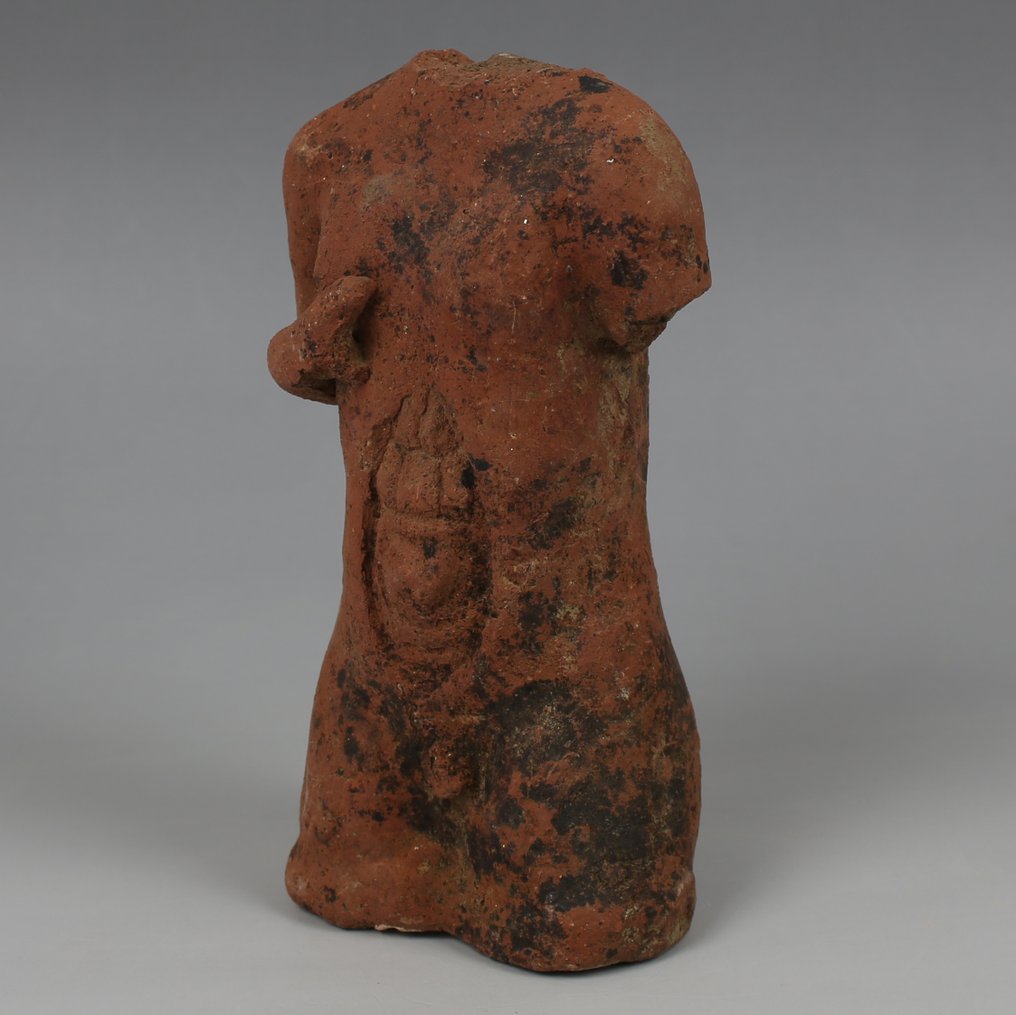
Etruscan Pottery Anatomical votive model of a torso



Opens 11:00
Starting bid
€ 1
Add to your favourites to get an alert when the auction starts.

Expert
Selected by Ruth Garrido Vila
Directed the Ifergan Collection Museum, specialising in Phoenician and Mediterranean archaeology.
Estimate € 1,000 - € 1,300
Catawiki Buyer Protection
Your payment’s safe with us until you receive your object.View details
Trustpilot 4.4 | 121798 reviews
Rated Excellent on Trustpilot.
Description from the seller
ITEM: Anatomical votive model of a torso
MATERIAL: Terracotta
CULTURE: Etruscan
PERIOD: 5th – 4th Century B.C
DIMENSIONS: 125 mm x 75 mm
CONDITION: Good condition
PROVENANCE: Ex Belgian private collection, Ex Spanish antiquities dealer (2022), Ex Belgian private collection, Brussels
Etruscan pottery reflects a dynamic blend of indigenous innovation and external influence, particularly from Greek and Near Eastern cultures. During the 7th century B.C., Etruscan potters developed the bucchero style—distinctive for its black, glossy surface achieved through a reducing firing technique. Bucchero vessels, often finely crafted and decorated with incised or relief patterns, served both everyday and ceremonial functions. Early examples were elegant and light, while later ones grew heavier and more elaborate, often mimicking metal prototypes.
By the 6th century B.C., the influence of Greek pottery became more pronounced, especially through the importation of Corinthian and Attic ceramics. Etruscan artisans began producing their own painted wares, imitating Greek black-figure and later red-figure techniques. These locally made vases, especially from workshops in places like Vulci and Cerveteri, frequently depict mythological scenes, banquets, and athletic contests, sometimes with uniquely Etruscan interpretations. Shapes such as amphorae, kraters, and kylikes were common, reflecting the importance of symposium culture.
In the 5th century B.C., Etruscan pottery production became increasingly regionalized and somewhat conservative compared to the innovations in Greek pottery. However, the continued production of impasto wares—coarse, hand-formed ceramics used for domestic purposes—demonstrates a parallel tradition alongside the finer, painted pieces.
Comes with Certificate of Authenticity and European Union export license
If you bid outside European Union and win the item, we must request a new export license to your country and the shipment will delay between 3 - 5 weeks.
Seller's Story
Your Antiquarian offers ancient art and ancient coins. Our main objective is to offer the highest quality at the best price respecting and strictly complying with the laws of heritage protection and UNESCO heritage norms. Therefore, all the pieces that are published come from private collections in which the provenance can be checked or international auctions. All our antiquities and coins are accompanied by their Certificate of Authenticity. We have a no quibble 90 day return policy. At Your Antiquarian we are committed to helping disadvantaged groups and for this reason a portion of each purchase is donated to charities to help people in need.
Translated by Google TranslateITEM: Anatomical votive model of a torso
MATERIAL: Terracotta
CULTURE: Etruscan
PERIOD: 5th – 4th Century B.C
DIMENSIONS: 125 mm x 75 mm
CONDITION: Good condition
PROVENANCE: Ex Belgian private collection, Ex Spanish antiquities dealer (2022), Ex Belgian private collection, Brussels
Etruscan pottery reflects a dynamic blend of indigenous innovation and external influence, particularly from Greek and Near Eastern cultures. During the 7th century B.C., Etruscan potters developed the bucchero style—distinctive for its black, glossy surface achieved through a reducing firing technique. Bucchero vessels, often finely crafted and decorated with incised or relief patterns, served both everyday and ceremonial functions. Early examples were elegant and light, while later ones grew heavier and more elaborate, often mimicking metal prototypes.
By the 6th century B.C., the influence of Greek pottery became more pronounced, especially through the importation of Corinthian and Attic ceramics. Etruscan artisans began producing their own painted wares, imitating Greek black-figure and later red-figure techniques. These locally made vases, especially from workshops in places like Vulci and Cerveteri, frequently depict mythological scenes, banquets, and athletic contests, sometimes with uniquely Etruscan interpretations. Shapes such as amphorae, kraters, and kylikes were common, reflecting the importance of symposium culture.
In the 5th century B.C., Etruscan pottery production became increasingly regionalized and somewhat conservative compared to the innovations in Greek pottery. However, the continued production of impasto wares—coarse, hand-formed ceramics used for domestic purposes—demonstrates a parallel tradition alongside the finer, painted pieces.
Comes with Certificate of Authenticity and European Union export license
If you bid outside European Union and win the item, we must request a new export license to your country and the shipment will delay between 3 - 5 weeks.
Seller's Story
Your Antiquarian offers ancient art and ancient coins. Our main objective is to offer the highest quality at the best price respecting and strictly complying with the laws of heritage protection and UNESCO heritage norms. Therefore, all the pieces that are published come from private collections in which the provenance can be checked or international auctions. All our antiquities and coins are accompanied by their Certificate of Authenticity. We have a no quibble 90 day return policy. At Your Antiquarian we are committed to helping disadvantaged groups and for this reason a portion of each purchase is donated to charities to help people in need.
Translated by Google TranslateDetails
Culture
Etruscan
Century/ Timeframe
5th – 4th Century B.C
Name of object
Anatomical votive model of a torso
Acquired from
Private collection
Year acquired
2025
Material
Pottery
Country acquired from
Belgium
Condition
Good
Previous owner acquired from
Antique market
Previous owner - year acquired
1980
Previous owner - country acquired from
Belgium
I verify that I have obtained this object legally and that I am allowed to sell it
Yes
Sold by
Disclaimer
The seller was informed by Catawiki about documentation requirements and guarantees the following: - the object was legally obtained, - the seller has the right to sell and/or export the object, as relevant, - the seller will provide the necessary provenance information and arrange required documentation and permits/licenses, as applicable and as per local laws, - the seller will notify the buyer of any delays in obtaining permits/licenses. By bidding, you acknowledge that import documentation may be required depending on your country of residence and that obtaining permits/licenses may cause delays in the delivery of your object.
The seller was informed by Catawiki about documentation requirements and guarantees the following: - the object was legally obtained, - the seller has the right to sell and/or export the object, as relevant, - the seller will provide the necessary provenance information and arrange required documentation and permits/licenses, as applicable and as per local laws, - the seller will notify the buyer of any delays in obtaining permits/licenses. By bidding, you acknowledge that import documentation may be required depending on your country of residence and that obtaining permits/licenses may cause delays in the delivery of your object.
