Etruscan Pottery Anatomical votive model of a head. With TL Test and Spanish Export License.



01
day
23
hours
39
minutes
59
seconds
Current bid
€ 300
Reserve price not met

Expert
Selected by Ruth Garrido Vila
Directed the Ifergan Collection Museum, specialising in Phoenician and Mediterranean archaeology.
Estimate € 2,800 - € 3,500
11 other people are watching this object
 Bidder 6088 Bidder 6088 | €300 | |
|---|---|---|
 Bidder 1565 Bidder 1565 | €200 | |
 Bidder 4159 Bidder 4159 | €120 | |
Catawiki Buyer Protection
Your payment’s safe with us until you receive your object.View details
Trustpilot 4.4 | 122385 reviews
Rated Excellent on Trustpilot.
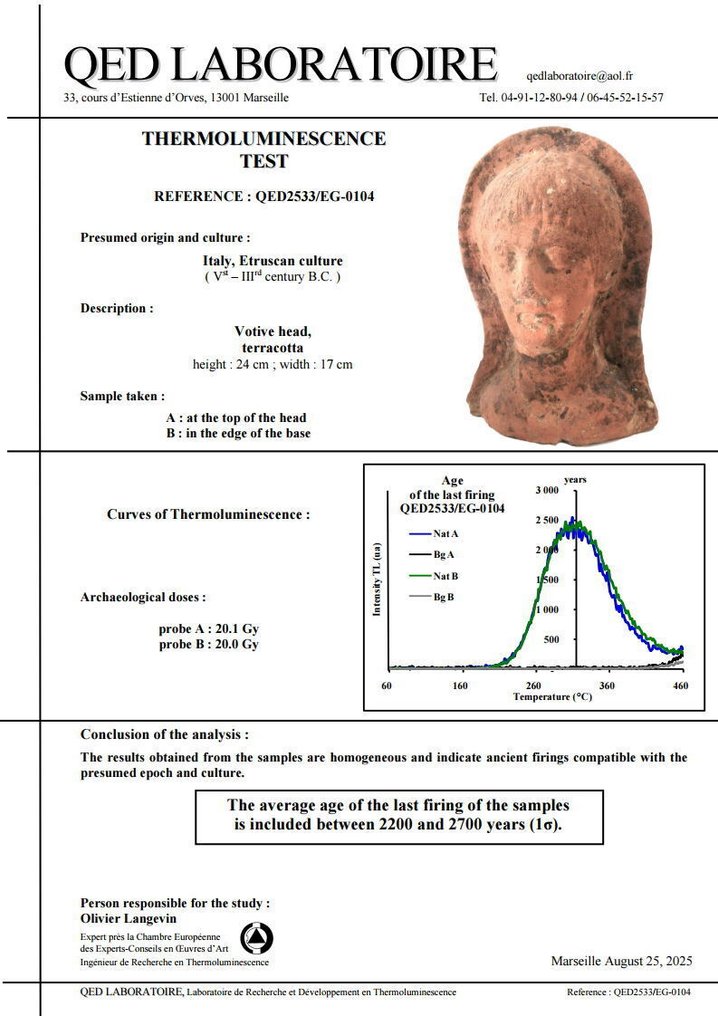
Anatomical votive model of a head in terracotta, Etruscan, dating to the 5th–4th century B.C., with dimensions 240 mm × 165 mm × 130 mm, in good condition, including a thermoluminescence test by QED Laboratory and European Union export license.
AI-assisted summary
Description from the seller
ITEM: Anatomical votive model of a head
MATERIAL: Terracotta
CULTURE: Etruscan
PERIOD: 5th - 4th Century B.C
DIMENSIONS: 240 mm x 165 mm x 130 mm
CONDITION: Good condition. Includes Thermoluminescence test by QED Laboratory (Reference QED2533/EG-0104)
PROVENANCE: Ex Belgian private collection, Ex Spanish antiquities dealer (2022), Ex Belgian private collection, Brussels
Etruscan votive models, particularly anatomical offerings and effigies, are fascinating artifacts that reveal much about the religious practices and medical concerns of ancient Etruria, especially between the 4th and 2nd centuries BCE. These votives were typically deposited in sanctuaries and sacred springs as acts of devotion or supplication to the gods, often in the hope of healing a specific ailment or in thanks for divine intervention. Crafted from terracotta, bronze, or occasionally stone, these models replicate human body parts—eyes, limbs, internal organs, breasts, genitalia—and are often found in large numbers at healing sanctuaries associated with deities like Menrva (Minerva) or Aplu (Apollo).
The anatomical votives represent a symbolic language of health and bodily integrity. For example, a votive eye might be offered in hopes of curing blindness or infection, while a model uterus could be linked to fertility concerns. Their realism varies: some are stylized and schematic, while others are surprisingly naturalistic, possibly even individualized. These offerings served a dual role: they were both ritual acts and communicative gestures, voicing the suppliant’s needs in a tangible, visible way. Some scholars have proposed that these votives may also reflect early understandings of anatomy and pathology in the Etruscan world, hinting at empirical observation rooted in experience, if not systematic medical science.
In addition to anatomical models, votive heads and full-figure statues were also common, often life-sized or larger. These heads, usually depicting serene or pious expressions, might represent the donor themselves or serve as idealized images of the human devotee in relation to the divine.
Comes with Certificate of Authenticity and European Union export license
If you bid outside European Union and win the item, we must request a new export license to your country and the shipment will delay between 3 - 5 weeks.
Seller's Story
Your Antiquarian offers ancient art and ancient coins. Our main objective is to offer the highest quality at the best price respecting and strictly complying with the laws of heritage protection and UNESCO heritage norms. Therefore, all the pieces that are published come from private collections in which the provenance can be checked or international auctions. All our antiquities and coins are accompanied by their Certificate of Authenticity. We have a no quibble 90 day return policy. At Your Antiquarian we are committed to helping disadvantaged groups and for this reason a portion of each purchase is donated to charities to help people in need.
Translated by Google TranslateITEM: Anatomical votive model of a head
MATERIAL: Terracotta
CULTURE: Etruscan
PERIOD: 5th - 4th Century B.C
DIMENSIONS: 240 mm x 165 mm x 130 mm
CONDITION: Good condition. Includes Thermoluminescence test by QED Laboratory (Reference QED2533/EG-0104)
PROVENANCE: Ex Belgian private collection, Ex Spanish antiquities dealer (2022), Ex Belgian private collection, Brussels
Etruscan votive models, particularly anatomical offerings and effigies, are fascinating artifacts that reveal much about the religious practices and medical concerns of ancient Etruria, especially between the 4th and 2nd centuries BCE. These votives were typically deposited in sanctuaries and sacred springs as acts of devotion or supplication to the gods, often in the hope of healing a specific ailment or in thanks for divine intervention. Crafted from terracotta, bronze, or occasionally stone, these models replicate human body parts—eyes, limbs, internal organs, breasts, genitalia—and are often found in large numbers at healing sanctuaries associated with deities like Menrva (Minerva) or Aplu (Apollo).
The anatomical votives represent a symbolic language of health and bodily integrity. For example, a votive eye might be offered in hopes of curing blindness or infection, while a model uterus could be linked to fertility concerns. Their realism varies: some are stylized and schematic, while others are surprisingly naturalistic, possibly even individualized. These offerings served a dual role: they were both ritual acts and communicative gestures, voicing the suppliant’s needs in a tangible, visible way. Some scholars have proposed that these votives may also reflect early understandings of anatomy and pathology in the Etruscan world, hinting at empirical observation rooted in experience, if not systematic medical science.
In addition to anatomical models, votive heads and full-figure statues were also common, often life-sized or larger. These heads, usually depicting serene or pious expressions, might represent the donor themselves or serve as idealized images of the human devotee in relation to the divine.
Comes with Certificate of Authenticity and European Union export license
If you bid outside European Union and win the item, we must request a new export license to your country and the shipment will delay between 3 - 5 weeks.
Seller's Story
Your Antiquarian offers ancient art and ancient coins. Our main objective is to offer the highest quality at the best price respecting and strictly complying with the laws of heritage protection and UNESCO heritage norms. Therefore, all the pieces that are published come from private collections in which the provenance can be checked or international auctions. All our antiquities and coins are accompanied by their Certificate of Authenticity. We have a no quibble 90 day return policy. At Your Antiquarian we are committed to helping disadvantaged groups and for this reason a portion of each purchase is donated to charities to help people in need.
Translated by Google TranslateDetails
Culture
Etruscan
Century/ Timeframe
5th – 4th Century B.C
Name of object
Anatomical votive model of a head. With TL Test and Spanish Export License.
Acquired from
Private collection
Year acquired
2025
Material
Pottery
Country acquired from
Belgium
Condition
Good
Previous owner acquired from
Antique market
Previous owner - year acquired
1980
Previous owner - country acquired from
Belgium
I verify that I have obtained this object legally and that I am allowed to sell it
Yes
Sold by
Disclaimer
The seller was informed by Catawiki about documentation requirements and guarantees the following: - the object was legally obtained, - the seller has the right to sell and/or export the object, as relevant, - the seller will provide the necessary provenance information and arrange required documentation and permits/licenses, as applicable and as per local laws, - the seller will notify the buyer of any delays in obtaining permits/licenses. By bidding, you acknowledge that import documentation may be required depending on your country of residence and that obtaining permits/licenses may cause delays in the delivery of your object.
The seller was informed by Catawiki about documentation requirements and guarantees the following: - the object was legally obtained, - the seller has the right to sell and/or export the object, as relevant, - the seller will provide the necessary provenance information and arrange required documentation and permits/licenses, as applicable and as per local laws, - the seller will notify the buyer of any delays in obtaining permits/licenses. By bidding, you acknowledge that import documentation may be required depending on your country of residence and that obtaining permits/licenses may cause delays in the delivery of your object.
