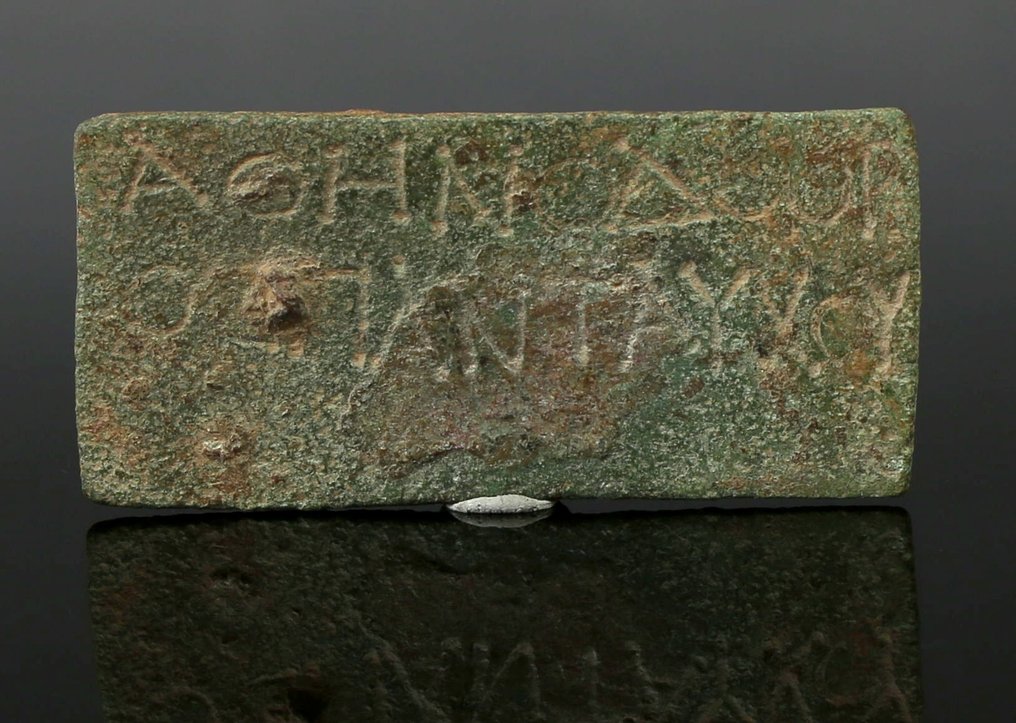
Ancient Roman, Empire Bronze Plaque with inscription, probably 'Athenodorus Omnipresent'


16
days
02
hours
15
minutes
29
seconds
Starting bid
€ 1
Reserve price not met

Expert
Selected by Ruth Garrido Vila
Directed the Ifergan Collection Museum, specialising in Phoenician and Mediterranean archaeology.
Estimate € 1,100 - € 1,400
No bids placed
Catawiki Buyer Protection
Your payment’s safe with us until you receive your object.View details
Trustpilot 4.4 | 121899 reviews
Rated Excellent on Trustpilot.
Ancient Roman bronze plaque with inscription, probably 'Athenodorus Omnipresent', dating to the 2nd–3rd century A.D.
AI-assisted summary
Description from the seller
ITEM: Plaque with inscription, probably 'Athenodorus Omnipresent' / ΑΘΗΝΟΔωΡ Ος ΠΑΝΤΑΥΧΟΥ
MATERIAL: Bronze
CULTURE: Roman
PERIOD: 2nd - 3rd Century A.D
DIMENSIONS: 28 mm x 58 mm x 4 mm
CONDITION: Good condition
PROVENANCE: Ex German private collection, acquired between 1980 - 1990
Comes with Certificate of Authenticity and Export license.
If you bid outside the European Union and win the item, we will have to apply for an export licence for your country and shipping will take 3 to 5 weeks.
Roman votive plaques were offerings made to the gods as acts of devotion, gratitude, or supplication. These dedications, known as ex voto offerings, were typically made in fulfillment of a vow (votum) and placed in temples, shrines, or sacred spaces. Votive plaques could be crafted from various materials, including bronze, terracotta, marble, and even wood, and they often bore inscriptions detailing the reason for the offering. Many plaques depicted images of deities, body parts (symbolizing healing requests), or scenes related to the supplicant’s prayers. Such dedications were an essential part of Roman religious life, reflecting personal and communal expressions of faith.
These plaques often served medical, military, and personal purposes. Individuals who had recovered from illness might dedicate a plaque featuring a sculpted relief of the healed body part as a gesture of thanks to a healing deity such as Aesculapius or Apollo. Soldiers and officials frequently left plaques honoring Mars, Jupiter, or Mithras after surviving battles or achieving victories. Likewise, traders and sailors dedicated plaques to Neptune or Mercury, seeking safe passage and commercial success. The inscriptions on these plaques, usually in Latin, provide valuable insights into the lives of ordinary Romans, revealing details about professions, social status, and personal concerns.
Votive plaques were an enduring tradition throughout the Roman world, found in Italy, Gaul, Britannia, and the provinces of the eastern Mediterranean. Over time, the practice evolved, with early Christian communities adopting similar forms of votive dedication, replacing pagan gods with saints. Many Roman plaques have been discovered in archaeological excavations, helping scholars reconstruct aspects of Roman religious practices and popular devotion. Today, these artifacts are displayed in museums, offering a tangible connection to the everyday spirituality of the ancient world.
Seller's Story
Your Antiquarian offers ancient art and ancient coins. Our main objective is to offer the highest quality at the best price respecting and strictly complying with the laws of heritage protection and UNESCO heritage norms. Therefore, all the pieces that are published come from private collections in which the provenance can be checked or international auctions. All our antiquities and coins are accompanied by their Certificate of Authenticity. We have a no quibble 90 day return policy. At Your Antiquarian we are committed to helping disadvantaged groups and for this reason a portion of each purchase is donated to charities to help people in need.
Translated by Google TranslateITEM: Plaque with inscription, probably 'Athenodorus Omnipresent' / ΑΘΗΝΟΔωΡ Ος ΠΑΝΤΑΥΧΟΥ
MATERIAL: Bronze
CULTURE: Roman
PERIOD: 2nd - 3rd Century A.D
DIMENSIONS: 28 mm x 58 mm x 4 mm
CONDITION: Good condition
PROVENANCE: Ex German private collection, acquired between 1980 - 1990
Comes with Certificate of Authenticity and Export license.
If you bid outside the European Union and win the item, we will have to apply for an export licence for your country and shipping will take 3 to 5 weeks.
Roman votive plaques were offerings made to the gods as acts of devotion, gratitude, or supplication. These dedications, known as ex voto offerings, were typically made in fulfillment of a vow (votum) and placed in temples, shrines, or sacred spaces. Votive plaques could be crafted from various materials, including bronze, terracotta, marble, and even wood, and they often bore inscriptions detailing the reason for the offering. Many plaques depicted images of deities, body parts (symbolizing healing requests), or scenes related to the supplicant’s prayers. Such dedications were an essential part of Roman religious life, reflecting personal and communal expressions of faith.
These plaques often served medical, military, and personal purposes. Individuals who had recovered from illness might dedicate a plaque featuring a sculpted relief of the healed body part as a gesture of thanks to a healing deity such as Aesculapius or Apollo. Soldiers and officials frequently left plaques honoring Mars, Jupiter, or Mithras after surviving battles or achieving victories. Likewise, traders and sailors dedicated plaques to Neptune or Mercury, seeking safe passage and commercial success. The inscriptions on these plaques, usually in Latin, provide valuable insights into the lives of ordinary Romans, revealing details about professions, social status, and personal concerns.
Votive plaques were an enduring tradition throughout the Roman world, found in Italy, Gaul, Britannia, and the provinces of the eastern Mediterranean. Over time, the practice evolved, with early Christian communities adopting similar forms of votive dedication, replacing pagan gods with saints. Many Roman plaques have been discovered in archaeological excavations, helping scholars reconstruct aspects of Roman religious practices and popular devotion. Today, these artifacts are displayed in museums, offering a tangible connection to the everyday spirituality of the ancient world.
Seller's Story
Your Antiquarian offers ancient art and ancient coins. Our main objective is to offer the highest quality at the best price respecting and strictly complying with the laws of heritage protection and UNESCO heritage norms. Therefore, all the pieces that are published come from private collections in which the provenance can be checked or international auctions. All our antiquities and coins are accompanied by their Certificate of Authenticity. We have a no quibble 90 day return policy. At Your Antiquarian we are committed to helping disadvantaged groups and for this reason a portion of each purchase is donated to charities to help people in need.
Translated by Google TranslateDetails
Culture
Ancient Roman, Empire
Century/ Timeframe
2nd - 3rd Century A.D
Name of object
Plaque with inscription, probably 'Athenodorus Omnipresent'
Acquired from
Private collection
Year acquired
2024
Material
Bronze
Country acquired from
Germany
Condition
Good
Previous owner acquired from
Antique market
Previous owner - year acquired
1990
Previous owner - country acquired from
Germany
I verify that I have obtained this object legally and that I am allowed to sell it
Yes
Sold by
Disclaimer
The seller was informed by Catawiki about documentation requirements and guarantees the following: - the object was legally obtained, - the seller has the right to sell and/or export the object, as relevant, - the seller will provide the necessary provenance information and arrange required documentation and permits/licenses, as applicable and as per local laws, - the seller will notify the buyer of any delays in obtaining permits/licenses. By bidding, you acknowledge that import documentation may be required depending on your country of residence and that obtaining permits/licenses may cause delays in the delivery of your object.
The seller was informed by Catawiki about documentation requirements and guarantees the following: - the object was legally obtained, - the seller has the right to sell and/or export the object, as relevant, - the seller will provide the necessary provenance information and arrange required documentation and permits/licenses, as applicable and as per local laws, - the seller will notify the buyer of any delays in obtaining permits/licenses. By bidding, you acknowledge that import documentation may be required depending on your country of residence and that obtaining permits/licenses may cause delays in the delivery of your object.
