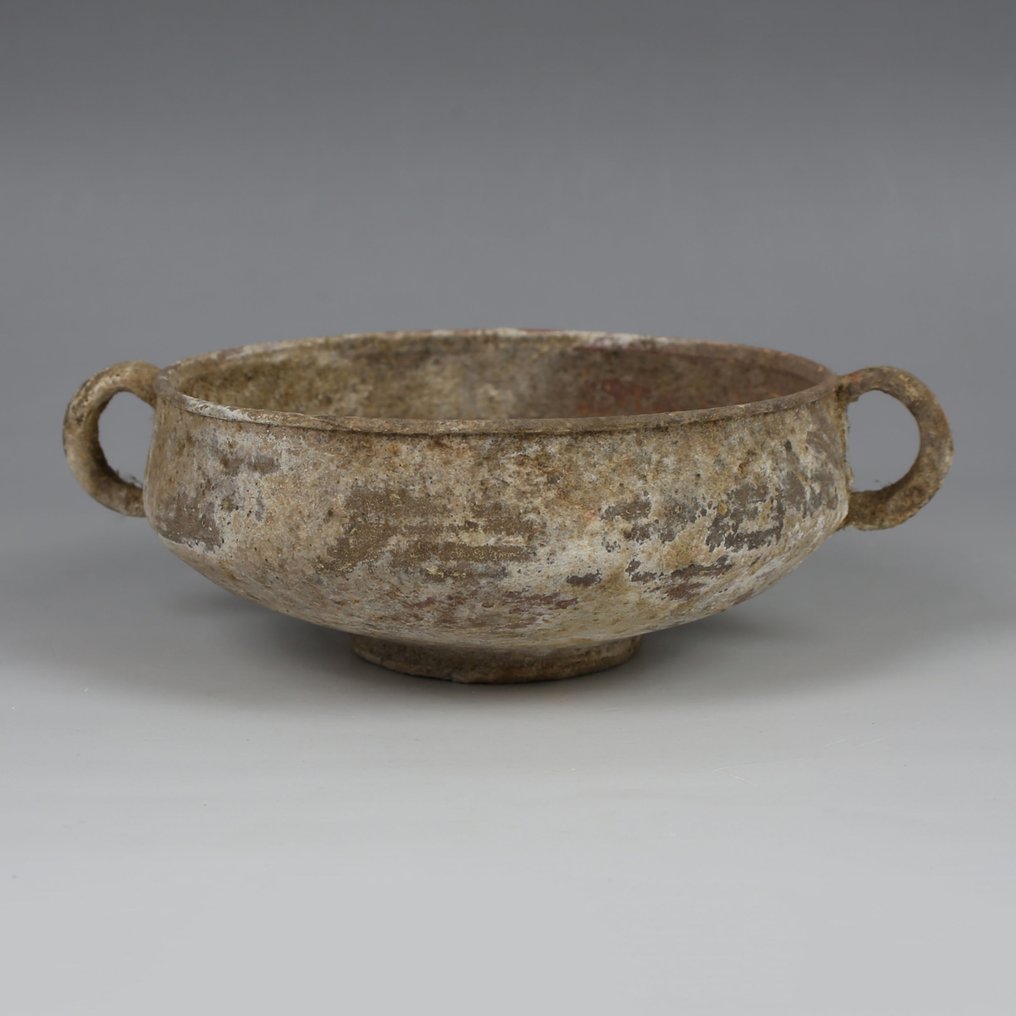
Ancient Roman Pottery Skyphos (No Reserve Price)


08
days
02
hours
45
minutes
17
seconds
Current bid
€ 3
No reserve price

Expert
Selected by Ruth Garrido Vila
Directed the Ifergan Collection Museum, specialising in Phoenician and Mediterranean archaeology.
Estimate € 330 - € 400
13 other people are watching this object
 Bidder 1717 Bidder 1717 | €3 |
|---|
Catawiki Buyer Protection
Your payment’s safe with us until you receive your object.View details
Trustpilot 4.4 | 121980 reviews
Rated Excellent on Trustpilot.
Skyphos, Ancient Roman pottery dating to the 1st–3rd century AD, in good condition, measuring 47 mm by 145 mm, acquired from an American private collection (circa 1970–2000) and accompanied by a Certificate of Authenticity and an export license.
AI-assisted summary
Description from the seller
ITEM: Skyphos
MATERIAL: Pottery
CULTURE: Roman
PERIOD: 1st - 3rd Century A.D
DIMENSIONS: 47 mm x 145 mm
CONDITION: Good condition
PROVENANCE: Ex American private collection, acquired between 1970 - 2000
Comes with Certificate of Authenticity and Export license.
If you bid outside the European Union and win the item, we will have to apply for an export licence for your country and shipping will take 3 to 5 weeks.
Roman pottery encompasses an enormous variety of ceramic vessels, fundamentally divided into fine wares (tableware) and coarse wares (utilitarian items). The most famous fine ware is Terra Sigillata (or Samian Ware), characterized by a distinctive, glossy red-slipped surface and made in standard shapes like plates (patinae), shallow dishes, and small cups (calices). Mass-produced using molds, particularly in centers like Arretium (Italy) and later in Gaul and North Africa, Terra Sigillata allowed Romans across the empire to have access to sophisticated and standardized tableware, often decorated with mythological scenes, gladiatorial fights, or floral patterns in low relief. Its widespread distribution makes it a crucial artifact for dating archaeological sites and tracking Roman trade networks.
The vast majority of Roman pottery comprised coarse wares, which were essential for cooking, everyday serving, and long-term storage. These functional vessels were often made locally from heat-resistant clay and include a range of forms, such as the large cooking pots (ollae or caccabi), frying pans (patellae), and simple bowls. A particularly important coarse ware vessel was the mortarium, a sturdy, shallow bowl with a thick, overhanging rim and a gritty interior surface. The mortarium was indispensable for grinding herbs, spices, and other ingredients, demonstrating the Roman adoption of new, complex culinary practices across the provinces.
Beyond the kitchen and the dining table, Roman potters produced highly specialized vessels critical to trade and domestic life. The two-handled amphora was the ultimate transport container, designed with a characteristic pointed base for stability when packed tightly in the ballast of ships. Different shapes of amphorae were specialized for specific commodities like Spanish olive oil, North African grain, or wine. For domestic or farm storage, enormous, globular jars called dolia were used to ferment wine or store bulk goods, sometimes reaching over two meters in height. This immense variety—from tiny perfume bottles (balsamaria) to massive storage jars—highlights pottery's central role in enabling the daily life, commerce, and agricultural system of the Roman Empire.
Seller's Story
Your Antiquarian offers ancient art and ancient coins. Our main objective is to offer the highest quality at the best price respecting and strictly complying with the laws of heritage protection and UNESCO heritage norms. Therefore, all the pieces that are published come from private collections in which the provenance can be checked or international auctions. All our antiquities and coins are accompanied by their Certificate of Authenticity. We have a no quibble 90 day return policy. At Your Antiquarian we are committed to helping disadvantaged groups and for this reason a portion of each purchase is donated to charities to help people in need.
Translated by Google TranslateITEM: Skyphos
MATERIAL: Pottery
CULTURE: Roman
PERIOD: 1st - 3rd Century A.D
DIMENSIONS: 47 mm x 145 mm
CONDITION: Good condition
PROVENANCE: Ex American private collection, acquired between 1970 - 2000
Comes with Certificate of Authenticity and Export license.
If you bid outside the European Union and win the item, we will have to apply for an export licence for your country and shipping will take 3 to 5 weeks.
Roman pottery encompasses an enormous variety of ceramic vessels, fundamentally divided into fine wares (tableware) and coarse wares (utilitarian items). The most famous fine ware is Terra Sigillata (or Samian Ware), characterized by a distinctive, glossy red-slipped surface and made in standard shapes like plates (patinae), shallow dishes, and small cups (calices). Mass-produced using molds, particularly in centers like Arretium (Italy) and later in Gaul and North Africa, Terra Sigillata allowed Romans across the empire to have access to sophisticated and standardized tableware, often decorated with mythological scenes, gladiatorial fights, or floral patterns in low relief. Its widespread distribution makes it a crucial artifact for dating archaeological sites and tracking Roman trade networks.
The vast majority of Roman pottery comprised coarse wares, which were essential for cooking, everyday serving, and long-term storage. These functional vessels were often made locally from heat-resistant clay and include a range of forms, such as the large cooking pots (ollae or caccabi), frying pans (patellae), and simple bowls. A particularly important coarse ware vessel was the mortarium, a sturdy, shallow bowl with a thick, overhanging rim and a gritty interior surface. The mortarium was indispensable for grinding herbs, spices, and other ingredients, demonstrating the Roman adoption of new, complex culinary practices across the provinces.
Beyond the kitchen and the dining table, Roman potters produced highly specialized vessels critical to trade and domestic life. The two-handled amphora was the ultimate transport container, designed with a characteristic pointed base for stability when packed tightly in the ballast of ships. Different shapes of amphorae were specialized for specific commodities like Spanish olive oil, North African grain, or wine. For domestic or farm storage, enormous, globular jars called dolia were used to ferment wine or store bulk goods, sometimes reaching over two meters in height. This immense variety—from tiny perfume bottles (balsamaria) to massive storage jars—highlights pottery's central role in enabling the daily life, commerce, and agricultural system of the Roman Empire.
Seller's Story
Your Antiquarian offers ancient art and ancient coins. Our main objective is to offer the highest quality at the best price respecting and strictly complying with the laws of heritage protection and UNESCO heritage norms. Therefore, all the pieces that are published come from private collections in which the provenance can be checked or international auctions. All our antiquities and coins are accompanied by their Certificate of Authenticity. We have a no quibble 90 day return policy. At Your Antiquarian we are committed to helping disadvantaged groups and for this reason a portion of each purchase is donated to charities to help people in need.
Translated by Google TranslateDetails
Culture
Ancient Roman
Century/ Timeframe
1st - 3rd Century A.D
Name of object
Skyphos
Acquired from
Private collection
Year acquired
2025
Material
Pottery
Country acquired from
France
Condition
Good
Previous owner acquired from
Antique market
Previous owner - year acquired
1970
Previous owner - country acquired from
United States
I verify that I have obtained this object legally and that I am allowed to sell it
Yes
Sold by
Disclaimer
The seller was informed by Catawiki about documentation requirements and guarantees the following: - the object was legally obtained, - the seller has the right to sell and/or export the object, as relevant, - the seller will provide the necessary provenance information and arrange required documentation and permits/licenses, as applicable and as per local laws, - the seller will notify the buyer of any delays in obtaining permits/licenses. By bidding, you acknowledge that import documentation may be required depending on your country of residence and that obtaining permits/licenses may cause delays in the delivery of your object.
The seller was informed by Catawiki about documentation requirements and guarantees the following: - the object was legally obtained, - the seller has the right to sell and/or export the object, as relevant, - the seller will provide the necessary provenance information and arrange required documentation and permits/licenses, as applicable and as per local laws, - the seller will notify the buyer of any delays in obtaining permits/licenses. By bidding, you acknowledge that import documentation may be required depending on your country of residence and that obtaining permits/licenses may cause delays in the delivery of your object.
