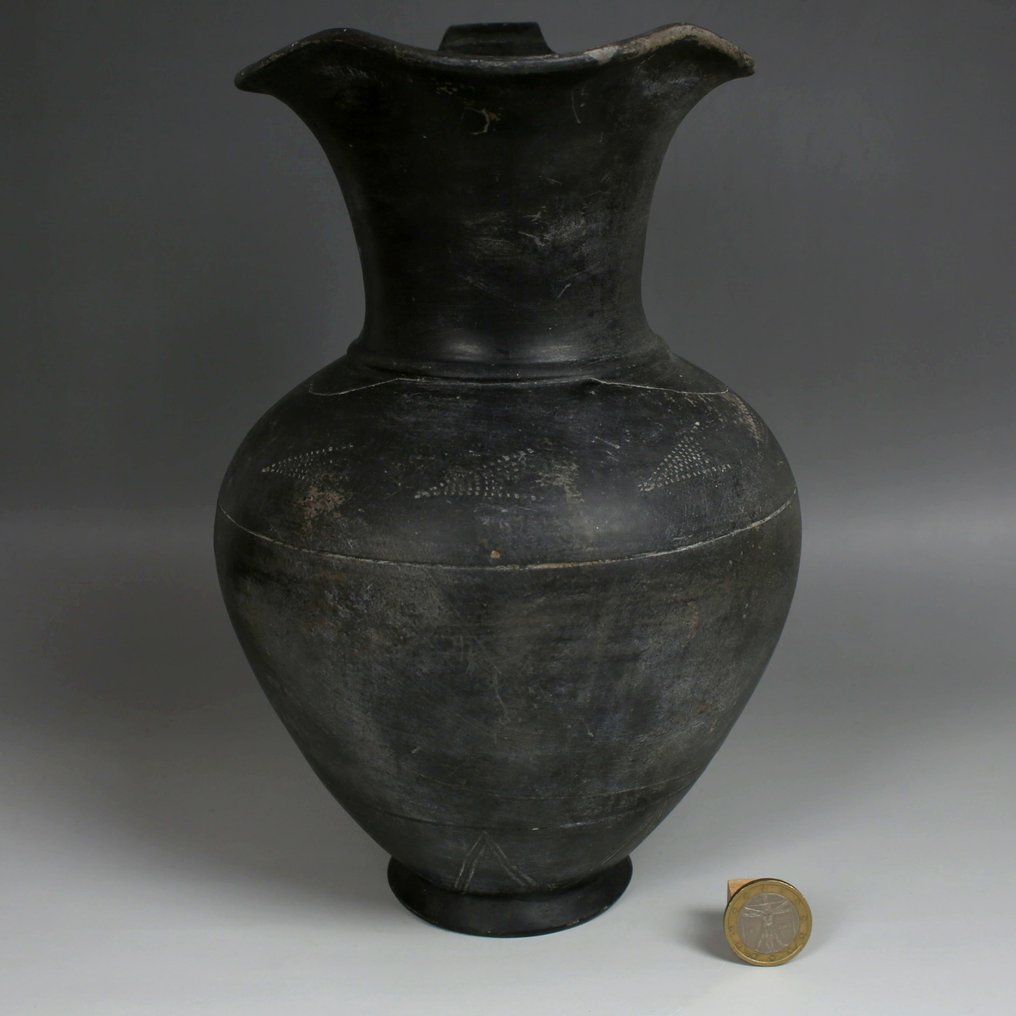
Etruscan Pottery Oinochoe with open fan decoration. Spanish Export License.




15
days
02
hours
11
minutes
07
seconds
Current bid
€ 50
Reserve price not met

Expert
Selected by Ruth Garrido Vila
Directed the Ifergan Collection Museum, specialising in Phoenician and Mediterranean archaeology.
Estimate € 650 - € 800
6 other people are watching this object
 Bidder 8303 Bidder 8303 | €50 | |
|---|---|---|
| Bidder 8303 | €3 | |
 Bidder 0844 Bidder 0844 | €2 | |
Catawiki Buyer Protection
Your payment’s safe with us until you receive your object.View details
Trustpilot 4.4 | 121980 reviews
Rated Excellent on Trustpilot.
Etruscan bucchero oinochoe with open fan decoration, dating to the 7th century B.C., in good condition with a restored foot, from a German private collection.
AI-assisted summary
Description from the seller
ITEM: Oinochoe with open fan decoration
MATERIAL: Pottery, Bucchero ware
CULTURE: Etruscan
PERIOD: 7th Century B.C
DIMENSIONS: 245 mm x 193 mm x 160 mm
CONDITION: Good condition, foot restored
PROVENANCE: Ex German private collection, acquired between 1971 - 1998
Bucchero ware is the quintessential ceramic fabric of the Etruscans, an indigenous, pre-Roman people of central Italy. Produced chiefly between the 7th and 5th centuries BCE, this distinctive pottery is instantly recognizable by its uniform jet-black color and striking, highly polished, almost metallic surface sheen. The color is not the result of a glaze or paint, but rather a sophisticated firing technique known as reduction firing. In this process, the oxygen supply in the kiln is deliberately restricted, causing the iron oxide naturally present in the clay to lose its oxygen molecules, changing the clay's natural red color to black—a color that penetrates the entire body of the ceramic. The lustrous finish was achieved by carefully burnishing (polishing by rubbing) the surface of the vessel before firing.
The forms and aesthetic of Bucchero ware strongly suggest it was intended to imitate the appearance of more expensive metalware, particularly silver vessels, which were popular luxury imports in Etruria. Etruscan potters cleverly translated the sharp lines, crisp edges, and sometimes elaborate handles and fittings of metal vessels into a ceramic medium, providing a less costly but still elegant alternative for the elite. Bucchero is broadly classified into two major styles reflecting its chronological development. The earliest and finest production is known as bucchero sottile ("thin bucchero"), characterized by extremely thin, delicate walls (sometimes less than 2mm thick), which represent a high technical achievement.
As the Etruscan culture matured, the style evolved from the subtle sottile to bucchero pesante ("heavy bucchero") starting around the mid-6th century BCE. This later style featured thicker walls, squatter proportions, and a heavier reliance on applied relief decoration, often created by rolling a cylinder with recessed designs over the soft clay. Bucchero vessels came in many forms—including the Greek-inspired kantharos (wine cup), oinochoe (jug), and amphora—and played a central role in the Etruscan banquet and funerary rituals. Found frequently in Etruscan tombs, Bucchero ware was also a significant trade item, with examples excavated across the Mediterranean, serving as an important archaeological marker for Etruscan influence and commerce.
Comes with Certificate of Authenticity and European Union export license
If you bid outside European Union and win the item, we must request a new export license to your country and the shipment will delay between 3 - 5 weeks.
Seller's Story
Your Antiquarian offers ancient art and ancient coins. Our main objective is to offer the highest quality at the best price respecting and strictly complying with the laws of heritage protection and UNESCO heritage norms. Therefore, all the pieces that are published come from private collections in which the provenance can be checked or international auctions. All our antiquities and coins are accompanied by their Certificate of Authenticity. We have a no quibble 90 day return policy. At Your Antiquarian we are committed to helping disadvantaged groups and for this reason a portion of each purchase is donated to charities to help people in need.
Translated by Google TranslateITEM: Oinochoe with open fan decoration
MATERIAL: Pottery, Bucchero ware
CULTURE: Etruscan
PERIOD: 7th Century B.C
DIMENSIONS: 245 mm x 193 mm x 160 mm
CONDITION: Good condition, foot restored
PROVENANCE: Ex German private collection, acquired between 1971 - 1998
Bucchero ware is the quintessential ceramic fabric of the Etruscans, an indigenous, pre-Roman people of central Italy. Produced chiefly between the 7th and 5th centuries BCE, this distinctive pottery is instantly recognizable by its uniform jet-black color and striking, highly polished, almost metallic surface sheen. The color is not the result of a glaze or paint, but rather a sophisticated firing technique known as reduction firing. In this process, the oxygen supply in the kiln is deliberately restricted, causing the iron oxide naturally present in the clay to lose its oxygen molecules, changing the clay's natural red color to black—a color that penetrates the entire body of the ceramic. The lustrous finish was achieved by carefully burnishing (polishing by rubbing) the surface of the vessel before firing.
The forms and aesthetic of Bucchero ware strongly suggest it was intended to imitate the appearance of more expensive metalware, particularly silver vessels, which were popular luxury imports in Etruria. Etruscan potters cleverly translated the sharp lines, crisp edges, and sometimes elaborate handles and fittings of metal vessels into a ceramic medium, providing a less costly but still elegant alternative for the elite. Bucchero is broadly classified into two major styles reflecting its chronological development. The earliest and finest production is known as bucchero sottile ("thin bucchero"), characterized by extremely thin, delicate walls (sometimes less than 2mm thick), which represent a high technical achievement.
As the Etruscan culture matured, the style evolved from the subtle sottile to bucchero pesante ("heavy bucchero") starting around the mid-6th century BCE. This later style featured thicker walls, squatter proportions, and a heavier reliance on applied relief decoration, often created by rolling a cylinder with recessed designs over the soft clay. Bucchero vessels came in many forms—including the Greek-inspired kantharos (wine cup), oinochoe (jug), and amphora—and played a central role in the Etruscan banquet and funerary rituals. Found frequently in Etruscan tombs, Bucchero ware was also a significant trade item, with examples excavated across the Mediterranean, serving as an important archaeological marker for Etruscan influence and commerce.
Comes with Certificate of Authenticity and European Union export license
If you bid outside European Union and win the item, we must request a new export license to your country and the shipment will delay between 3 - 5 weeks.
Seller's Story
Your Antiquarian offers ancient art and ancient coins. Our main objective is to offer the highest quality at the best price respecting and strictly complying with the laws of heritage protection and UNESCO heritage norms. Therefore, all the pieces that are published come from private collections in which the provenance can be checked or international auctions. All our antiquities and coins are accompanied by their Certificate of Authenticity. We have a no quibble 90 day return policy. At Your Antiquarian we are committed to helping disadvantaged groups and for this reason a portion of each purchase is donated to charities to help people in need.
Translated by Google TranslateDetails
Culture
Etruscan
Century/ Timeframe
7th Century B.C
Name of object
Oinochoe with open fan decoration. Spanish Export License.
Acquired from
Private collection
Year acquired
2025
Material
Pottery
Country acquired from
Germany
Condition
Good
Previous owner acquired from
Antique market
Previous owner - year acquired
1980
Previous owner - country acquired from
Germany
I verify that I have obtained this object legally and that I am allowed to sell it
Yes
Sold by
Disclaimer
The seller was informed by Catawiki about documentation requirements and guarantees the following: - the object was legally obtained, - the seller has the right to sell and/or export the object, as relevant, - the seller will provide the necessary provenance information and arrange required documentation and permits/licenses, as applicable and as per local laws, - the seller will notify the buyer of any delays in obtaining permits/licenses. By bidding, you acknowledge that import documentation may be required depending on your country of residence and that obtaining permits/licenses may cause delays in the delivery of your object.
The seller was informed by Catawiki about documentation requirements and guarantees the following: - the object was legally obtained, - the seller has the right to sell and/or export the object, as relevant, - the seller will provide the necessary provenance information and arrange required documentation and permits/licenses, as applicable and as per local laws, - the seller will notify the buyer of any delays in obtaining permits/licenses. By bidding, you acknowledge that import documentation may be required depending on your country of residence and that obtaining permits/licenses may cause delays in the delivery of your object.
