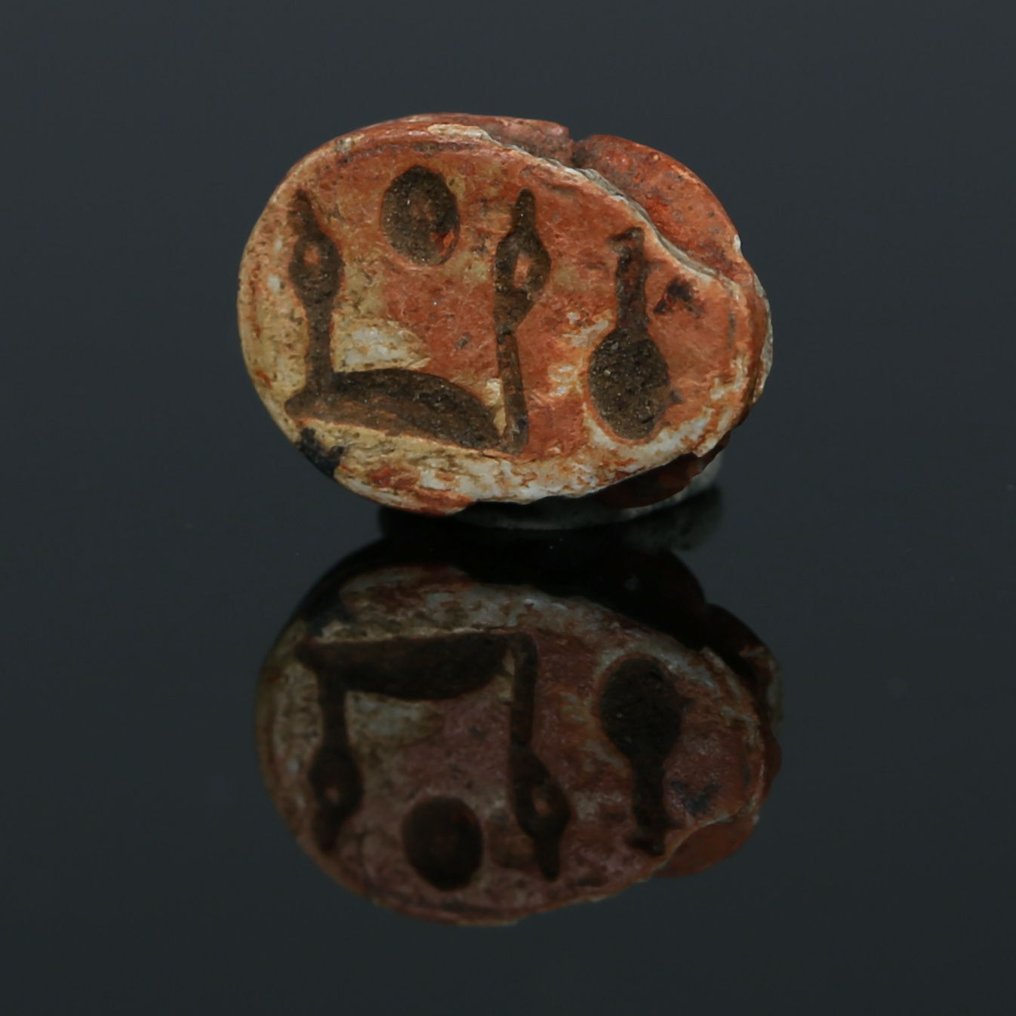
Ancient Egypt, Third Intermediate Period Steatite Scarab of Neferkare, Ex MUSEUM. Spanish Export License.




03
days
00
hours
49
minutes
37
seconds
Current bid
€ 30
Reserve price not met

Expert
Selected by Ruth Garrido Vila
Directed the Ifergan Collection Museum, specialising in Phoenician and Mediterranean archaeology.
Estimate € 500 - € 650
14 other people are watching this object
 Bidder 5850 Bidder 5850 | €30 | |
|---|---|---|
 Bidder 1329 Bidder 1329 | €2 | |
| Bidder 8002 | €1 |
Catawiki Buyer Protection
Your payment’s safe with us until you receive your object.View details
Trustpilot 4.4 | 122190 reviews
Rated Excellent on Trustpilot.
Scarab of Neferkare, a steatite scarab from the 25th Dynasty of Ancient Egypt (713–698 BC), measuring 7 × 11 mm in good condition, acquired in 2025 from a private collection in Germany with a previous owner in Germany since 1990, and supplied with a Certificate of Authenticity and an export license.
AI-assisted summary
Description from the seller
ITEM: Scarab of Neferkare
MATERIAL: Steatite
CULTURE: Egyptian
PERIOD: Third Intermediate Period, 25th Dynasty, 713 - 698 B.C
DIMENSIONS: 7 mm x 11 mm
CONDITION: Good condition
PROVENANCE: Ex Museum Exhibiton of the Arbeitsgruppe für Biblische Archäologie, Germany (Deaccession)
Comes with Certificate of Authenticity and Export license
If you bid outside the european union and win the item, we will have to apply for an export licence for your country and shipping will take 3 to 5 weeks.
The Scarab of Pharaoh Shabako, identified by his prenomen (throne name) Neferkare, serves as an important artifact connecting the Kushite rulers of the 25th Dynasty to the ancient traditions of Egyptian kingship. Shabako, who reigned approximately from 713–698 B.C., was a Nubian pharaoh who successfully consolidated Kushite control over the whole of Egypt, reviving many old Egyptian customs and commissioning extensive building works. The appearance of his royal name, Neferkare ("Beautiful is the Soul of Re"), on a scarab is significant because the scarab beetle itself was a potent symbol of the sun god Khepri, representing rebirth, regeneration, and the daily cycle of the sun. By inscribing his name onto this powerful amulet, Shabako not only reinforced his divine authority but also firmly positioned himself as a legitimate successor to the pharaohs of Egypt's glorious past, even adopting the prenomen of the Sixth Dynasty ruler Pepi II.
Shabako’s royal-name scarabs were typically crafted from materials like hematite, blue faience, or glazed steatite and were small, worn as protective amulets, personal seals, or integrated into jewelry. These scarabs played a crucial dual role: they served a practical administrative function as seals, confirming royal decree or ownership, and an apotropaic, ritual function, providing protection and guaranteeing the pharaoh's success and eternal existence. Notably, the 25th Dynasty revived the tradition of creating large, commemorative scarabs—a practice originally associated with the powerful New Kingdom pharaoh Amenhotep III. These larger pieces were often used to advertise major royal achievements, such as military victories, thereby functioning as important political and diplomatic propaganda across the empire.
The legacy of the Neferkare Shabako scarab lies in its ability to embody the political and cultural agenda of the 25th Dynasty. As Kushites, these rulers needed to visibly demonstrate their piety and commitment to Egyptian state religion to secure the support of the influential Egyptian clergy and populace. By producing numerous artifacts like the royal-name scarabs, often mimicking classical Egyptian styles while maintaining their distinct Kushite identity, Shabako cemented the legitimacy of his rule over both the Delta and the Thebais. These ubiquitous small objects, recovered widely across Egypt and the Levant, confirm the extent of his consolidated control and his successful adoption of the millennia-old symbols of Egyptian royal power and divine protection.
Seller's Story
Your Antiquarian offers ancient art and ancient coins. Our main objective is to offer the highest quality at the best price respecting and strictly complying with the laws of heritage protection and UNESCO heritage norms. Therefore, all the pieces that are published come from private collections in which the provenance can be checked or international auctions. All our antiquities and coins are accompanied by their Certificate of Authenticity. We have a no quibble 90 day return policy. At Your Antiquarian we are committed to helping disadvantaged groups and for this reason a portion of each purchase is donated to charities to help people in need.
Translated by Google TranslateITEM: Scarab of Neferkare
MATERIAL: Steatite
CULTURE: Egyptian
PERIOD: Third Intermediate Period, 25th Dynasty, 713 - 698 B.C
DIMENSIONS: 7 mm x 11 mm
CONDITION: Good condition
PROVENANCE: Ex Museum Exhibiton of the Arbeitsgruppe für Biblische Archäologie, Germany (Deaccession)
Comes with Certificate of Authenticity and Export license
If you bid outside the european union and win the item, we will have to apply for an export licence for your country and shipping will take 3 to 5 weeks.
The Scarab of Pharaoh Shabako, identified by his prenomen (throne name) Neferkare, serves as an important artifact connecting the Kushite rulers of the 25th Dynasty to the ancient traditions of Egyptian kingship. Shabako, who reigned approximately from 713–698 B.C., was a Nubian pharaoh who successfully consolidated Kushite control over the whole of Egypt, reviving many old Egyptian customs and commissioning extensive building works. The appearance of his royal name, Neferkare ("Beautiful is the Soul of Re"), on a scarab is significant because the scarab beetle itself was a potent symbol of the sun god Khepri, representing rebirth, regeneration, and the daily cycle of the sun. By inscribing his name onto this powerful amulet, Shabako not only reinforced his divine authority but also firmly positioned himself as a legitimate successor to the pharaohs of Egypt's glorious past, even adopting the prenomen of the Sixth Dynasty ruler Pepi II.
Shabako’s royal-name scarabs were typically crafted from materials like hematite, blue faience, or glazed steatite and were small, worn as protective amulets, personal seals, or integrated into jewelry. These scarabs played a crucial dual role: they served a practical administrative function as seals, confirming royal decree or ownership, and an apotropaic, ritual function, providing protection and guaranteeing the pharaoh's success and eternal existence. Notably, the 25th Dynasty revived the tradition of creating large, commemorative scarabs—a practice originally associated with the powerful New Kingdom pharaoh Amenhotep III. These larger pieces were often used to advertise major royal achievements, such as military victories, thereby functioning as important political and diplomatic propaganda across the empire.
The legacy of the Neferkare Shabako scarab lies in its ability to embody the political and cultural agenda of the 25th Dynasty. As Kushites, these rulers needed to visibly demonstrate their piety and commitment to Egyptian state religion to secure the support of the influential Egyptian clergy and populace. By producing numerous artifacts like the royal-name scarabs, often mimicking classical Egyptian styles while maintaining their distinct Kushite identity, Shabako cemented the legitimacy of his rule over both the Delta and the Thebais. These ubiquitous small objects, recovered widely across Egypt and the Levant, confirm the extent of his consolidated control and his successful adoption of the millennia-old symbols of Egyptian royal power and divine protection.
Seller's Story
Your Antiquarian offers ancient art and ancient coins. Our main objective is to offer the highest quality at the best price respecting and strictly complying with the laws of heritage protection and UNESCO heritage norms. Therefore, all the pieces that are published come from private collections in which the provenance can be checked or international auctions. All our antiquities and coins are accompanied by their Certificate of Authenticity. We have a no quibble 90 day return policy. At Your Antiquarian we are committed to helping disadvantaged groups and for this reason a portion of each purchase is donated to charities to help people in need.
Translated by Google TranslateDetails
Culture
Ancient Egypt, Third Intermediate Period
Century/ Timeframe
25th Dynasty, 713 - 698 B.C
Name of object
Scarab of Neferkare, Ex MUSEUM. Spanish Export License.
Acquired from
Private collection
Year acquired
2025
Material
Steatite
Country acquired from
Germany
Condition
Good
Previous owner acquired from
Antique market
Previous owner - year acquired
1990
Previous owner - country acquired from
Germany
I verify that I have obtained this object legally and that I am allowed to sell it
Yes
Sold by
Disclaimer
The seller was informed by Catawiki about documentation requirements and guarantees the following: - the object was legally obtained, - the seller has the right to sell and/or export the object, as relevant, - the seller will provide the necessary provenance information and arrange required documentation and permits/licenses, as applicable and as per local laws, - the seller will notify the buyer of any delays in obtaining permits/licenses. By bidding, you acknowledge that import documentation may be required depending on your country of residence and that obtaining permits/licenses may cause delays in the delivery of your object.
The seller was informed by Catawiki about documentation requirements and guarantees the following: - the object was legally obtained, - the seller has the right to sell and/or export the object, as relevant, - the seller will provide the necessary provenance information and arrange required documentation and permits/licenses, as applicable and as per local laws, - the seller will notify the buyer of any delays in obtaining permits/licenses. By bidding, you acknowledge that import documentation may be required depending on your country of residence and that obtaining permits/licenses may cause delays in the delivery of your object.
