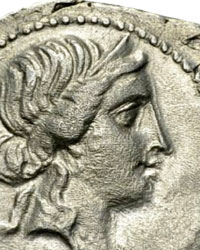
Roman Empire. Maximinus Thrax (AD 235-238). Sestertius Rome - FIDES MILITVM


07
days
11
hours
53
minutes
26
seconds
Current bid
€ 1
Reserve price not met

Expert
Selected by Alessandro Fiamingo
Holds a master’s degree in art history and a master’s degree in chemistry. Has over ten years of experience as a conservation scientist at the Vatican Museums.
Estimate € 150 - € 200
10 other people are watching this object
 Bidder 5121 Bidder 5121 | €1 |
|---|
Catawiki Buyer Protection
Your payment’s safe with us until you receive your object.View details
Trustpilot 4.4 | 122553 reviews
Rated Excellent on Trustpilot.
Ungraded bronze AE Sestertius of Roman Emperor Maximinus Thrax (AD 235–238), Rome – FIDES MILITVM, 28 mm, 23.9 g; obverse: IMP MAXIMINVS PIVS AVG, laureate, draped and cuirassed bust to the right seen from behind; reverse: FIDES MILITVM / S-C, Fides standing facing, head to left, holding standard in each hand; includes Certificate of Authenticity and Export Licence, with a 5% export licence cost for non-EU destinations added to the final invoice.
AI-assisted summary
Description from the seller
RULER: Maximinus I
DATE: 235 - 238 A.D
DENOMINATION: Sestertius
MATERIAL: Bronze, AE
SIZE & WEIGHT: 28 mm, 23,9 gr
OBVERSE: IMP MAXIMINVS PIVS AVG, laureate, draped and cuirassed bust of Maximinus I to right, seen from behind.
REVERSE: FIDES MILITVM / S - C, Fides standing facing, head to left, holding standard in each hand.
REFERENCES: BMC 63; Cohen 10; RIC 43.
Comes with Certificate of Authenticity and Export Licence. If you are from outside the European Union, we will have to apply for the export licence again for your country, this takes 3 to 5 weeks and has a cost of 5% of the hammer price, this amount will be added to the final invoice.
Gaius Julius Verus Maximinus, better known as Maximinus Thrax ("the Thracian"), reigned as Roman Emperor from 235 to 238 CE. He is a pivotal, though short-lived, figure in Roman history as he is generally considered the first of the so-called "Barracks Emperors" and his elevation marked the brutal beginning of the tumultuous Crisis of the Third Century. Maximinus was a provincial of reportedly humble origins, having risen through the ranks as a career soldier, possibly starting as an auxiliary in the Balkans. His rise shattered the established tradition that emperors must hail from the senatorial or equestrian classes, introducing a new era where military power alone determined the imperial office.
Maximinus's accession was violent: he was proclaimed emperor by the legions near Mainz after they assassinated the previous emperor, Severus Alexander, in 235 CE. A man famed in ancient sources for his colossal size and immense strength, Maximinus was a pure military ruler who never once set foot in Rome during his reign. Instead, he campaigned relentlessly on the frontiers, successfully defending and pushing back incursions by the Alemanni on the Rhine and the Dacians and Sarmatians on the Danube. To secure the loyalty of his troops—the sole basis of his power—he doubled their pay, an extravagant move that necessitated aggressive taxation and confiscation of wealth, primarily targeting the senatorial elite and wealthy landowners.
This brutal policy of financial coercion and Maximinus's contempt for the Senate provoked widespread resentment and ultimately led to his downfall. In 238 CE, a revolt against his rule began in Africa, elevating the elderly Gordian I and his son Gordian II as rival emperors. When this revolt was quickly suppressed, the Senate—now fully committed to opposing Maximinus—proclaimed two of their own, Pupienus and Balbinus, as emperors. Maximinus responded by marching his army into Italy to crush the rebellion, but was stalled by a stubborn siege at the city of Aquileia. Faced with famine, disease, and the emperor's harsh discipline, his own troops lost morale and mutinied, assassinating Maximinus and his son Maximus in their tent in April 238 CE, thus ending the reign of the first soldier to ascend to the imperial purple.
Seller's Story
Your Antiquarian offers ancient art and ancient coins. Our main objective is to offer the highest quality at the best price respecting and strictly complying with the laws of heritage protection and UNESCO heritage norms. Therefore, all the pieces that are published come from private collections in which the provenance can be checked or international auctions. All our antiquities and coins are accompanied by their Certificate of Authenticity. We have a no quibble 90 day return policy. At Your Antiquarian we are committed to helping disadvantaged groups and for this reason a portion of each purchase is donated to charities to help people in need.
Translated by Google TranslateRULER: Maximinus I
DATE: 235 - 238 A.D
DENOMINATION: Sestertius
MATERIAL: Bronze, AE
SIZE & WEIGHT: 28 mm, 23,9 gr
OBVERSE: IMP MAXIMINVS PIVS AVG, laureate, draped and cuirassed bust of Maximinus I to right, seen from behind.
REVERSE: FIDES MILITVM / S - C, Fides standing facing, head to left, holding standard in each hand.
REFERENCES: BMC 63; Cohen 10; RIC 43.
Comes with Certificate of Authenticity and Export Licence. If you are from outside the European Union, we will have to apply for the export licence again for your country, this takes 3 to 5 weeks and has a cost of 5% of the hammer price, this amount will be added to the final invoice.
Gaius Julius Verus Maximinus, better known as Maximinus Thrax ("the Thracian"), reigned as Roman Emperor from 235 to 238 CE. He is a pivotal, though short-lived, figure in Roman history as he is generally considered the first of the so-called "Barracks Emperors" and his elevation marked the brutal beginning of the tumultuous Crisis of the Third Century. Maximinus was a provincial of reportedly humble origins, having risen through the ranks as a career soldier, possibly starting as an auxiliary in the Balkans. His rise shattered the established tradition that emperors must hail from the senatorial or equestrian classes, introducing a new era where military power alone determined the imperial office.
Maximinus's accession was violent: he was proclaimed emperor by the legions near Mainz after they assassinated the previous emperor, Severus Alexander, in 235 CE. A man famed in ancient sources for his colossal size and immense strength, Maximinus was a pure military ruler who never once set foot in Rome during his reign. Instead, he campaigned relentlessly on the frontiers, successfully defending and pushing back incursions by the Alemanni on the Rhine and the Dacians and Sarmatians on the Danube. To secure the loyalty of his troops—the sole basis of his power—he doubled their pay, an extravagant move that necessitated aggressive taxation and confiscation of wealth, primarily targeting the senatorial elite and wealthy landowners.
This brutal policy of financial coercion and Maximinus's contempt for the Senate provoked widespread resentment and ultimately led to his downfall. In 238 CE, a revolt against his rule began in Africa, elevating the elderly Gordian I and his son Gordian II as rival emperors. When this revolt was quickly suppressed, the Senate—now fully committed to opposing Maximinus—proclaimed two of their own, Pupienus and Balbinus, as emperors. Maximinus responded by marching his army into Italy to crush the rebellion, but was stalled by a stubborn siege at the city of Aquileia. Faced with famine, disease, and the emperor's harsh discipline, his own troops lost morale and mutinied, assassinating Maximinus and his son Maximus in their tent in April 238 CE, thus ending the reign of the first soldier to ascend to the imperial purple.
Seller's Story
Your Antiquarian offers ancient art and ancient coins. Our main objective is to offer the highest quality at the best price respecting and strictly complying with the laws of heritage protection and UNESCO heritage norms. Therefore, all the pieces that are published come from private collections in which the provenance can be checked or international auctions. All our antiquities and coins are accompanied by their Certificate of Authenticity. We have a no quibble 90 day return policy. At Your Antiquarian we are committed to helping disadvantaged groups and for this reason a portion of each purchase is donated to charities to help people in need.
Translated by Google TranslateDetails
Era
Before 1400
Culture/region
Roman Empire
Year/Period and Variation
Rome - FIDES MILITVM
Ruler
Maximinus Thrax (AD 235-238)
Denomination
Sestertius
Metal
Æ
Condition
Ungraded
Sold by