Commandant Bonnot - Récit de la première traversée transatlantique de l’hydravion Latécoère 521 - 1935



08
days
09
hours
06
minutes
19
seconds

No bids placed
Catawiki Buyer Protection
Your payment’s safe with us until you receive your object.View details
Trustpilot 4.4 | 121798 reviews
Rated Excellent on Trustpilot.
Description from the seller
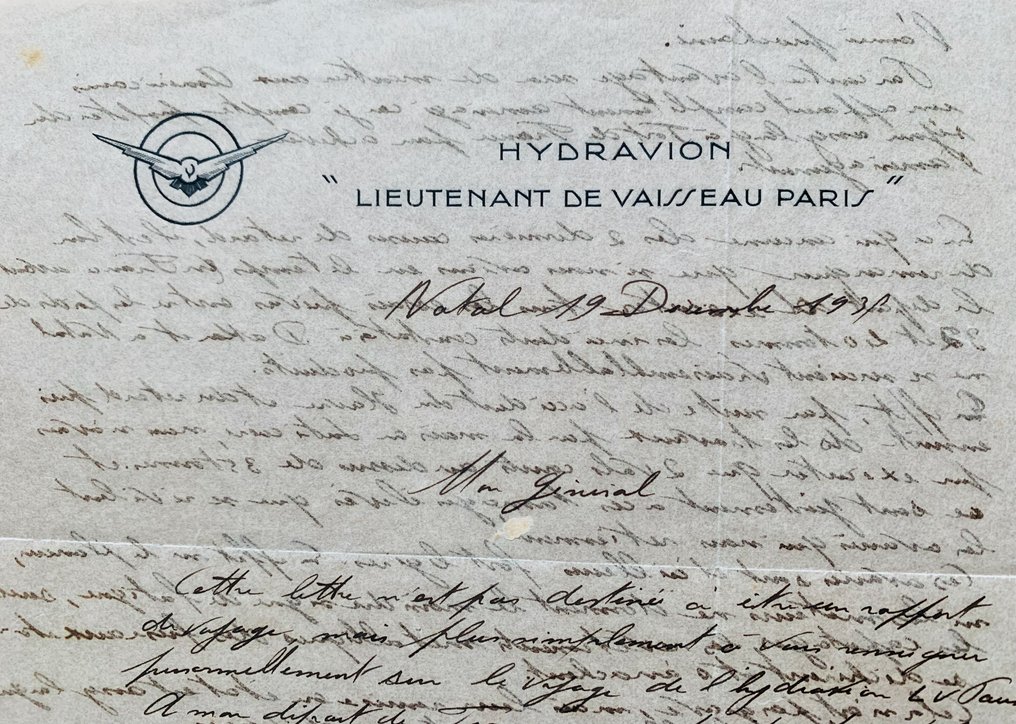
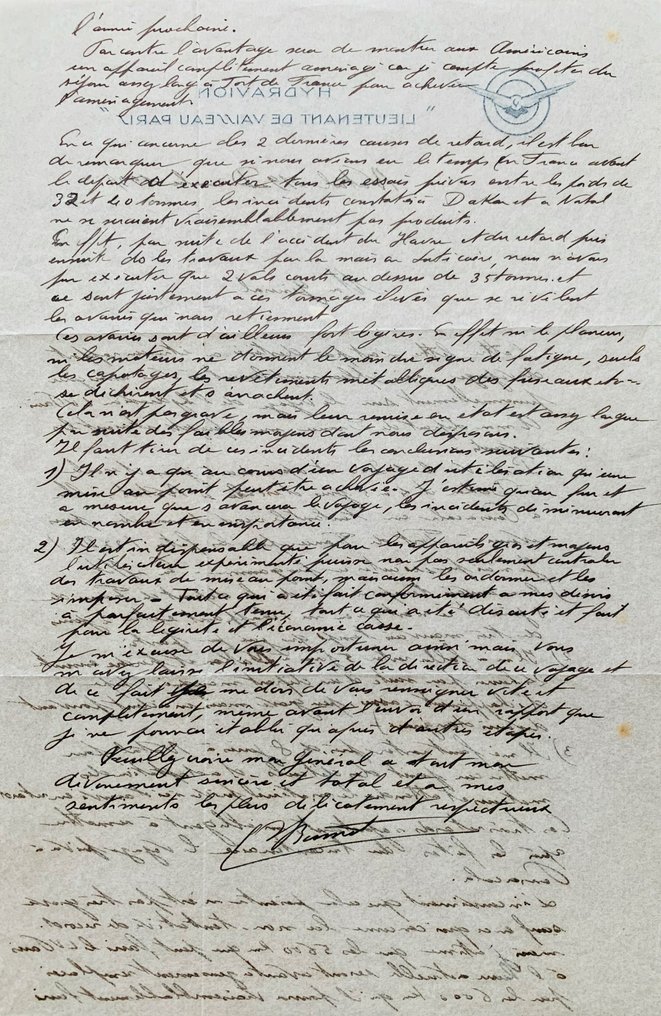
Letter from Commander Bonnot, written upon his arrival in Natal, Brazil, addressed to General Victor Denain of the Air Force. Two pages on fine paper. Natal, December 19, 1935.
Interesting account of the first transatlantic crossing of the transatlantic jumbo in aviation history, the Latécoère 521 seaplane named 'lieutenant de vaisseau Paris,' which could carry 72 passengers in great comfort.
The inaugural flight took place on January 10, 1935. However, it was during December of the same year that it made its first tour, traveling from Dakar to Natal (Brazil) and then to Pensacola, Florida. In this letter, Commander Bonnot, who piloted the aircraft, provides an update on the crossing and the aborted world record attempt. He explains the causes of the delay from the planned schedule. "2/ I had to stay five days in Dakar and then lose 24 hours due to a missed departure (a broken exhaust pipe, not serious but a potentially dangerous incident). 3/ I needed to stay nearly eight days in Natal to fine-tune engine adaptations and wait for the equipment expected here, which arrived late [...]. The inconvenience this causes is not very serious except regarding the record attempt. But I believe that the 5600 km the LV Paris can currently cover will be advantageously replaced by the 6000 km it will likely be able to cover next year. On the other hand, the advantage will be to show the Americans a fully equipped aircraft, as I plan to take advantage of the fairly long stay in Fort de France to complete the modifications." He regrets that not enough time was taken to perform all the planned tests in France. "Indeed, due to the Havre accident and the subsequent delays in the work by the Latécoère company, we only managed two short flights over 35 tons, and it is precisely at these high weights that the failures become apparent. These failures are quite minor. Neither the glider nor the engines show any signs of fatigue; only the cowlings and the metallic coverings of the fuselage tear and rip [...]. From these incidents, the following conclusions must be drawn: 1/ Only during a voyage can a fine-tuning be completed. I believe that as the journey progresses, incidents will decrease in number and severity. 2/ It is essential that for large and medium aircraft, the experienced operator can not only monitor the adjustments but also command and enforce them. Everything done according to my wishes has held up perfectly; everything discussed and done for lightness and economy has broken [...].
Seaplane header Lieutenant of the vessel Paris.
Letter from Commander Bonnot, written upon his arrival in Natal, Brazil, addressed to General Victor Denain of the Air Force. Two pages on fine paper. Natal, December 19, 1935.
Interesting account of the first transatlantic crossing of the transatlantic jumbo in aviation history, the Latécoère 521 seaplane named 'lieutenant de vaisseau Paris,' which could carry 72 passengers in great comfort.
The inaugural flight took place on January 10, 1935. However, it was during December of the same year that it made its first tour, traveling from Dakar to Natal (Brazil) and then to Pensacola, Florida. In this letter, Commander Bonnot, who piloted the aircraft, provides an update on the crossing and the aborted world record attempt. He explains the causes of the delay from the planned schedule. "2/ I had to stay five days in Dakar and then lose 24 hours due to a missed departure (a broken exhaust pipe, not serious but a potentially dangerous incident). 3/ I needed to stay nearly eight days in Natal to fine-tune engine adaptations and wait for the equipment expected here, which arrived late [...]. The inconvenience this causes is not very serious except regarding the record attempt. But I believe that the 5600 km the LV Paris can currently cover will be advantageously replaced by the 6000 km it will likely be able to cover next year. On the other hand, the advantage will be to show the Americans a fully equipped aircraft, as I plan to take advantage of the fairly long stay in Fort de France to complete the modifications." He regrets that not enough time was taken to perform all the planned tests in France. "Indeed, due to the Havre accident and the subsequent delays in the work by the Latécoère company, we only managed two short flights over 35 tons, and it is precisely at these high weights that the failures become apparent. These failures are quite minor. Neither the glider nor the engines show any signs of fatigue; only the cowlings and the metallic coverings of the fuselage tear and rip [...]. From these incidents, the following conclusions must be drawn: 1/ Only during a voyage can a fine-tuning be completed. I believe that as the journey progresses, incidents will decrease in number and severity. 2/ It is essential that for large and medium aircraft, the experienced operator can not only monitor the adjustments but also command and enforce them. Everything done according to my wishes has held up perfectly; everything discussed and done for lightness and economy has broken [...].
Seaplane header Lieutenant of the vessel Paris.
Details
Era
1900-2000
Number of Books
1
Height
27.3 cm
Author/ Illustrator
Commandant Bonnot
Width
18 cm
Title
Récit de la première traversée transatlantique de l’hydravion Latécoère 521
Condition
Good
Year
1935
Language
French
Original language
Yes
Autographed by a famous person
No
Sold by