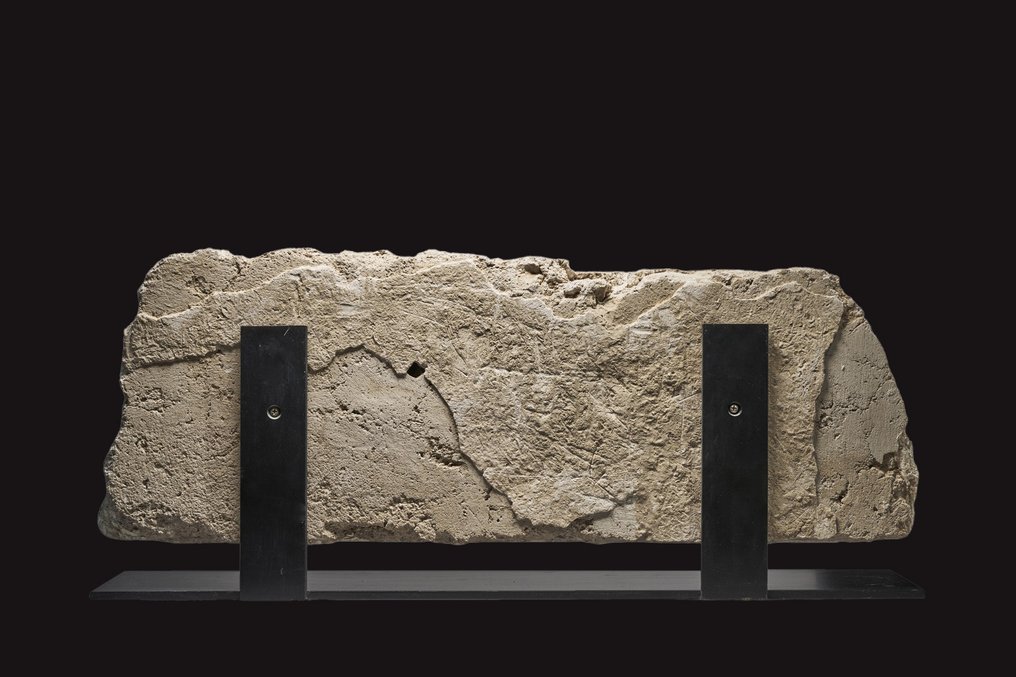
Ancient Roman Stucco Fragment of frieze - 24 cm


07
days
09
hours
53
minutes
12
seconds
Starting bid
€ 1
Reserve price not met

Expert
Selected by Ruth Garrido Vila
Directed the Ifergan Collection Museum, specialising in Phoenician and Mediterranean archaeology.
Estimate € 18,000 - € 22,000
No bids placed
Catawiki Buyer Protection
Your payment’s safe with us until you receive your object.View details
Trustpilot 4.4 | 122713 reviews
Rated Excellent on Trustpilot.
Fragment of a Roman stucco frieze, 24 cm high, 77 cm wide and 14 cm deep, dating to the 1st–3rd century AD.
AI-assisted summary
Description from the seller
Roman Stucco Frieze – 1st-3rd century AD
A large fragment of a higly decorative stucco frieze with rows of ornaments. From top: tendrils and fruit, egg-and-dart, blossoms, dentils and egg-and-dart.
Stucco has a long history in the Mediterranean world. Typically consisting of crushed or burned lime or gypsum mixed with sand and water, stucco was easily molded or modeled into relief decoration for walls, ceilings, and floors in both interior and exterior spaces
Roman stuccowork grew out of Hellenistic practices in the Mediterranean world, which, in turn, combined earlier Greek and Egyptian traditions.
Following Greek tradition, Roman stuccowork used white lime plaster, which was lightweight and easily worked. This type of plaster was also used in contemporary fresco painting, and its preparation and application is described in detail by ancient authors such as Vitruvius and Pliny the Elder. Stuccowork grew in popularity in late Republican and early imperial Rome as a result of the construction boom associated with brick and cement construction. While it is not as widely known today as other types of Roman decor, it played a significant role in well-planned and -executed interior spaces, complementing painted compositions, mosaic floors, and sculptural assemblages with projecting architectural elements and relief schemes.
Artists working in Roman Italy created expansive stucco schemes in private homes, tombs, and public buildings, particularly in baths. The pieces in high relief were secured to the walls with metal rods or nails. Some forms were molded before they were attached to the walls, but other shapes and designs, such as cornices or frieze borders, were stamped into semi-dry plaster after application to the wall or ceiling. The stamped patterns imitated the egg-and-dart and vegetal borders carved on monumental architecture.
Provenance: From the private collection of R.L., Belgium. Acquired around 2007 from Ariadne Gallery, New York. Previously in a private collection in New York.
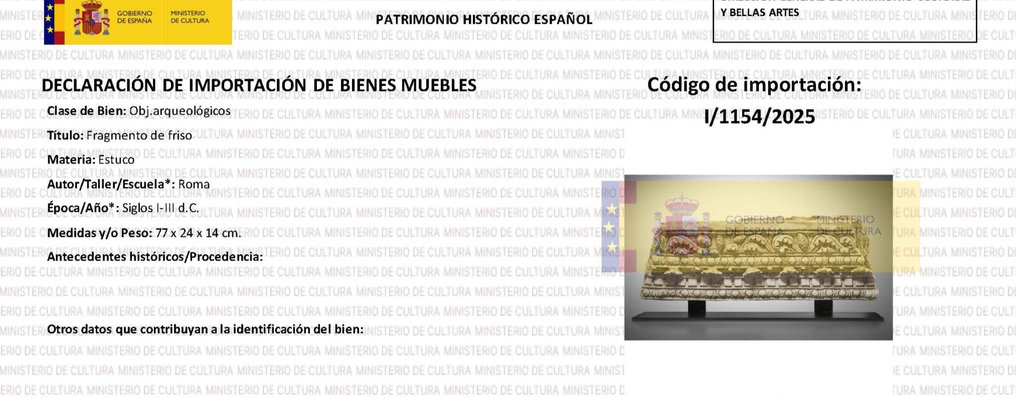
Attached import certificate from Spanish Ministry of Culture.
The Supplier warrants that he obtained this lot legally. Provenance statement seen by Catawiki. Important information. The seller guarantees that he is entitled to ship this lot. The seller will take care that any necessary permits will be arranged. The seller will inform the buyer about this if this takes more than a few days.
Important: For destinations out of Spanish territory: all our objects will be shipped after obtaining CERTIFICATE OF EXPORTATION by Ministry of Culture of Spain. We inform our clients that it may take between 4-8 weeks.
Roman Stucco Frieze – 1st-3rd century AD
A large fragment of a higly decorative stucco frieze with rows of ornaments. From top: tendrils and fruit, egg-and-dart, blossoms, dentils and egg-and-dart.
Stucco has a long history in the Mediterranean world. Typically consisting of crushed or burned lime or gypsum mixed with sand and water, stucco was easily molded or modeled into relief decoration for walls, ceilings, and floors in both interior and exterior spaces
Roman stuccowork grew out of Hellenistic practices in the Mediterranean world, which, in turn, combined earlier Greek and Egyptian traditions.
Following Greek tradition, Roman stuccowork used white lime plaster, which was lightweight and easily worked. This type of plaster was also used in contemporary fresco painting, and its preparation and application is described in detail by ancient authors such as Vitruvius and Pliny the Elder. Stuccowork grew in popularity in late Republican and early imperial Rome as a result of the construction boom associated with brick and cement construction. While it is not as widely known today as other types of Roman decor, it played a significant role in well-planned and -executed interior spaces, complementing painted compositions, mosaic floors, and sculptural assemblages with projecting architectural elements and relief schemes.
Artists working in Roman Italy created expansive stucco schemes in private homes, tombs, and public buildings, particularly in baths. The pieces in high relief were secured to the walls with metal rods or nails. Some forms were molded before they were attached to the walls, but other shapes and designs, such as cornices or frieze borders, were stamped into semi-dry plaster after application to the wall or ceiling. The stamped patterns imitated the egg-and-dart and vegetal borders carved on monumental architecture.
Provenance: From the private collection of R.L., Belgium. Acquired around 2007 from Ariadne Gallery, New York. Previously in a private collection in New York.
Attached import certificate from Spanish Ministry of Culture.
The Supplier warrants that he obtained this lot legally. Provenance statement seen by Catawiki. Important information. The seller guarantees that he is entitled to ship this lot. The seller will take care that any necessary permits will be arranged. The seller will inform the buyer about this if this takes more than a few days.
Important: For destinations out of Spanish territory: all our objects will be shipped after obtaining CERTIFICATE OF EXPORTATION by Ministry of Culture of Spain. We inform our clients that it may take between 4-8 weeks.
Details
Culture
Ancient Roman
Century/ Timeframe
1st-3rd century AD
Name of object
Fragment of frieze
Acquired from
Auction house
Year acquired
2025
Material
Stucco
Country acquired from
Germany
Condition
Good
Previous owner acquired from
Gallery / Antique dealer
Height
24 cm
Previous owner - year acquired
2007
Width
77 cm
Previous owner - country acquired from
United States
Depth
14 cm
I verify that I have obtained this object legally and that I am allowed to sell it
Yes
Sold by
Disclaimer
The seller was informed by Catawiki about documentation requirements and guarantees the following: - the object was legally obtained, - the seller has the right to sell and/or export the object, as relevant, - the seller will provide the necessary provenance information and arrange required documentation and permits/licenses, as applicable and as per local laws, - the seller will notify the buyer of any delays in obtaining permits/licenses. By bidding, you acknowledge that import documentation may be required depending on your country of residence and that obtaining permits/licenses may cause delays in the delivery of your object.
The seller was informed by Catawiki about documentation requirements and guarantees the following: - the object was legally obtained, - the seller has the right to sell and/or export the object, as relevant, - the seller will provide the necessary provenance information and arrange required documentation and permits/licenses, as applicable and as per local laws, - the seller will notify the buyer of any delays in obtaining permits/licenses. By bidding, you acknowledge that import documentation may be required depending on your country of residence and that obtaining permits/licenses may cause delays in the delivery of your object.
