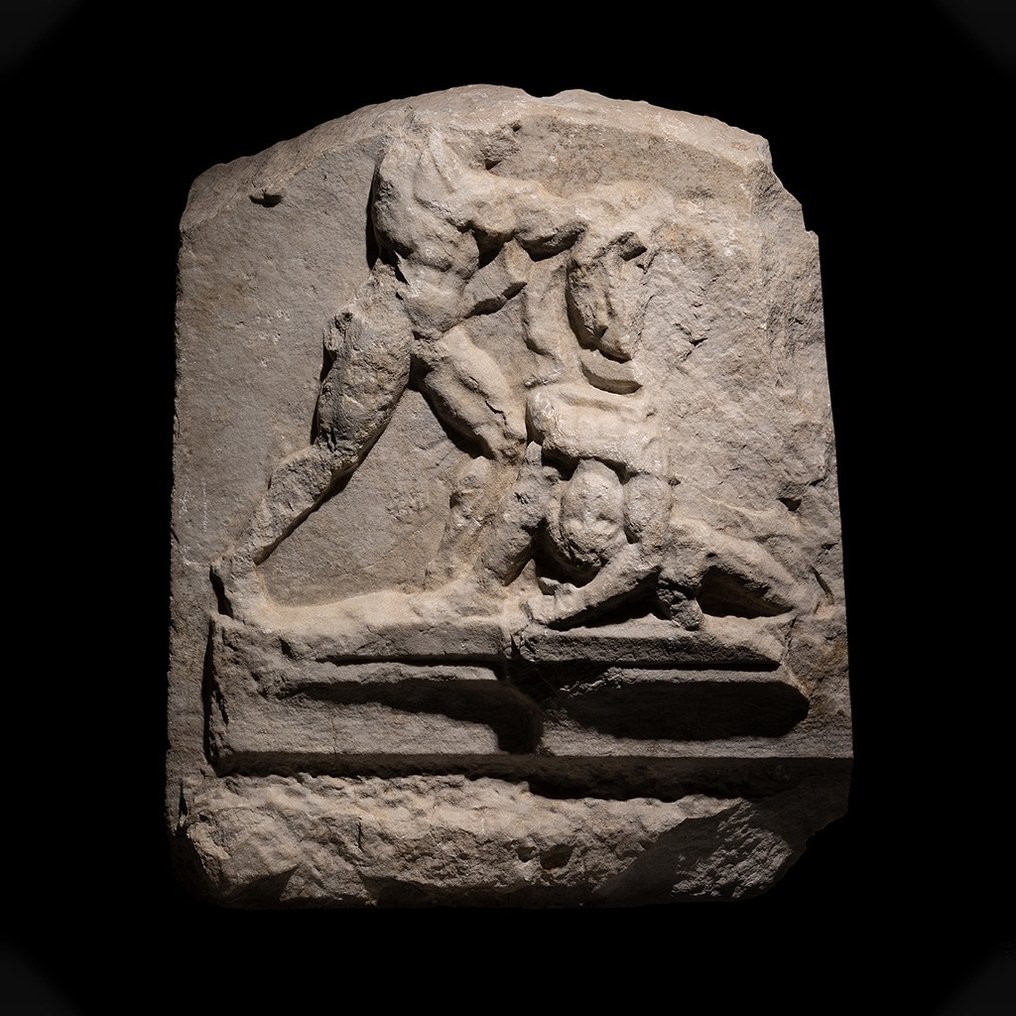
Ancient Greek Marble Metope from a temple with Heracles hero fighting Hippolyta. 5th-4th century BC. 59.6 cm height. EX-



08
days
11
hours
20
minutes
18
seconds
Starting bid
€ 1
Reserve price not met

Expert
Selected by Ruth Garrido Vila
Directed the Ifergan Collection Museum, specialising in Phoenician and Mediterranean archaeology.
Estimate € 19,000 - € 21,000
No bids placed
Catawiki Buyer Protection
Your payment’s safe with us until you receive your object.View details
Trustpilot 4.4 | 121899 reviews
Rated Excellent on Trustpilot.
Metope from a Greek temple in white marble depicting Heracles and Hippolyta, 5th–4th century BC, height 59.6 cm, width 49.2 cm, with wear and missing parts to the head and right arm, no restoration, acquired from a private Spanish collection and Sotheby’s 1995 auction lot 276.
AI-assisted summary
Description from the seller
Metope from a temple with Heracles hero fighting Hippolyta.
Ancient Greek, 5th – 4th century BC.
White marble.
Height 59.6 cm; width 49.2 cm.
PROVENANCE: Private collection, Spain. Private collection of Jane David Doggett, Hobe Sound, Florida (USA). Acquired at Sotheby’s, 8th December 1995, auction “Antiquities and Islamic Art” as part of lot 276. Previously in a private collection, USA.
PUBLICATIONS:
- Sotheby’s, Antiquities and Islamic art, Friday December 8, 1995. New York. Auction 6789, part of lot 276.
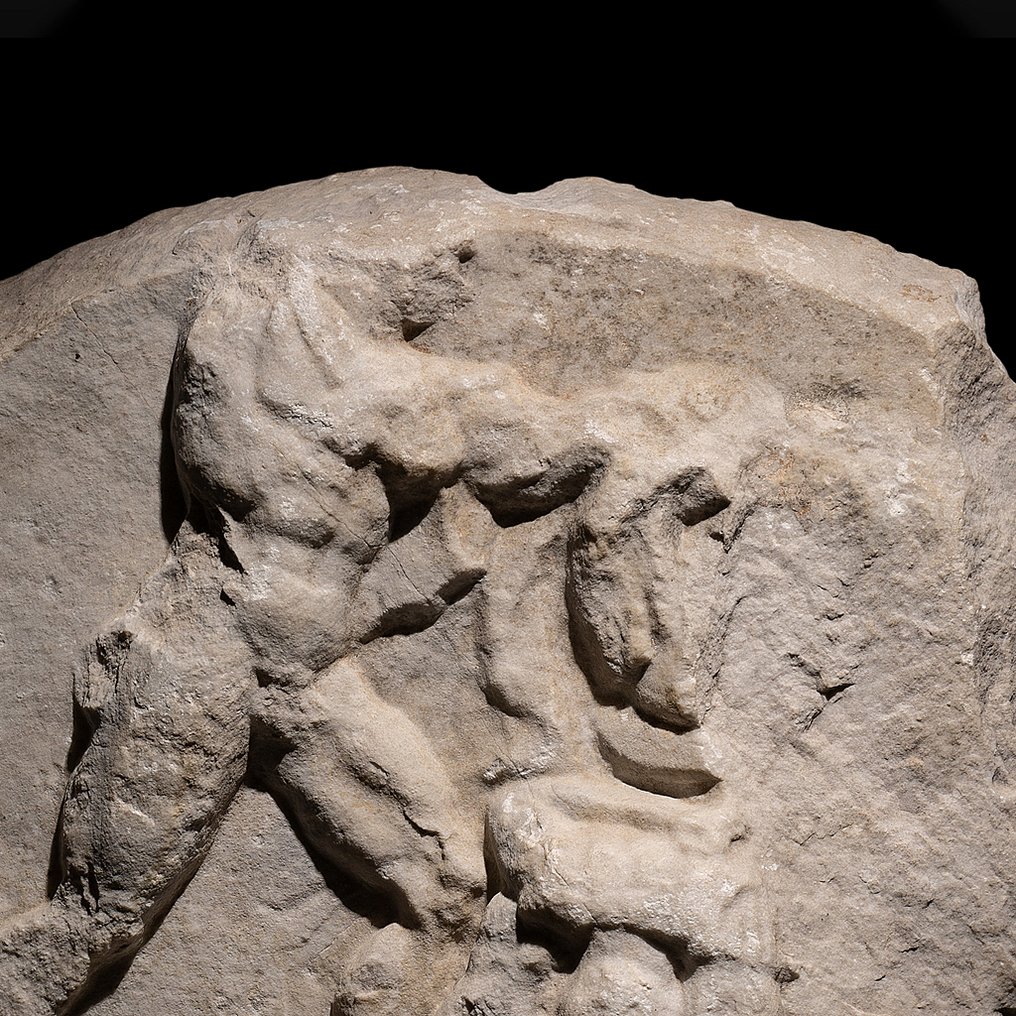
CONDITION: The metope exhibits some general wear. Part of the head of Heracles is missing in the upper area, as is part of the right arm and most of the club. The piece is as it was originally; no restoration has been carried out.
DESCRIPTION:
Wall high relief to be placed in a frieze on a Greek temple between two triglyphs. The two figures seen here are a muscular male and a female figure: Heracles and the Amazon Queen, Hippolyta. The scene depicts the ninth Labour of Heracles, where he had to obtain the queen’s girdle. On this temple each metope corresponded to one of the Twelve Labours of Hercules.
The two figures are shown on a rectangular plinth. Heracles is advancing forward with his club in his right hand, and is about to strike Hippolyta. The skin of the Nemean lion can be seen over the shoulders of the figure. Heracles seems to be lifting up the dead or injured Hippolyta with his left arm, possibly holding her by her girdle. The Amazon is shown facing forward with her arms fallen by her side, her legs bent. Her inert body seems to be raised up by the force with which Heracles is holding her by the magic girdle.
Three metopes for their provenance appear published in a 1995 catalogue of Sotheby’s. Each depicts one of the Labours of Heracles, and in style appear to be from the same Greek construction, part of a group which has now been split up.
The Twelve Labours of the hero Herakles were frequently depicted in Greek architectural decoration, especially on the metopes that adorned the architrave of temples. The most famous example appeared on the twelve metopes of the 5th century BC temple of Zeus at Olympia.
Heracles is the most famous hero in Greek mythology and perhaps also in all classic antiquity. His name comes from the goddess Hera and the Greek word “kleos” (glory), meaning “the glory of Hera”. He was considered to be the son of Zeus and Alceme, a mortal queen, foster son of Amphitryon and great-grandson of Perseus on his mother’s side. At birth he was given the name of Alcaeus or Alcides, in honour of his grandfather. This very word evokes the idea of strength. It was as an adult that he received the name with which he is known, imposed on him by Apollo through the Pythia, to indicate his condition as a follower of the goddess Hera. In ancient Rome as in Western Europe, he is better known as Hercules, and some Roman emperors, Commodus and Maximian among others, identified with his figure.
His extraordinary strength is the most important of his attributes, but he is also known for courage, pride, a certain candour and formidable sexual prowess. He is considered to be the forebear of the kings of Sparta, and this was one of the reasons for the dissemination of his legend and cult, making Heracles the Dorian hero par excellence. There are many stories in mythology about him, the most important one is that of the Twelve Labours of Heracles. The stories in which he has the leading role form a cycle which is constant through all antiquity and for this reason it is difficult to give a chronological, or even a coherent exposition of them.
In classical architecture, a metope is a rectangular architectural element that fills the space between two triglyphs in a Doric frieze, which is a decorative band of alternating triglyphs and metopes above the architrave of a building of the Doric order. Metopes often had painted or sculptural decoration; the most famous example are the 92 metopes of the Parthenon marbles some of which depict the battle between the Centaurs and the Lapiths. The painting on most metopes has been lost, but sufficient traces remain to allow a close idea of their original appearance.
In terms of structure, metopes may be carved from a single block with a triglyph (or triglyphs), or they may be cut separately and slide into slots in the triglyph blocks as at the Temple of Aphaea. Sometimes the metopes and friezes were cut from different stone, to provide colour contrast. Although they tend to be close to square in shape, some metopes are noticeably larger in height or in width. They may also vary in width within a single structure to allow for corner contraction, an adjustment of the column spacing and arrangement of the Doric frieze in a temple to make the design appear more harmonious.
PARALLELS:
- Heracles against Hippolyta, Volute krater signed by Euphronios. 500 - 470 BC Arezzo Museum. Note the similarity of the position of Heracles
BIBLIOGRAPHY:
- REINACH, S. “Repeteroire de la statuaire grecque et romaine, tome IV”. « L’ERMA » di BVRETSCHNEIDER. Rome.
Notes:
The piece includes authenticity certificate.
The piece includes Spanish Export License (Passport for European Union) - If the piece is destined outside the European Union a substitution of the export permit should be requested. This process could take between 1 and 2 months.
#ExclusiveJurassicAntiquity
Seller's Story
Gallery of Ancient Art - Archeology based in Barcelona with more than fifteen years of experience. Specialized in classical art, Egyptian art, Asian art and pre-Columbian art. It guarantees the authenticity of all its pieces. It participates in the most important art fairs in Spain, such as Feriarte, as well as in fairs abroad, BRAFA, Parcours des Mondes, Cultures Brussels.
All the pieces are sent with an Export Permit issued by the Spanish Ministry of Culture.
We are quick to ship via DHL Express or Direct Art Transport.
Translated by Google TranslateMetope from a temple with Heracles hero fighting Hippolyta.
Ancient Greek, 5th – 4th century BC.
White marble.
Height 59.6 cm; width 49.2 cm.
PROVENANCE: Private collection, Spain. Private collection of Jane David Doggett, Hobe Sound, Florida (USA). Acquired at Sotheby’s, 8th December 1995, auction “Antiquities and Islamic Art” as part of lot 276. Previously in a private collection, USA.
PUBLICATIONS:
- Sotheby’s, Antiquities and Islamic art, Friday December 8, 1995. New York. Auction 6789, part of lot 276.
CONDITION: The metope exhibits some general wear. Part of the head of Heracles is missing in the upper area, as is part of the right arm and most of the club. The piece is as it was originally; no restoration has been carried out.
DESCRIPTION:
Wall high relief to be placed in a frieze on a Greek temple between two triglyphs. The two figures seen here are a muscular male and a female figure: Heracles and the Amazon Queen, Hippolyta. The scene depicts the ninth Labour of Heracles, where he had to obtain the queen’s girdle. On this temple each metope corresponded to one of the Twelve Labours of Hercules.
The two figures are shown on a rectangular plinth. Heracles is advancing forward with his club in his right hand, and is about to strike Hippolyta. The skin of the Nemean lion can be seen over the shoulders of the figure. Heracles seems to be lifting up the dead or injured Hippolyta with his left arm, possibly holding her by her girdle. The Amazon is shown facing forward with her arms fallen by her side, her legs bent. Her inert body seems to be raised up by the force with which Heracles is holding her by the magic girdle.
Three metopes for their provenance appear published in a 1995 catalogue of Sotheby’s. Each depicts one of the Labours of Heracles, and in style appear to be from the same Greek construction, part of a group which has now been split up.
The Twelve Labours of the hero Herakles were frequently depicted in Greek architectural decoration, especially on the metopes that adorned the architrave of temples. The most famous example appeared on the twelve metopes of the 5th century BC temple of Zeus at Olympia.
Heracles is the most famous hero in Greek mythology and perhaps also in all classic antiquity. His name comes from the goddess Hera and the Greek word “kleos” (glory), meaning “the glory of Hera”. He was considered to be the son of Zeus and Alceme, a mortal queen, foster son of Amphitryon and great-grandson of Perseus on his mother’s side. At birth he was given the name of Alcaeus or Alcides, in honour of his grandfather. This very word evokes the idea of strength. It was as an adult that he received the name with which he is known, imposed on him by Apollo through the Pythia, to indicate his condition as a follower of the goddess Hera. In ancient Rome as in Western Europe, he is better known as Hercules, and some Roman emperors, Commodus and Maximian among others, identified with his figure.
His extraordinary strength is the most important of his attributes, but he is also known for courage, pride, a certain candour and formidable sexual prowess. He is considered to be the forebear of the kings of Sparta, and this was one of the reasons for the dissemination of his legend and cult, making Heracles the Dorian hero par excellence. There are many stories in mythology about him, the most important one is that of the Twelve Labours of Heracles. The stories in which he has the leading role form a cycle which is constant through all antiquity and for this reason it is difficult to give a chronological, or even a coherent exposition of them.
In classical architecture, a metope is a rectangular architectural element that fills the space between two triglyphs in a Doric frieze, which is a decorative band of alternating triglyphs and metopes above the architrave of a building of the Doric order. Metopes often had painted or sculptural decoration; the most famous example are the 92 metopes of the Parthenon marbles some of which depict the battle between the Centaurs and the Lapiths. The painting on most metopes has been lost, but sufficient traces remain to allow a close idea of their original appearance.
In terms of structure, metopes may be carved from a single block with a triglyph (or triglyphs), or they may be cut separately and slide into slots in the triglyph blocks as at the Temple of Aphaea. Sometimes the metopes and friezes were cut from different stone, to provide colour contrast. Although they tend to be close to square in shape, some metopes are noticeably larger in height or in width. They may also vary in width within a single structure to allow for corner contraction, an adjustment of the column spacing and arrangement of the Doric frieze in a temple to make the design appear more harmonious.
PARALLELS:
- Heracles against Hippolyta, Volute krater signed by Euphronios. 500 - 470 BC Arezzo Museum. Note the similarity of the position of Heracles
BIBLIOGRAPHY:
- REINACH, S. “Repeteroire de la statuaire grecque et romaine, tome IV”. « L’ERMA » di BVRETSCHNEIDER. Rome.
Notes:
The piece includes authenticity certificate.
The piece includes Spanish Export License (Passport for European Union) - If the piece is destined outside the European Union a substitution of the export permit should be requested. This process could take between 1 and 2 months.
#ExclusiveJurassicAntiquity
Seller's Story
Gallery of Ancient Art - Archeology based in Barcelona with more than fifteen years of experience. Specialized in classical art, Egyptian art, Asian art and pre-Columbian art. It guarantees the authenticity of all its pieces. It participates in the most important art fairs in Spain, such as Feriarte, as well as in fairs abroad, BRAFA, Parcours des Mondes, Cultures Brussels.
All the pieces are sent with an Export Permit issued by the Spanish Ministry of Culture.
We are quick to ship via DHL Express or Direct Art Transport.
Translated by Google TranslateDetails
Culture
Ancient Greek
Century/ Timeframe
5th-4th century BC
Name of object
Metope from a temple with Heracles hero fighting Hippolyta. 5th-4th century BC. 59.6 cm height. EX-
Acquired from
Private collection
Material
Marble
Condition
Good
Disclaimer
The seller was informed by Catawiki about documentation requirements and guarantees the following: - the object was legally obtained, - the seller has the right to sell and/or export the object, as relevant, - the seller will provide the necessary provenance information and arrange required documentation and permits/licenses, as applicable and as per local laws, - the seller will notify the buyer of any delays in obtaining permits/licenses. By bidding, you acknowledge that import documentation may be required depending on your country of residence and that obtaining permits/licenses may cause delays in the delivery of your object.
The seller was informed by Catawiki about documentation requirements and guarantees the following: - the object was legally obtained, - the seller has the right to sell and/or export the object, as relevant, - the seller will provide the necessary provenance information and arrange required documentation and permits/licenses, as applicable and as per local laws, - the seller will notify the buyer of any delays in obtaining permits/licenses. By bidding, you acknowledge that import documentation may be required depending on your country of residence and that obtaining permits/licenses may cause delays in the delivery of your object.
