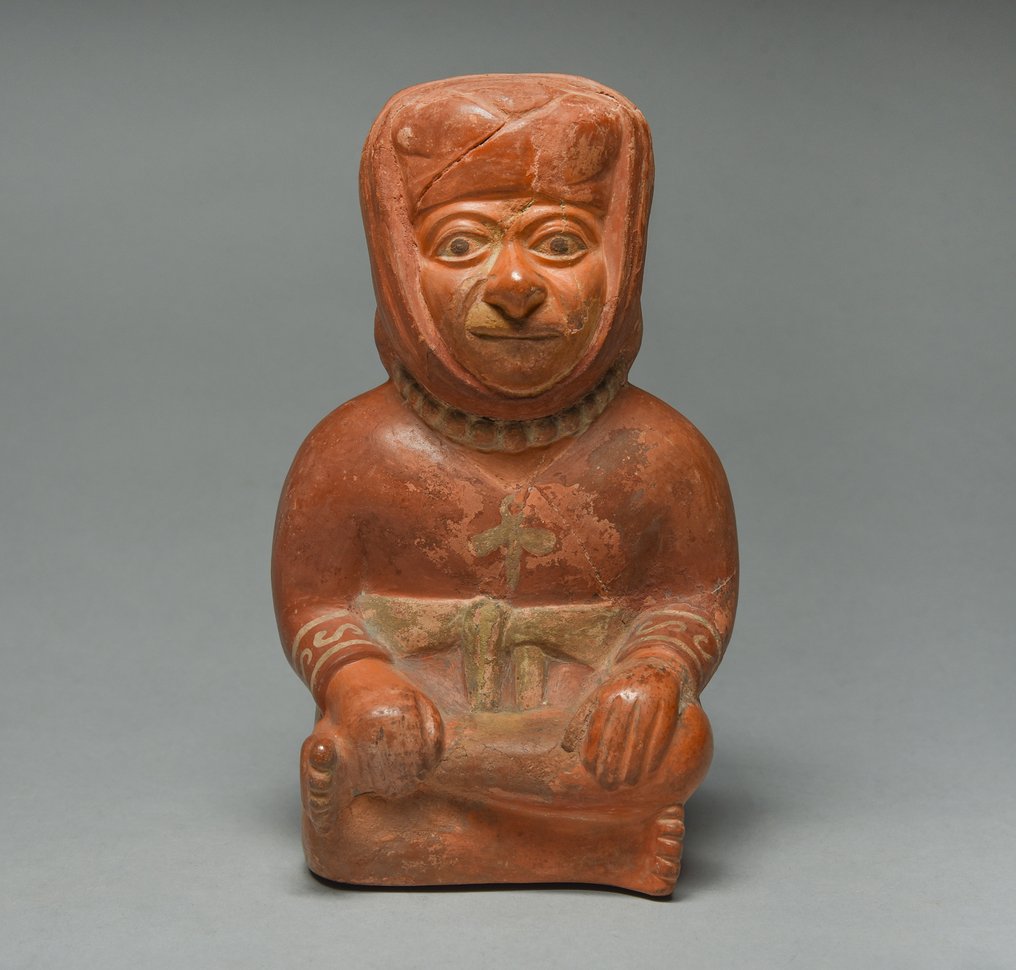
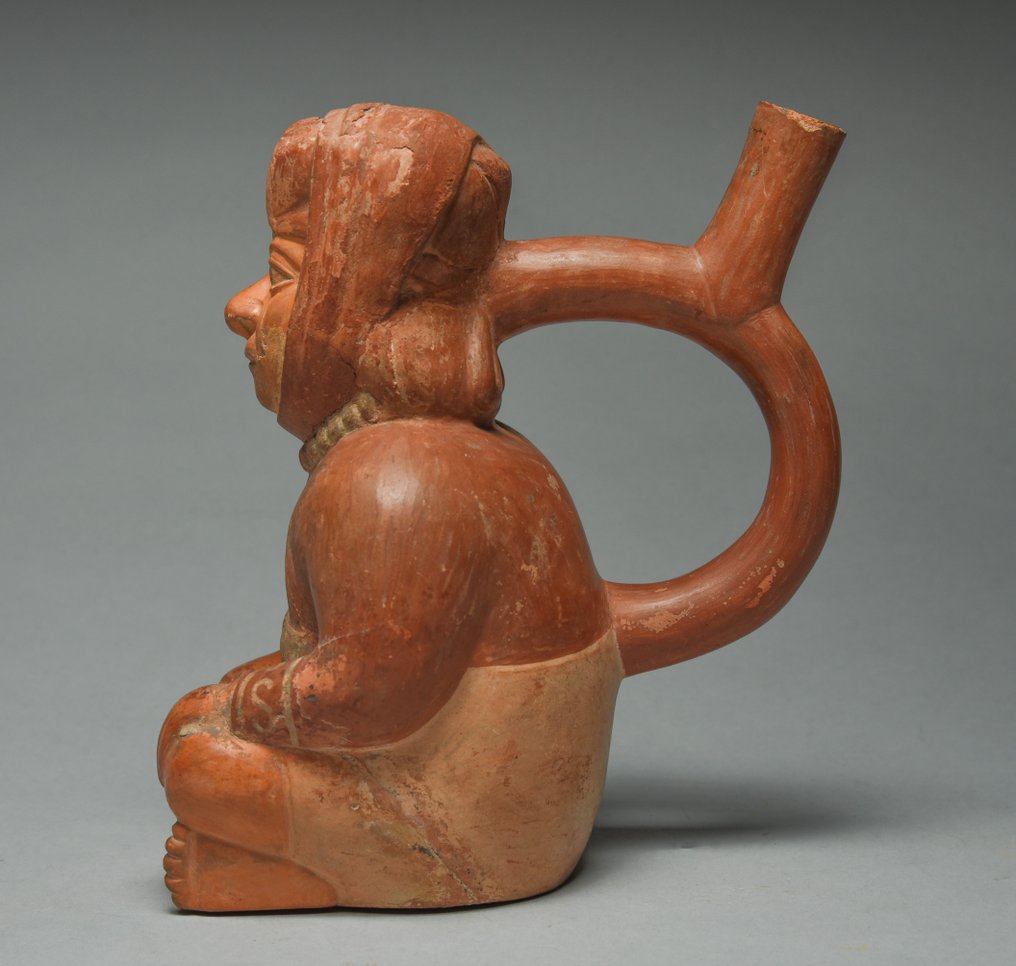
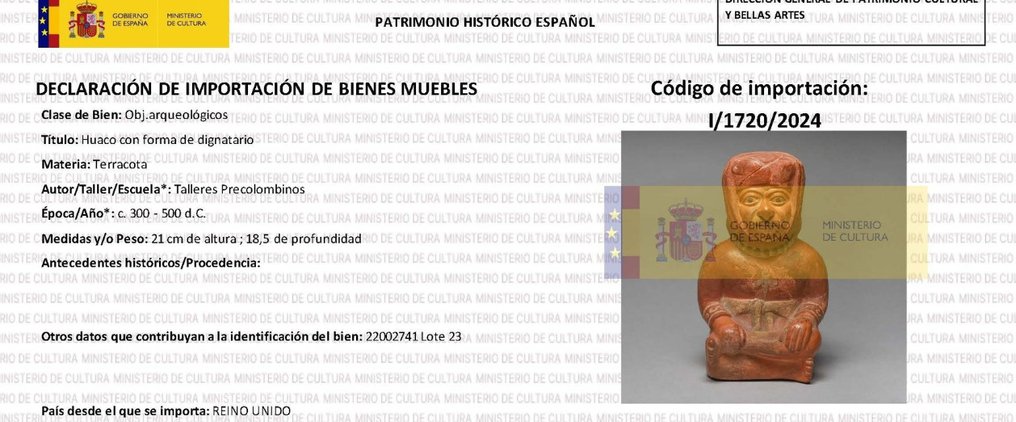
Moche, Perú Terracotta Huaco with stirrup handle in the shape of a dignitary. 300-500 AD. 21 cm Height. Spanish Import


01
day
00
hours
31
minutes
45
seconds
Current bid
€ 802
Reserve price not met

Expert
Selected by Ruth Garrido Vila
Directed the Ifergan Collection Museum, specialising in Phoenician and Mediterranean archaeology.
Estimate € 1,900 - € 2,100
5 other people are watching this object
 Bidder 9247 Bidder 9247 | €802 | |
|---|---|---|
| Bidder 9247 | €752 | |
| Bidder 9247 | €702 | |
Catawiki Buyer Protection
Your payment’s safe with us until you receive your object.View details
Trustpilot 4.4 | 122630 reviews
Rated Excellent on Trustpilot.
Huaco with stirrup handle in the shape of a dignitary, Moche culture, Peru, terracotta, height 21 cm, period 300–500 AD, good condition with a diagonal crack and professionally restored.
AI-assisted summary
Description from the seller
Huaco with stirrup handle in the shape of a dignitary.
CULTURE: Moche, Perú
PERIOD: 300-500 AD
MATERIAL: Terracotta
DIMENSIONS: Height 21 cm and 18.5 cm length
CONDITION: Good condition, has a diagonal crack, professionally restored.
PROVENANCE: Private collection, United Kingdom. Purchased at Christie's, London, March 24, 1992, lot 23.
DESCRIPTION:
The Moche culture inhabited the coast of present-day northern Peru, concentrating in the valleys of Lambayeque, Chicama, Moche and Virú. This desert region is crossed by several rivers that flow down into the Pacific Ocean, where marine resources are plentiful.
The Moche produced fine ceramic, textile and precious metal pieces. Their characteristic style can be seen in a wide range of goods such as fire-engraved gourds, wall murals, featherwork art, body painting and tattoos. Their ceramic decoration displays a level of skill that has rarely been surpassed, and included such techniques as incision, bas-relief with stamps, and painting on smooth surfaces. Many were made in state-run workshops that mass-produced pieces from molds. Their ceramics came in a variety of forms and decorative styles and displayed myths and ritual motifs as well. Notable among these earthenware forms were the so-called “portrait bottles”, bottles molded with the face of a well-known Moche figure. These highly detailed facial portraits reflect the Moche’s own use of face paint and/or tattoos, as well as elaborate headdresses. This portrait-making expertise can also be observed in everyday scenes and erotic representations, as well as in figures of individuals that were hunch backed, blind, or suffered from other disorders. They were skillful metalworkers, using gold, copper and silver to make ear ornaments, nose rings, bracelets, necklace beads, tweezers and a variety of tools. Especially notable is the tumi or ceremonial knife that was usually only carried by Moche officials.
Many of the motifs adorning early Moche ceramics were derived from the Recuay culture. These two peoples were certainly in contact, as all of the irrigation waters the Moche used in their valleys flowed down from Recuay territory. In the early years, the Moche also had contact with groups of the Salinar and Gallinazo cultures. It is very likely that the Moche disappeared when they were overtaken by the Wari Empire, but their civilization also suffered from long periods of flooding by the El Niño phenomenon, which would have destroyed their farming infrastructure and could have helped precipitate their collapse. The final stage of the Moche culture displays features that would later appear in the Chimú culture.
Notes:
The seller guarantees that he acquired this piece according to all national and international laws related to the ownership of cultural property. Provenance statement seen by Catawiki.
The seller will take care that any necessary permits, like an export license will be arranged, he will inform the buyer about the status of it if this takes more than a few days.
The piece includes authenticity certificate.
The piece includes Spanish Export License.
#ExclusiveCabinetofCuriosities
Seller's Story
Gallery of Ancient Art - Archeology based in Barcelona with more than fifteen years of experience. Specialized in classical art, Egyptian art, Asian art and pre-Columbian art. It guarantees the authenticity of all its pieces. It participates in the most important art fairs in Spain, such as Feriarte, as well as in fairs abroad, BRAFA, Parcours des Mondes, Cultures Brussels.
All the pieces are sent with an Export Permit issued by the Spanish Ministry of Culture.
We are quick to ship via DHL Express or Direct Art Transport.
Translated by Google TranslateHuaco with stirrup handle in the shape of a dignitary.
CULTURE: Moche, Perú
PERIOD: 300-500 AD
MATERIAL: Terracotta
DIMENSIONS: Height 21 cm and 18.5 cm length
CONDITION: Good condition, has a diagonal crack, professionally restored.
PROVENANCE: Private collection, United Kingdom. Purchased at Christie's, London, March 24, 1992, lot 23.
DESCRIPTION:
The Moche culture inhabited the coast of present-day northern Peru, concentrating in the valleys of Lambayeque, Chicama, Moche and Virú. This desert region is crossed by several rivers that flow down into the Pacific Ocean, where marine resources are plentiful.
The Moche produced fine ceramic, textile and precious metal pieces. Their characteristic style can be seen in a wide range of goods such as fire-engraved gourds, wall murals, featherwork art, body painting and tattoos. Their ceramic decoration displays a level of skill that has rarely been surpassed, and included such techniques as incision, bas-relief with stamps, and painting on smooth surfaces. Many were made in state-run workshops that mass-produced pieces from molds. Their ceramics came in a variety of forms and decorative styles and displayed myths and ritual motifs as well. Notable among these earthenware forms were the so-called “portrait bottles”, bottles molded with the face of a well-known Moche figure. These highly detailed facial portraits reflect the Moche’s own use of face paint and/or tattoos, as well as elaborate headdresses. This portrait-making expertise can also be observed in everyday scenes and erotic representations, as well as in figures of individuals that were hunch backed, blind, or suffered from other disorders. They were skillful metalworkers, using gold, copper and silver to make ear ornaments, nose rings, bracelets, necklace beads, tweezers and a variety of tools. Especially notable is the tumi or ceremonial knife that was usually only carried by Moche officials.
Many of the motifs adorning early Moche ceramics were derived from the Recuay culture. These two peoples were certainly in contact, as all of the irrigation waters the Moche used in their valleys flowed down from Recuay territory. In the early years, the Moche also had contact with groups of the Salinar and Gallinazo cultures. It is very likely that the Moche disappeared when they were overtaken by the Wari Empire, but their civilization also suffered from long periods of flooding by the El Niño phenomenon, which would have destroyed their farming infrastructure and could have helped precipitate their collapse. The final stage of the Moche culture displays features that would later appear in the Chimú culture.
Notes:
The seller guarantees that he acquired this piece according to all national and international laws related to the ownership of cultural property. Provenance statement seen by Catawiki.
The seller will take care that any necessary permits, like an export license will be arranged, he will inform the buyer about the status of it if this takes more than a few days.
The piece includes authenticity certificate.
The piece includes Spanish Export License.
#ExclusiveCabinetofCuriosities
Seller's Story
Gallery of Ancient Art - Archeology based in Barcelona with more than fifteen years of experience. Specialized in classical art, Egyptian art, Asian art and pre-Columbian art. It guarantees the authenticity of all its pieces. It participates in the most important art fairs in Spain, such as Feriarte, as well as in fairs abroad, BRAFA, Parcours des Mondes, Cultures Brussels.
All the pieces are sent with an Export Permit issued by the Spanish Ministry of Culture.
We are quick to ship via DHL Express or Direct Art Transport.
Translated by Google TranslateDetails
Culture
Moche, Perú
Century/ Timeframe
300-500 AD
Name of object
Huaco with stirrup handle in the shape of a dignitary. 300-500 AD. 21 cm Height. Spanish Import
Acquired from
Private collection
Year acquired
2024
Material
Terracotta
Country acquired from
United Kingdom
Condition
Good
Previous owner acquired from
Private collection
Previous owner - year acquired
1980
Previous owner - country acquired from
United Kingdom
I verify that I have obtained this object legally and that I am allowed to sell it
Yes
Disclaimer
The seller was informed by Catawiki about documentation requirements and guarantees the following: - the object was legally obtained, - the seller has the right to sell and/or export the object, as relevant, - the seller will provide the necessary provenance information and arrange required documentation and permits/licenses, as applicable and as per local laws, - the seller will notify the buyer of any delays in obtaining permits/licenses. By bidding, you acknowledge that import documentation may be required depending on your country of residence and that obtaining permits/licenses may cause delays in the delivery of your object.
The seller was informed by Catawiki about documentation requirements and guarantees the following: - the object was legally obtained, - the seller has the right to sell and/or export the object, as relevant, - the seller will provide the necessary provenance information and arrange required documentation and permits/licenses, as applicable and as per local laws, - the seller will notify the buyer of any delays in obtaining permits/licenses. By bidding, you acknowledge that import documentation may be required depending on your country of residence and that obtaining permits/licenses may cause delays in the delivery of your object.
