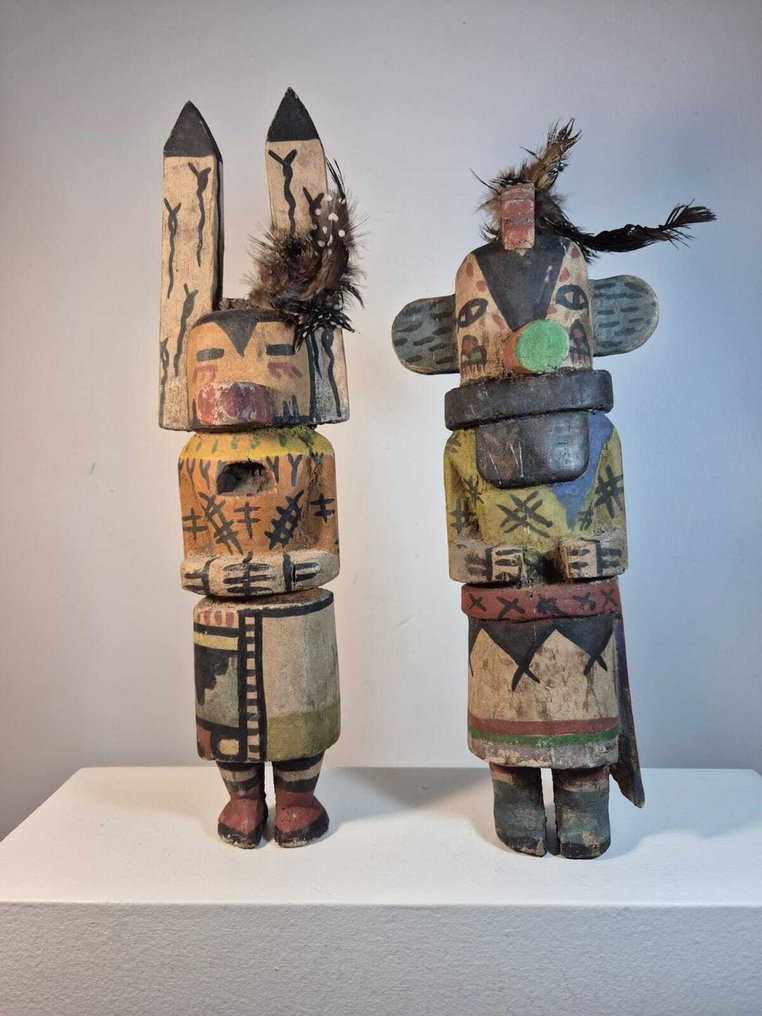
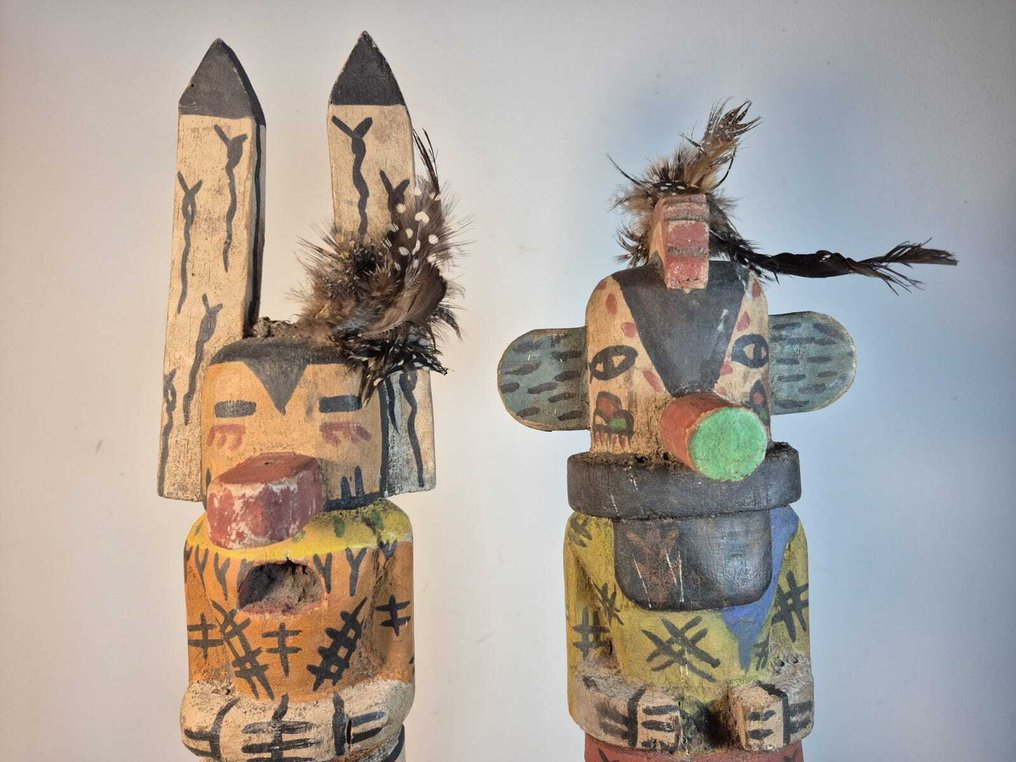
Très beau couple Kachina/Hopi - Doll



02
days
09
hours
08
minutes
33
seconds

28 other people are watching this object
 Bidder 9011 Bidder 9011 | €92 | |
|---|---|---|
| Bidder 5125 | €87 | |
| Bidder 9011 | €82 | |
Catawiki Buyer Protection
Your payment’s safe with us until you receive your object.View details
Trustpilot 4.4 | 123718 reviews
Rated Excellent on Trustpilot.
A 35 cm high wooden Kachina/Hopi doll from the United States (Dakota region), weighing 1950 g, in good condition, with 9 cm width and 8 cm depth.
AI-assisted summary
Description from the seller
Linked to dances and spiritual ceremonies, Kachina dolls are reminders of North American Hopi traditions.
About fifty centimeters tall at most, made from cottonwood, sometimes adorned with feathers and painted in blue, white, or yellow: Kachina dolls seem quite mysterious to untrained eyes. 'They come from the Hopi tribe in northern Arizona and are used to teach non-initiates, mainly the young, the dances and ceremonies that mark daily life. Like children's books,' These rituals involving the Kachinas take place between the winter solstice and the summer solstice, with more than thirty occurring during which spirits are embodied by masked and costumed dancers resembling the Kachinas.
An art that dates back to the 14th century.
Historically, the existence of Kachinas has been confirmed since around the 14th century, but the most interesting period is between 1880 and 1920. The first Kachinas are flat and minimally decorated, without legs, and the craftsmanship became more refined and sophisticated over the years.
Before these years, the Kachina dolls represented both the spirits of Hopi mythology and their functions. Every detail is significant: on the Palhik Mana, two ears of corn symbolize good harvests, encouraged by the rain that adorns the cheeks in the form of red chevrons. The Sikya Heheya, also known as the yellow ogre, is known for threatening children and misbehaving until the ogress, his wife, scolds him. The Tête de boue Kachina is happier, as it is a clown representation asking young girls to crush corn to taste the flour. And the Püch Tihu is intended for young women who wish to have children.
Country of origin
United States
Region
Dakota
Height
35cm
Weight in grams
1950
Colissimo Shipping
Linked to dances and spiritual ceremonies, Kachina dolls are reminders of North American Hopi traditions.
About fifty centimeters tall at most, made from cottonwood, sometimes adorned with feathers and painted in blue, white, or yellow: Kachina dolls seem quite mysterious to untrained eyes. 'They come from the Hopi tribe in northern Arizona and are used to teach non-initiates, mainly the young, the dances and ceremonies that mark daily life. Like children's books,' These rituals involving the Kachinas take place between the winter solstice and the summer solstice, with more than thirty occurring during which spirits are embodied by masked and costumed dancers resembling the Kachinas.
An art that dates back to the 14th century.
Historically, the existence of Kachinas has been confirmed since around the 14th century, but the most interesting period is between 1880 and 1920. The first Kachinas are flat and minimally decorated, without legs, and the craftsmanship became more refined and sophisticated over the years.
Before these years, the Kachina dolls represented both the spirits of Hopi mythology and their functions. Every detail is significant: on the Palhik Mana, two ears of corn symbolize good harvests, encouraged by the rain that adorns the cheeks in the form of red chevrons. The Sikya Heheya, also known as the yellow ogre, is known for threatening children and misbehaving until the ogress, his wife, scolds him. The Tête de boue Kachina is happier, as it is a clown representation asking young girls to crush corn to taste the flour. And the Püch Tihu is intended for young women who wish to have children.
Country of origin
United States
Region
Dakota
Height
35cm
Weight in grams
1950
Colissimo Shipping
Details
Era
After 2000
Brand
Très beau couple Kachina/Hopi
Condition
Good
Material
Wood
Width
9 cm
Height
35 cm
Depth
8 cm
Sold by