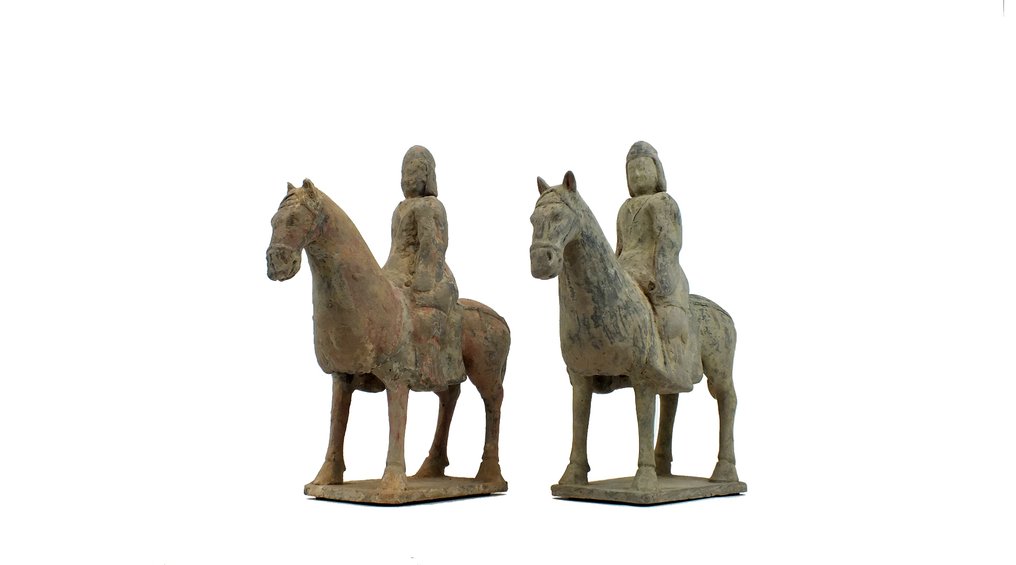
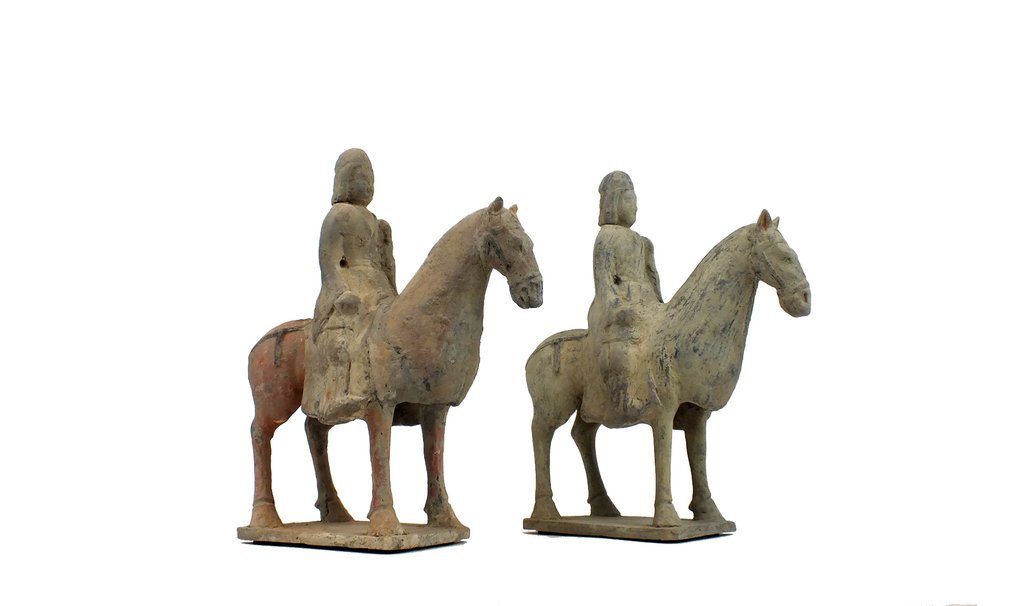
Ancient Chinese, Northern Wei Terracotta Extremely Rare Pair of Pottery Figures of Mounted Warriors, Conducting a Military Orchestra, N. TL - 29 cm



Opens 11:00
Starting bid
€ 1
Add to your favourites to get an alert when the auction starts.

Expert
Selected by Ruth Garrido Vila
Directed the Ifergan Collection Museum, specialising in Phoenician and Mediterranean archaeology.
Estimate € 5,000 - € 6,500
Catawiki Buyer Protection
Your payment’s safe with us until you receive your object.View details
Trustpilot 4.4 | 121798 reviews
Rated Excellent on Trustpilot.
Description from the seller
Terracotta, Earthenware with pigment
Northern Wei Dynasty (386-535)
Height: 29 cm. Width: 25 cm. each
Original colour! Very important.
Each of the horses is mounted with a saddle upon which sits a warrior wearing a hood with round top (fengmao) and a tunic with an overlapping front. The pair of shaking drums (taogu) in their hands suggests that they are conducting a military orchestra. They are probably members of the guard of honor to the N. wei dynasty.
-Provenance: Old private collection, London, UK
-Note from the expert: the warriors conducting a military orchestra are masterpieces and very rare regarding its style, details, original pigment and period (N. wei dynasty).
– The results of thermoluminescence tests are consistent with the dating of this object. N. Wei dynasty (ca. 1590 years old). Sampling in 3 different points.
– Extra test: Pre-dose test has been done: Pre-dose test confirms old firing without any kind of artificial x-ray treatments!
This horses and riders are moulded in a dark and fine-grained terracotta. The horse are typical of this era with a very broad chest and short strong legs attached to a terrace. The riders is outfitted in traditional attire consisting of a crossed tunic that falls over leggings. One finds here the characteristic silhouette of the Wei, very clearly drawn upwards with a perfectly flat back.
Note: It will be professionally packed and safely sent in a wooden crate within 3 working days by FedEx. Shipped with Insurance!
The Wei dynasty was founded by people of Turkish-Mongol origin known as the Tabghatch or Toba, who broke with the Han people who represent the main strain of population in China. As followers of the Taoist faith, this was a hard people whose crown prince asked his mother to commit suicide when he ascended to the throne. The Northern Dynasties Beichao 北朝 (386-581) is a series of dynasties that ruled over northern China, while the south was ruled by the so-called Southern dynasties南朝 (420~589). Both groups of dynasties are called the Southern and Northern dynastiesNanbeichao 南北朝 (300~600). The period of the Northern Dynasties begins either with the foundation of the non-Chinese Northern Wei dynasty in 386, or in 439, the year of the reunification of northern China by the Northern Wei, and ends with the foundation of the Sui dynasty隋 (581-618) that eventually reunited the whole of China. The 5th and 6th century is therefore called the era of the Southern and Northern dynasties南北朝 (300~600). Except those of the Northern Qi Dynasties北齊 (550-577), all rulers of the Northern Dynasties belonged to the people of the Tabac拓跋, a tribe of the steppe federation of the Xianbei鮮卑. Their dynasties were the Northern Wei北魏 (386-534), Western Wei西魏 (535-556) and Eastern Wei東魏 (534-550), and the Northern Wei北周 (557-581).
Three Kingdoms, Jin Dynasty, Northern and Southern Dynasties (Six Dynasties) 220 – 589 A.D.
During the Northern dynasties period, increased contact between the people of China and the northwest frontier brought about cultural exchange between the two regions. Pottery sculptures of this period show distinct influence from outside China. Sculptures of camel become increasingly common: figurines of foreigner, civil officials, horses, and warriors. Equestrian themes showing warriors mounted on armoured horses also prevailed.
The types of burial figurines used during the Northern Qi dynasty were similar to those of the Northern and Eastern Wei dynasties. Warriors, attendants, musicians, dancers, and tomb guardians in the form of divine beasts constitute the bulk of the figurines but particularly interesting are the armoured horses and mounted musicians among the tomb master’s guards of honour.
- A Certificate of Authenticity from Becker Antiques (specialist in Chinese pottery since 1969, Amsterdam) will accompany the item.
Condition: Very good condition. Wear consistent with the age, some loss of color. Please be advised that all ancient Chinese pottery objects had been buried in tombs and are excavated from there. Therefore, they can always have some restorations. Also worth of note is that the item is more than 1600 years old.
Important information.
The seller guarantees that he is entitled to ship this lot.
It will be professionally packed and safely sent in a wooden crate by FedEx.
Buyers are responsible for import regulation and restrictions of their own country
Seller's Story
Becker Antiques is one of the most respected and established antique dealers in the Netherlands. Known for excellence in both fine antiques and personalized service, Becker Antiques has earned an international reputation for quality and expertise.
Founded in 1966 by Jan Simon Becker, the gallery is located in Amsterdam’s prestigious Museum Quarter (Oud-Zuid), just minutes from the Rijksmuseum, the Van Gogh Museum, and the renowned Royal Concert Hall, “Koninklijk Concertgebouw.” Housed in a stunning five-storey mansion built in 1891, Becker Antiques offers a truly memorable setting for discovering art and history.
Our primary specialty lies in ceramics—especially pottery tomb figures from the Han to Ming Dynasties—along with Buddhist sculptures and rare Chinese artworks. We also offer a curated selection of Asian art from Japan and Southeast Asia, including bronze, stone, and wooden sculptures, as well as Qing Dynasty Chinese furniture and other unique finds.
For over 59 years, we have proudly served museums, private collectors, and dealers worldwide, offering not only antiques of the highest caliber but also the knowledge and passion that bring them to life.
Terracotta, Earthenware with pigment
Northern Wei Dynasty (386-535)
Height: 29 cm. Width: 25 cm. each
Original colour! Very important.
Each of the horses is mounted with a saddle upon which sits a warrior wearing a hood with round top (fengmao) and a tunic with an overlapping front. The pair of shaking drums (taogu) in their hands suggests that they are conducting a military orchestra. They are probably members of the guard of honor to the N. wei dynasty.
-Provenance: Old private collection, London, UK
-Note from the expert: the warriors conducting a military orchestra are masterpieces and very rare regarding its style, details, original pigment and period (N. wei dynasty).
– The results of thermoluminescence tests are consistent with the dating of this object. N. Wei dynasty (ca. 1590 years old). Sampling in 3 different points.
– Extra test: Pre-dose test has been done: Pre-dose test confirms old firing without any kind of artificial x-ray treatments!
This horses and riders are moulded in a dark and fine-grained terracotta. The horse are typical of this era with a very broad chest and short strong legs attached to a terrace. The riders is outfitted in traditional attire consisting of a crossed tunic that falls over leggings. One finds here the characteristic silhouette of the Wei, very clearly drawn upwards with a perfectly flat back.
Note: It will be professionally packed and safely sent in a wooden crate within 3 working days by FedEx. Shipped with Insurance!
The Wei dynasty was founded by people of Turkish-Mongol origin known as the Tabghatch or Toba, who broke with the Han people who represent the main strain of population in China. As followers of the Taoist faith, this was a hard people whose crown prince asked his mother to commit suicide when he ascended to the throne. The Northern Dynasties Beichao 北朝 (386-581) is a series of dynasties that ruled over northern China, while the south was ruled by the so-called Southern dynasties南朝 (420~589). Both groups of dynasties are called the Southern and Northern dynastiesNanbeichao 南北朝 (300~600). The period of the Northern Dynasties begins either with the foundation of the non-Chinese Northern Wei dynasty in 386, or in 439, the year of the reunification of northern China by the Northern Wei, and ends with the foundation of the Sui dynasty隋 (581-618) that eventually reunited the whole of China. The 5th and 6th century is therefore called the era of the Southern and Northern dynasties南北朝 (300~600). Except those of the Northern Qi Dynasties北齊 (550-577), all rulers of the Northern Dynasties belonged to the people of the Tabac拓跋, a tribe of the steppe federation of the Xianbei鮮卑. Their dynasties were the Northern Wei北魏 (386-534), Western Wei西魏 (535-556) and Eastern Wei東魏 (534-550), and the Northern Wei北周 (557-581).
Three Kingdoms, Jin Dynasty, Northern and Southern Dynasties (Six Dynasties) 220 – 589 A.D.
During the Northern dynasties period, increased contact between the people of China and the northwest frontier brought about cultural exchange between the two regions. Pottery sculptures of this period show distinct influence from outside China. Sculptures of camel become increasingly common: figurines of foreigner, civil officials, horses, and warriors. Equestrian themes showing warriors mounted on armoured horses also prevailed.
The types of burial figurines used during the Northern Qi dynasty were similar to those of the Northern and Eastern Wei dynasties. Warriors, attendants, musicians, dancers, and tomb guardians in the form of divine beasts constitute the bulk of the figurines but particularly interesting are the armoured horses and mounted musicians among the tomb master’s guards of honour.
- A Certificate of Authenticity from Becker Antiques (specialist in Chinese pottery since 1969, Amsterdam) will accompany the item.
Condition: Very good condition. Wear consistent with the age, some loss of color. Please be advised that all ancient Chinese pottery objects had been buried in tombs and are excavated from there. Therefore, they can always have some restorations. Also worth of note is that the item is more than 1600 years old.
Important information.
The seller guarantees that he is entitled to ship this lot.
It will be professionally packed and safely sent in a wooden crate by FedEx.
Buyers are responsible for import regulation and restrictions of their own country
Seller's Story
Becker Antiques is one of the most respected and established antique dealers in the Netherlands. Known for excellence in both fine antiques and personalized service, Becker Antiques has earned an international reputation for quality and expertise.
Founded in 1966 by Jan Simon Becker, the gallery is located in Amsterdam’s prestigious Museum Quarter (Oud-Zuid), just minutes from the Rijksmuseum, the Van Gogh Museum, and the renowned Royal Concert Hall, “Koninklijk Concertgebouw.” Housed in a stunning five-storey mansion built in 1891, Becker Antiques offers a truly memorable setting for discovering art and history.
Our primary specialty lies in ceramics—especially pottery tomb figures from the Han to Ming Dynasties—along with Buddhist sculptures and rare Chinese artworks. We also offer a curated selection of Asian art from Japan and Southeast Asia, including bronze, stone, and wooden sculptures, as well as Qing Dynasty Chinese furniture and other unique finds.
For over 59 years, we have proudly served museums, private collectors, and dealers worldwide, offering not only antiques of the highest caliber but also the knowledge and passion that bring them to life.
Details
Culture
Ancient Chinese, Northern Wei
Century/ Timeframe
Northern Wei dynasty (386–534/535 CE)
Name of object
Extremely Rare Pair of Pottery Figures of Mounted Warriors, Conducting a Military Orchestra, N. TL
Acquired from
Private collection
Year acquired
2024
Material
Terracotta
Country acquired from
United Kingdom
Condition
Very good
Previous owner acquired from
Gallery / Antique dealer
Height
29 cm
Previous owner - year acquired
2002
Width
25 cm
Previous owner - country acquired from
United Kingdom
I verify that I have obtained this object legally and that I am allowed to sell it
Yes
Sold by
Disclaimer
The seller was informed by Catawiki about documentation requirements and guarantees the following: - the object was legally obtained, - the seller has the right to sell and/or export the object, as relevant, - the seller will provide the necessary provenance information and arrange required documentation and permits/licenses, as applicable and as per local laws, - the seller will notify the buyer of any delays in obtaining permits/licenses. By bidding, you acknowledge that import documentation may be required depending on your country of residence and that obtaining permits/licenses may cause delays in the delivery of your object.
The seller was informed by Catawiki about documentation requirements and guarantees the following: - the object was legally obtained, - the seller has the right to sell and/or export the object, as relevant, - the seller will provide the necessary provenance information and arrange required documentation and permits/licenses, as applicable and as per local laws, - the seller will notify the buyer of any delays in obtaining permits/licenses. By bidding, you acknowledge that import documentation may be required depending on your country of residence and that obtaining permits/licenses may cause delays in the delivery of your object.
