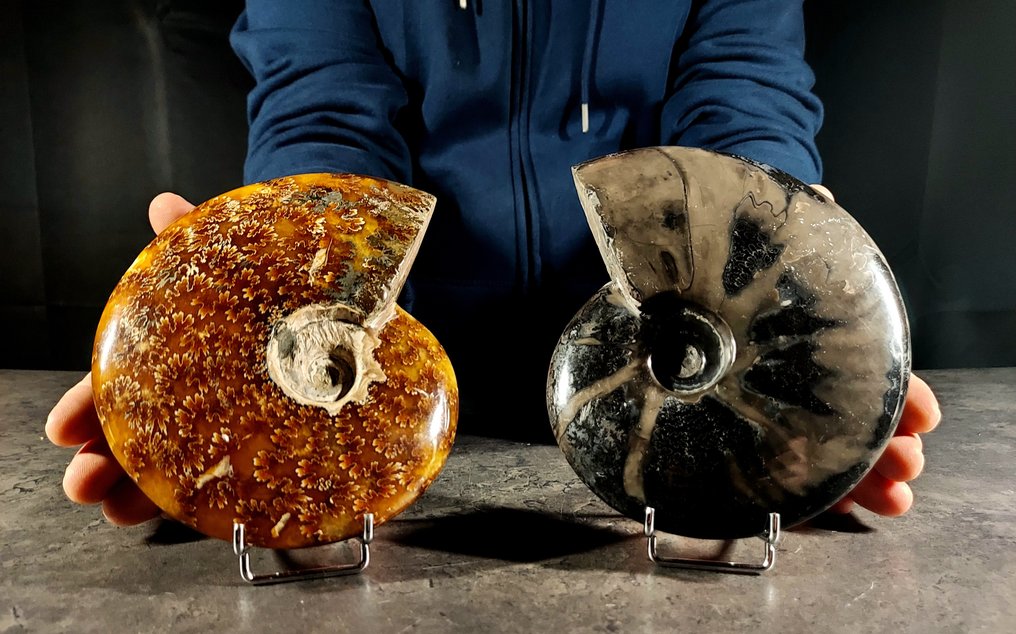
warned - Fossilised animal - cleoniceras + cleoniceras con ematite - 160 mm - 125 mm



02
days
13
hours
17
minutes
18
seconds

No bids placed
Catawiki Buyer Protection
Your payment’s safe with us until you receive your object.View details
Trustpilot 4.4 | 122028 reviews
Rated Excellent on Trustpilot.
Two ammonite specimens, Cleoniceras and Cleoniceras con ematite, from the Devonian period (419.2–358.9 Ma) Madagascar, polished and in natural condition.
AI-assisted summary
Description from the seller
A very important fossil group from the Devonian-Cretaceous period. Completely extinct by the end of the Cretaceous, it is believed to have descended from ancestors belonging to Nautiloidea. Although part of the mollusk cephalopod group, CLEONICERAS is distinguished mainly by the shape of its shell, characterized by bilateral symmetry. The shell is divided into an anterior, undivided region where the animal resided, and a posterior region divided into chambers. The line of closure between the chambers is highly indicative and facilitates species recognition. Additionally, its outline, initially quite simple and linear in early forms, gradually changed until the more recent ammonites, which are often very jagged and almost baroque. Sizes vary: from a few centimeters to as much as 10 centimeters. Since these are entirely extinct marine species, we can only hypothesize about their lifestyle. It is believed that forms with smooth shells on the outside were swimmers, often predators. Species with more costate and ornamented shells were predominantly benthic.
Unmissable lot consisting of two splendid examples of worked Cleoniceras, one of which has the dark color typical of hematite.
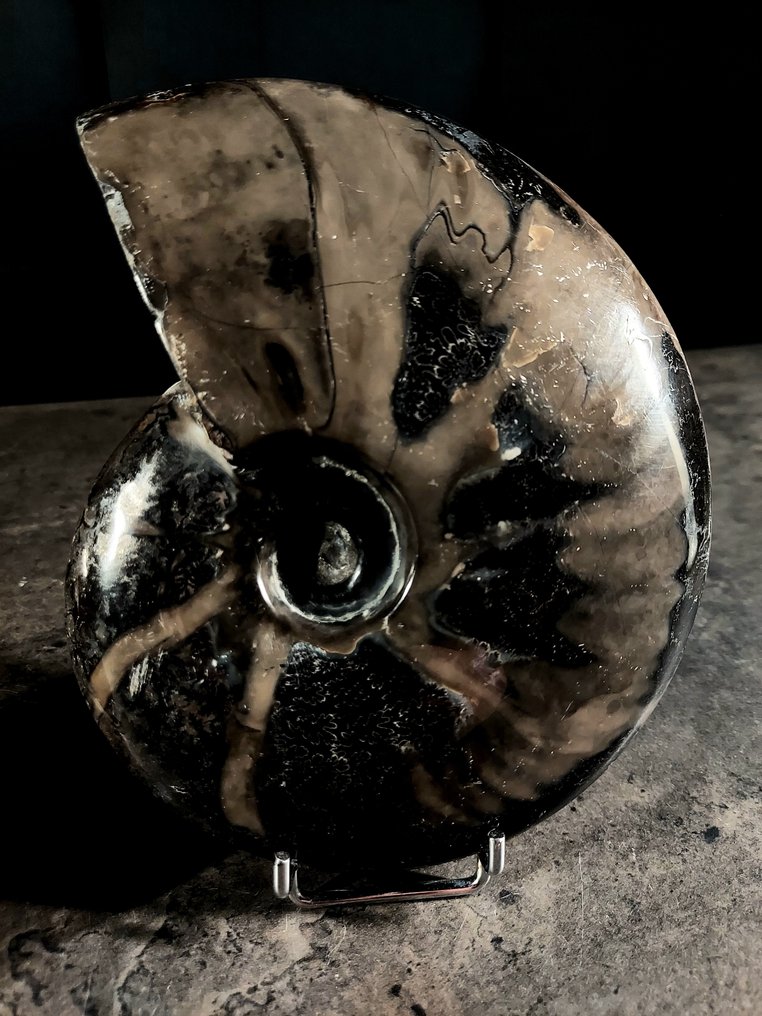
Looking at the outside of these beautiful fossils, the characteristic suture lines of the species are clearly visible, intertwining in a pattern reminiscent of the sinuous movements of flames.
Two true masterpieces.
Cleoniceras: 125mm x 160mm x 40mm
Cleoniceras with hematite: 123mm x 155mm x 35mm.
Pedestals not included.
Seller's Story
We deal with naturalistic objects in
Prevalence coming from the fascinating
marine world, but by enthusiasts and
Lovers of enchanting facets.
Of life, we also propose minerals and.
metaphysical stones, taxidermies, fossils, and
decorative objects
A continuous journey through time and...
Space for the search for testimonies.
Precious.
Passion is the fire that fuels.
Our choices: collaborations with the
Major importers from exotic countries.
but also travels to discover sought-after destinations
objects
Ongoing research of new developments and
Our increasingly refined aesthetic.
main objectives
Just observe like a collector.
He manages the objects in his display case.
As soon as he/she/they take(s) one in hand, the
His or her inspired gaze seems to pierce through.
The object is to lose oneself in its distances.
Here lies the magical side of the collector.
Walter Benjamin
Translated by Google TranslateA very important fossil group from the Devonian-Cretaceous period. Completely extinct by the end of the Cretaceous, it is believed to have descended from ancestors belonging to Nautiloidea. Although part of the mollusk cephalopod group, CLEONICERAS is distinguished mainly by the shape of its shell, characterized by bilateral symmetry. The shell is divided into an anterior, undivided region where the animal resided, and a posterior region divided into chambers. The line of closure between the chambers is highly indicative and facilitates species recognition. Additionally, its outline, initially quite simple and linear in early forms, gradually changed until the more recent ammonites, which are often very jagged and almost baroque. Sizes vary: from a few centimeters to as much as 10 centimeters. Since these are entirely extinct marine species, we can only hypothesize about their lifestyle. It is believed that forms with smooth shells on the outside were swimmers, often predators. Species with more costate and ornamented shells were predominantly benthic.
Unmissable lot consisting of two splendid examples of worked Cleoniceras, one of which has the dark color typical of hematite.
Looking at the outside of these beautiful fossils, the characteristic suture lines of the species are clearly visible, intertwining in a pattern reminiscent of the sinuous movements of flames.
Two true masterpieces.
Cleoniceras: 125mm x 160mm x 40mm
Cleoniceras with hematite: 123mm x 155mm x 35mm.
Pedestals not included.
Seller's Story
We deal with naturalistic objects in
Prevalence coming from the fascinating
marine world, but by enthusiasts and
Lovers of enchanting facets.
Of life, we also propose minerals and.
metaphysical stones, taxidermies, fossils, and
decorative objects
A continuous journey through time and...
Space for the search for testimonies.
Precious.
Passion is the fire that fuels.
Our choices: collaborations with the
Major importers from exotic countries.
but also travels to discover sought-after destinations
objects
Ongoing research of new developments and
Our increasingly refined aesthetic.
main objectives
Just observe like a collector.
He manages the objects in his display case.
As soon as he/she/they take(s) one in hand, the
His or her inspired gaze seems to pierce through.
The object is to lose oneself in its distances.
Here lies the magical side of the collector.
Walter Benjamin
Translated by Google TranslateDetails
Number of items
2
Specimen
warned
Scientific name
cleoniceras + cleoniceras con ematite
Country of Origin
Madagascar
Geological Period
Devonian (419.2 - 358.9 million years)
Condition
Natural
Treatment
Polished
Weight
740 g
Height
160 mm
Width
125 mm
Depth
40 mm