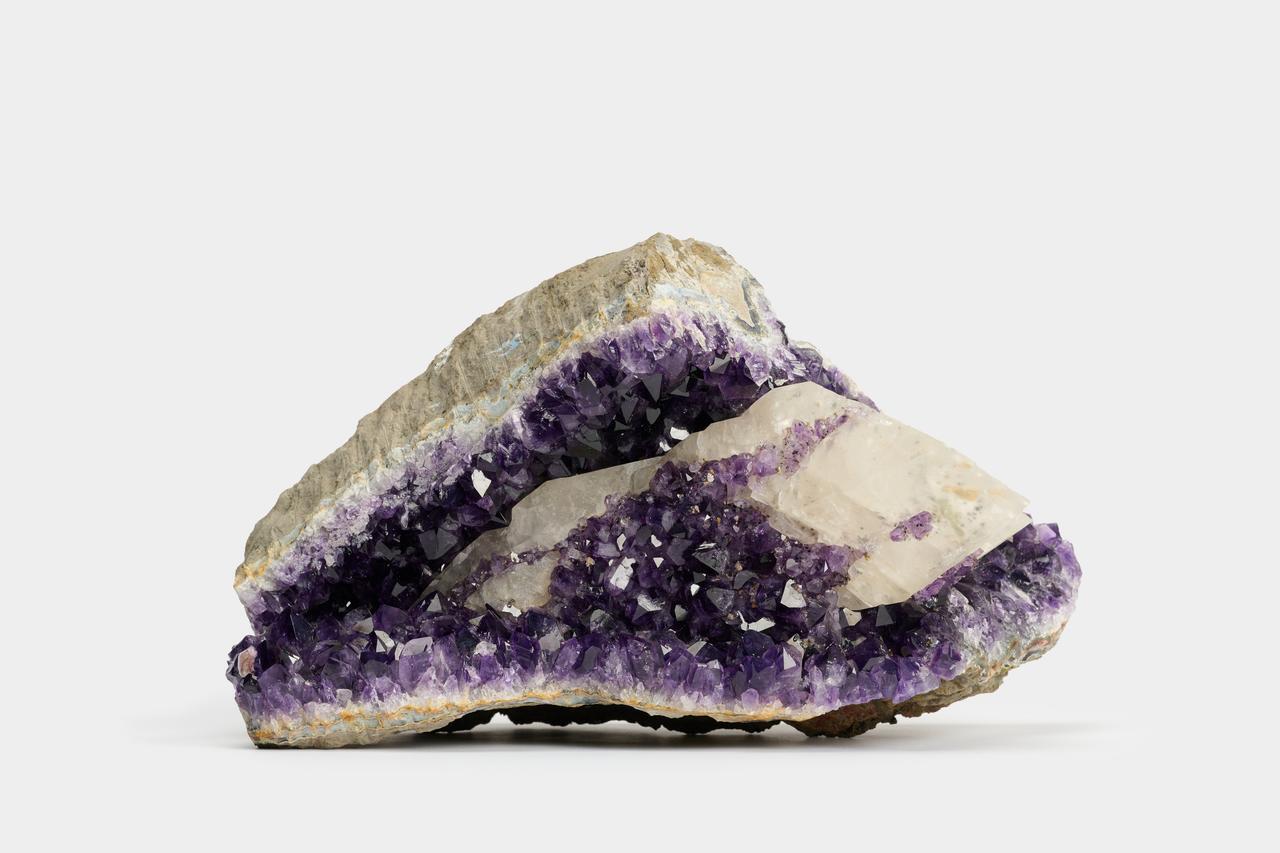
The RARE Orbicular Oceanic Jasper of Madagascar Ocean Jasper – Orbicular Ocean Jasper Block from the 4th Vein - Height: 290 mm - Width: 240 mm- 15520 g


02
days
22
hours
11
minutes
41
seconds
Current bid
€ 2
Reserve price not met

Expert
Selected by Antonio Rapisarda
Holds a master’s in chemistry with 25 years’ experience in minerals consulting.
Estimate € 3,600 - € 4,000
6 other people are watching this object
 Bidder 2514 Bidder 2514 | €2 | |
|---|---|---|
 Bidder 0377 Bidder 0377 | €1 |
Catawiki Buyer Protection
Your payment’s safe with us until you receive your object.View details
Trustpilot 4.4 | 122713 reviews
Rated Excellent on Trustpilot.
Description from the seller
This large block of Ocean Jasper from the fourth vein is one of those pieces that seem to tell the geology of Madagascar on their own. An ancient, volcanic land sculpted by oceans that advance and retreat, by slow magmatic intrusions like deep breaths, and by geothermal processes that seem devised by a visionary mind. Ocean Jasper is born only here, along the northwestern coast of the island, between Marovato and Kabamby. In this remote stretch, for millions of years, tiny cavities within basalts filled with silica-rich solutions. As they cooled slowly, these fluids gave rise to spheroid structures—the orbs—small three-dimensional spheres of chalcedony that, once cut, reveal surprising patterns: concentric circles, flowers, stars, fans, radial bands, and, in the more open zones, perfectly formed quartz crystals. Among the eight veins discovered at Marovato, the 4th vein is remembered as one of the most irregular: not a continuous lode, but a succession of chambers, pockets, and segments where silica, oxides, clays, and basaltic residues alternate like a natural mosaic. This very discontinuity has generated some of the most fascinating patterns of the entire deposit: forest-green orbiculations with soft edges, ochre and orange zones created by iron oxidation, cavities filled with quartz with fan-like growths, and textures reminiscent of biological forms, almost as if ancient petrified colonies. The orbicular structure of Ocean Jasper arises from a process called spherulitization: tiny silica particles begin to crystallize from a central point and grow in all directions like spokes of a wheel. When multiple spherulites develop side by side, they compress each other, creating complex geometries: irregular polygons similar to honeycombs, star-shaped flowers, concentric rings, and orbiculations with multiple color layers. Every pattern we see on the surface is, in fact, the two-dimensional cut of a spherical body hidden within the stone. The coast of Marovato is a unique place: black basalts sculpted by the sea, fractures filled with hydrothermal fluids from the Miocene epoch, silica intrusions into volcanic cavities, and long oxidation cycles that colored the material in intense greens, yellows, and oranges. Ocean Jasper was extracted only at low tide because the deposit emerged directly on the cliff face, facing the ocean. Today, the mine is completely exhausted, and every large block from this vein represents a chapter now closed in Madagascar's geological history. The 4th vein is famous for its double character: densely packed zones of orbiculations alongside open pockets of quartz, as if the stone preserved both order and chaos, structure and improvisation. A jasper that does not exist anywhere else in the world and that makes each specimen from this vein absolutely unique.
Seller's Story
The Mineral Art Gallery offers minerals, fossils, shells and natural elements.
Born in Italy in 2017, today she collaborates with international galleries and collectors, she is a direct importer of large minerals and naturalistic collectible elements; deals with the processing to insert them inside the living space. A section of the gallery was dedicated to the Wunderkammer, "chamber of wonders or cabinet of curiosities" in which Mirabilia elements are presented: naturalia and italiania, a union between "the present is the past".
All lots are shipped via DHL Express and Fercam couriers, with insured parcel and tracking.
Translated by Google TranslateThis large block of Ocean Jasper from the fourth vein is one of those pieces that seem to tell the geology of Madagascar on their own. An ancient, volcanic land sculpted by oceans that advance and retreat, by slow magmatic intrusions like deep breaths, and by geothermal processes that seem devised by a visionary mind. Ocean Jasper is born only here, along the northwestern coast of the island, between Marovato and Kabamby. In this remote stretch, for millions of years, tiny cavities within basalts filled with silica-rich solutions. As they cooled slowly, these fluids gave rise to spheroid structures—the orbs—small three-dimensional spheres of chalcedony that, once cut, reveal surprising patterns: concentric circles, flowers, stars, fans, radial bands, and, in the more open zones, perfectly formed quartz crystals. Among the eight veins discovered at Marovato, the 4th vein is remembered as one of the most irregular: not a continuous lode, but a succession of chambers, pockets, and segments where silica, oxides, clays, and basaltic residues alternate like a natural mosaic. This very discontinuity has generated some of the most fascinating patterns of the entire deposit: forest-green orbiculations with soft edges, ochre and orange zones created by iron oxidation, cavities filled with quartz with fan-like growths, and textures reminiscent of biological forms, almost as if ancient petrified colonies. The orbicular structure of Ocean Jasper arises from a process called spherulitization: tiny silica particles begin to crystallize from a central point and grow in all directions like spokes of a wheel. When multiple spherulites develop side by side, they compress each other, creating complex geometries: irregular polygons similar to honeycombs, star-shaped flowers, concentric rings, and orbiculations with multiple color layers. Every pattern we see on the surface is, in fact, the two-dimensional cut of a spherical body hidden within the stone. The coast of Marovato is a unique place: black basalts sculpted by the sea, fractures filled with hydrothermal fluids from the Miocene epoch, silica intrusions into volcanic cavities, and long oxidation cycles that colored the material in intense greens, yellows, and oranges. Ocean Jasper was extracted only at low tide because the deposit emerged directly on the cliff face, facing the ocean. Today, the mine is completely exhausted, and every large block from this vein represents a chapter now closed in Madagascar's geological history. The 4th vein is famous for its double character: densely packed zones of orbiculations alongside open pockets of quartz, as if the stone preserved both order and chaos, structure and improvisation. A jasper that does not exist anywhere else in the world and that makes each specimen from this vein absolutely unique.
Seller's Story
The Mineral Art Gallery offers minerals, fossils, shells and natural elements.
Born in Italy in 2017, today she collaborates with international galleries and collectors, she is a direct importer of large minerals and naturalistic collectible elements; deals with the processing to insert them inside the living space. A section of the gallery was dedicated to the Wunderkammer, "chamber of wonders or cabinet of curiosities" in which Mirabilia elements are presented: naturalia and italiania, a union between "the present is the past".
All lots are shipped via DHL Express and Fercam couriers, with insured parcel and tracking.
Translated by Google TranslateDetails
Main Mineral
The RARE Orbicular Oceanic Jasper of Madagascar
Mineral Form
Ocean Jasper – Orbicular Ocean Jasper Block from the 4th Vein
Weight
15520 g
Country of Origin
Madagascar
Height
290 mm
Width
240 mm
Depth
130 mm
Sold by