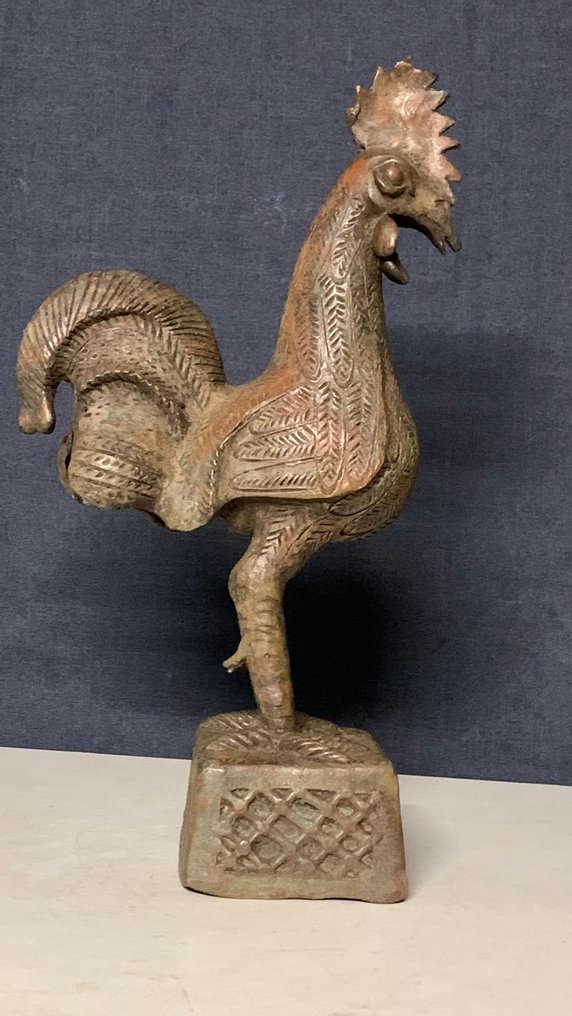
Rare et exceptionnelle personnage coq - Figurehead - Royal Rooster - thousand and one - Nigeria (No reserve price)




01
day
15
hours
14
minutes
17
seconds
Current bid
€ 44
No reserve price

Expert
Selected by Julien Gauthier
With almost a decade of experience bridging science, museum curation, and traditional blacksmithing, Julien has developed a unique expertise in historical arms, armour, and African art.
Estimate € 170 - € 200
32 other people are watching this object
 Bidder 9297 Bidder 9297 | €44 | |
|---|---|---|
 Bidder 9954 Bidder 9954 | €39 | |
 Bidder 8956 Bidder 8956 | €34 | |
Catawiki Buyer Protection
Your payment’s safe with us until you receive your object.View details
Trustpilot 4.4 | 122115 reviews
Rated Excellent on Trustpilot.
Rare and exceptional bronze Coq royal figure from Nigeria, belonging to the Bini Edo culture, with provenance linked to the Edo kingdom of Benin.
AI-assisted summary
Description from the seller
was formerly called Dahomey and adopted the name Benin in 1975.
The inhabitants of this ancient kingdom are known as the Edo (the Edos), as is their language (Edo), but later, the Edos were called the Binis, who spoke Bini.
According to legends, the Edos came from the sky, but according to historical realities, their homeland could be either Ifès or Sudan.
Historically, the Kingdom of Benin was founded by its first dynasty around 900 AD, but this kingdom reached its peak in the 16th century under the reign of the second dynasty, which was established in the city by Prince Oranmiyan from the powerful city-state of Ife during the 13th century; his son Eweka I (around 1280) was the first king (oba) of the current royal lineage. The Edo Kingdom of Benin established trade relations with Europe as early as the 15th-16th centuries; the first contacts were with the Portuguese, dating back to 1486. The Kingdom of Benin was one of the main suppliers of slaves for the Western market.
The Edo Kingdom of Benin was flourishing until February 1897, when its capital, Benin City, was besieged by a British regiment of nearly twelve hundred men supported by several hundred Africans; the British acted in this way to punish King Ovonramwen (1888 - 1914), as he posed a major obstacle to their colonial ambitions in this part of Africa. The British also conducted this military campaign in retaliation for the death of the British vice-consul, J.R. Philips, and all members of his expedition, killed by the Binis, because J.R. Philips refused to respect the ban on visiting the Oba on the day of the Igue ceremony, when he becomes a sacred deity and cannot appear to the public.
was formerly called Dahomey and adopted the name Benin in 1975.
The inhabitants of this ancient kingdom are known as the Edo (the Edos), as is their language (Edo), but later, the Edos were called the Binis, who spoke Bini.
According to legends, the Edos came from the sky, but according to historical realities, their homeland could be either Ifès or Sudan.
Historically, the Kingdom of Benin was founded by its first dynasty around 900 AD, but this kingdom reached its peak in the 16th century under the reign of the second dynasty, which was established in the city by Prince Oranmiyan from the powerful city-state of Ife during the 13th century; his son Eweka I (around 1280) was the first king (oba) of the current royal lineage. The Edo Kingdom of Benin established trade relations with Europe as early as the 15th-16th centuries; the first contacts were with the Portuguese, dating back to 1486. The Kingdom of Benin was one of the main suppliers of slaves for the Western market.
The Edo Kingdom of Benin was flourishing until February 1897, when its capital, Benin City, was besieged by a British regiment of nearly twelve hundred men supported by several hundred Africans; the British acted in this way to punish King Ovonramwen (1888 - 1914), as he posed a major obstacle to their colonial ambitions in this part of Africa. The British also conducted this military campaign in retaliation for the death of the British vice-consul, J.R. Philips, and all members of his expedition, killed by the Binis, because J.R. Philips refused to respect the ban on visiting the Oba on the day of the Igue ceremony, when he becomes a sacred deity and cannot appear to the public.
Details
Era
After 2000
Weight
4.5 kg
No. of items
1
Title
Rare et exceptionnelle personnage coq
Country of Origin
Nigeria
Material
Bronze
Ethnic group/ culture
thousand and one
Indigenous object name
Royal Rooster
Sold with stand
No
Condition
Good condition - used with small signs of aging & blemishes
Height
46 cm
Width
13 cm
Depth
46 cm
Sold by
