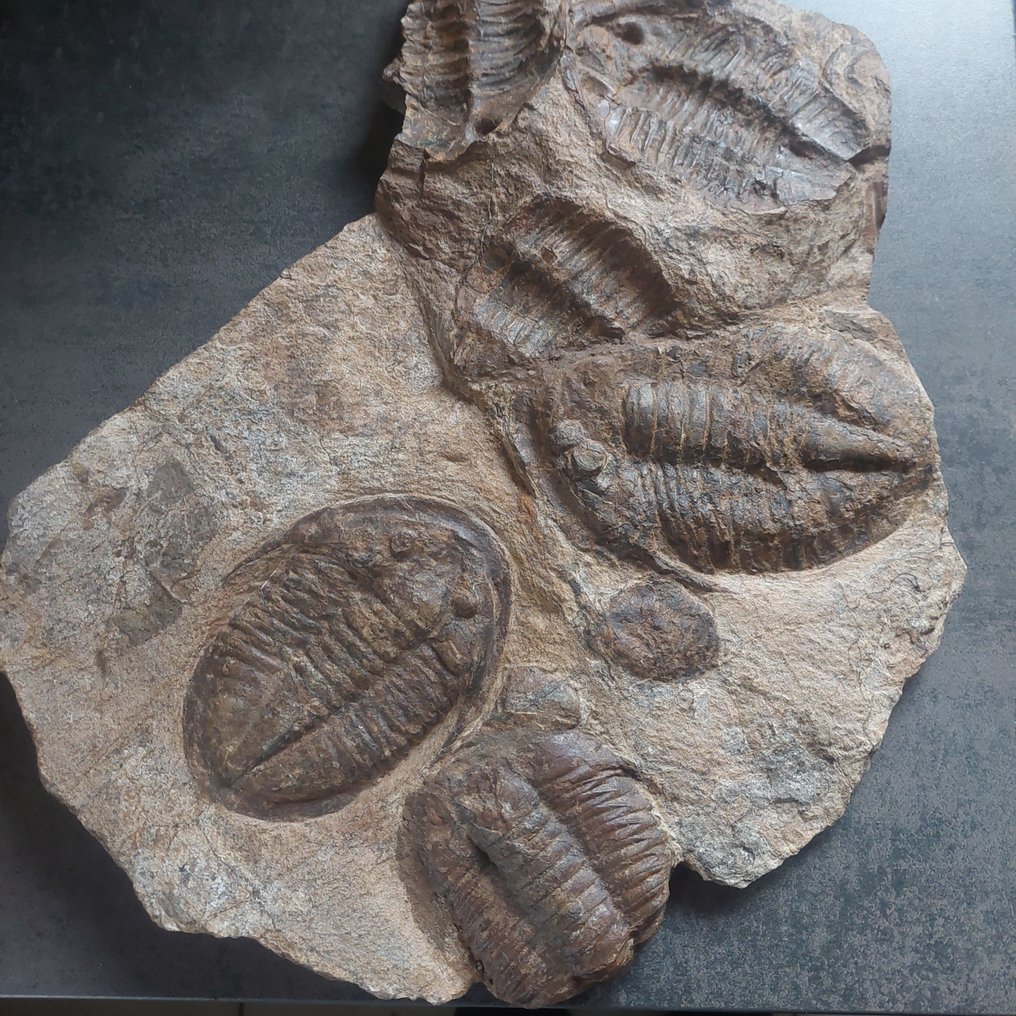
Mega large trilobite mortality plate. - Fossil mortality plate - Asaphus sp. Trilobiten-Assoziation - 410 mm - 330 mm


05
days
18
hours
49
minutes
41
seconds

No bids placed
Catawiki Buyer Protection
Your payment’s safe with us until you receive your object.View details
Trustpilot 4.4 | 122290 reviews
Rated Excellent on Trustpilot.
Asaphus sp. trilobite association on a mega-sized plate from the Ordovician, perfectly prepared and in natural condition.
AI-assisted summary
Description from the seller
Fossil: Asaphus sp., a large trilobite association from the Ordovician, in natural condition, originating from Morocco.
Locality: Ktaoua Formation - Anti-Atlas Mountains, Morocco
ALTER: ORDOVICIAN: from 488 to 443 million years ago
SIZE: 410 x 330 x 35 mm in original matrix
Length per trilobite 120 mm
Perfectly elaborately prepared plate with original fossils — no fakes!
This is an absolute museum piece.
Asaphus is a genus of extinct trilobites from the Ordovician period (approximately 500 to 450 million years ago). The trilobites lived in the seas of the then-continent Baltica. Fossils of these trilobites are mainly found in Eastern Europe. The genus Asaphus belongs to the order Asaphida. Trilobites of this genus are typically between three and ten centimeters long, with a smooth cephalon that is clearly separated from the glabellum. The segments of the pygidium are fused in this genus. The species within the genus Asaphus were benthic predators or detritivores.
These animals lived in our world's oceans long before there were even dinosaurs.
Fossil: Asaphus sp., a large trilobite association from the Ordovician, in natural condition, originating from Morocco.
Locality: Ktaoua Formation - Anti-Atlas Mountains, Morocco
ALTER: ORDOVICIAN: from 488 to 443 million years ago
SIZE: 410 x 330 x 35 mm in original matrix
Length per trilobite 120 mm
Perfectly elaborately prepared plate with original fossils — no fakes!
This is an absolute museum piece.
Asaphus is a genus of extinct trilobites from the Ordovician period (approximately 500 to 450 million years ago). The trilobites lived in the seas of the then-continent Baltica. Fossils of these trilobites are mainly found in Eastern Europe. The genus Asaphus belongs to the order Asaphida. Trilobites of this genus are typically between three and ten centimeters long, with a smooth cephalon that is clearly separated from the glabellum. The segments of the pygidium are fused in this genus. The species within the genus Asaphus were benthic predators or detritivores.
These animals lived in our world's oceans long before there were even dinosaurs.
Details
Specimen
Mega large trilobite mortality plate.
Scientific name
Asaphus sp. Trilobiten-Assoziation
Geological Period
Ordovician, Upper (458.4 - 443.8 million years)
Condition
Natural
Treatment
Perfect preparation
Weight
4500 g
Height
410 mm
Width
330 mm
Depth
35 mm
Sold by