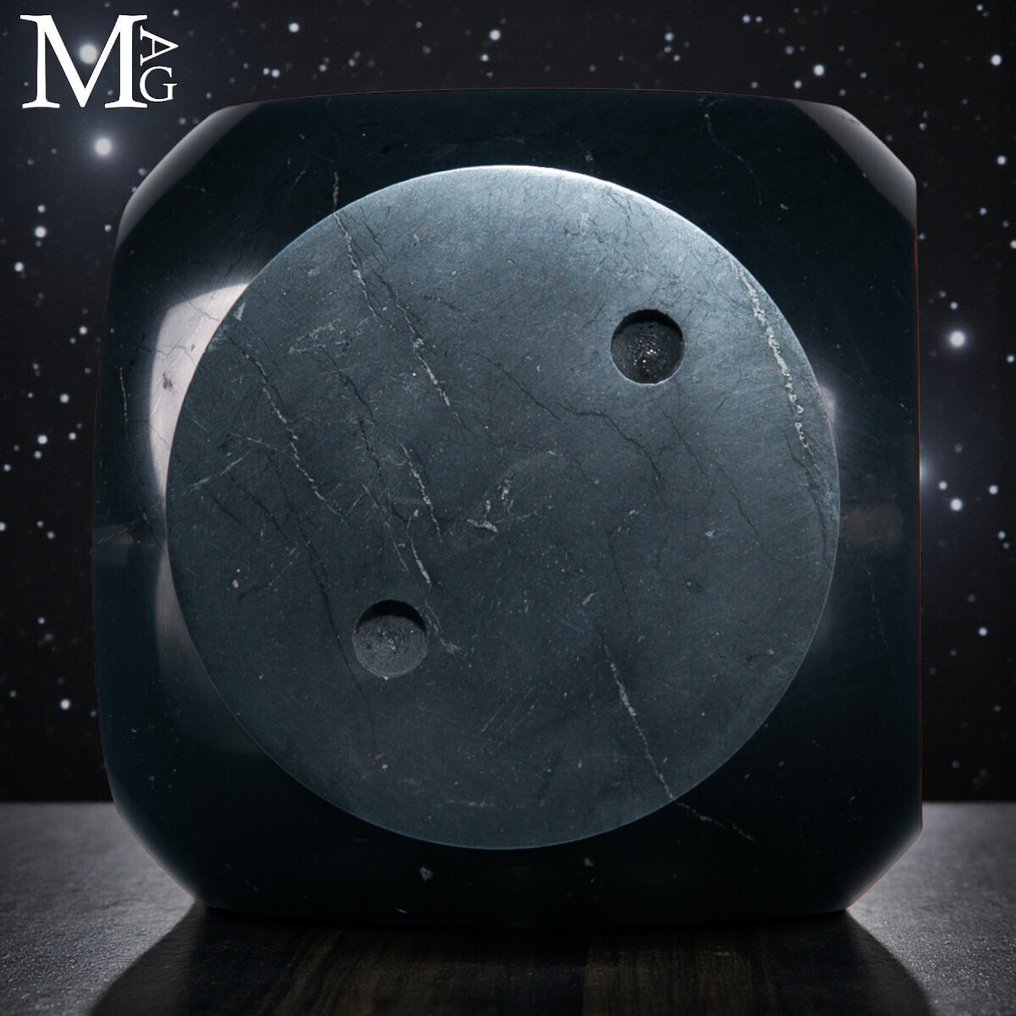
Shungite – The Stone of Primordial Carbon Shungite Dice – Archetype of Silent Destiny - Height: 65 mm - Width: 65 mm- 564 g


02
days
21
hours
19
minutes
43
seconds
Current bid
€ 10
Reserve price not met

Expert
Selected by Georgia Foteinou
Holds BSc in geology and post-graduate qualifications in geochemistry.
Estimate € 150 - € 200
1 other person has their eye on this
 Bidder 4111 Bidder 4111 | €10 | |
|---|---|---|
| Bidder 4111 | €9 | |
| Bidder 4111 | €8 | |
Catawiki Buyer Protection
Your payment’s safe with us until you receive your object.View details
Trustpilot 4.4 | 122813 reviews
Rated Excellent on Trustpilot.
Shungite Dice, an Archetype of Silent Destiny carved from a single natural block, 65 mm per side and weighing 564 g, originating from Russia and presented as a Shungite meteorite in this form.
AI-assisted summary
Description from the seller
Given in shungite, carved from a single natural block with a side length of 65 mm, this object combines geometric rigor, primordial matter, and profound symbolism. The shape of the die, a universal archetype of order, destiny, and possibility, is reinterpreted here in an essential and ancestral key, transforming from a simple playful object into a solid loaded with meaning. Shungite, a carbon-rich rock formed over two billion years ago, gives the die an intense and silent presence. The deep, opaque black, interrupted by subtle veins, microfractures, and natural marks, tells a story that predates complex life on Earth. Each face bears unique traces of geological time, making every specimen unrepeatable, never exactly identical to another. The incised dots on the faces appear as primary signs, almost symbols, evoking cycles, probabilities, choice, and fate. In this interpretation, the die does not represent chaotic chance but the encounter between order and unpredictability, between structure and movement. Shungite, known in metaphysical circles for its absorption, protection, and grounding qualities, reinforces this dimension: it does not expand but contains; it does not disperse but stabilizes.
Seller's Story
The Mineral Art Gallery offers minerals, fossils, shells and natural elements.
Born in Italy in 2017, today she collaborates with international galleries and collectors, she is a direct importer of large minerals and naturalistic collectible elements; deals with the processing to insert them inside the living space. A section of the gallery was dedicated to the Wunderkammer, "chamber of wonders or cabinet of curiosities" in which Mirabilia elements are presented: naturalia and italiania, a union between "the present is the past".
All lots are shipped via DHL Express and Fercam couriers, with insured parcel and tracking.
Translated by Google TranslateGiven in shungite, carved from a single natural block with a side length of 65 mm, this object combines geometric rigor, primordial matter, and profound symbolism. The shape of the die, a universal archetype of order, destiny, and possibility, is reinterpreted here in an essential and ancestral key, transforming from a simple playful object into a solid loaded with meaning. Shungite, a carbon-rich rock formed over two billion years ago, gives the die an intense and silent presence. The deep, opaque black, interrupted by subtle veins, microfractures, and natural marks, tells a story that predates complex life on Earth. Each face bears unique traces of geological time, making every specimen unrepeatable, never exactly identical to another. The incised dots on the faces appear as primary signs, almost symbols, evoking cycles, probabilities, choice, and fate. In this interpretation, the die does not represent chaotic chance but the encounter between order and unpredictability, between structure and movement. Shungite, known in metaphysical circles for its absorption, protection, and grounding qualities, reinforces this dimension: it does not expand but contains; it does not disperse but stabilizes.
Seller's Story
The Mineral Art Gallery offers minerals, fossils, shells and natural elements.
Born in Italy in 2017, today she collaborates with international galleries and collectors, she is a direct importer of large minerals and naturalistic collectible elements; deals with the processing to insert them inside the living space. A section of the gallery was dedicated to the Wunderkammer, "chamber of wonders or cabinet of curiosities" in which Mirabilia elements are presented: naturalia and italiania, a union between "the present is the past".
All lots are shipped via DHL Express and Fercam couriers, with insured parcel and tracking.
Translated by Google TranslateDetails
Main Mineral
Shungite – The Stone of Primordial Carbon
Mineral Form
Shungite Dice – Archetype of Silent Destiny
Supplement
TTO-90
Weight
564 g
Country of Origin
Russia
Height
65 mm
Width
65 mm
Depth
65 mm
Sold by