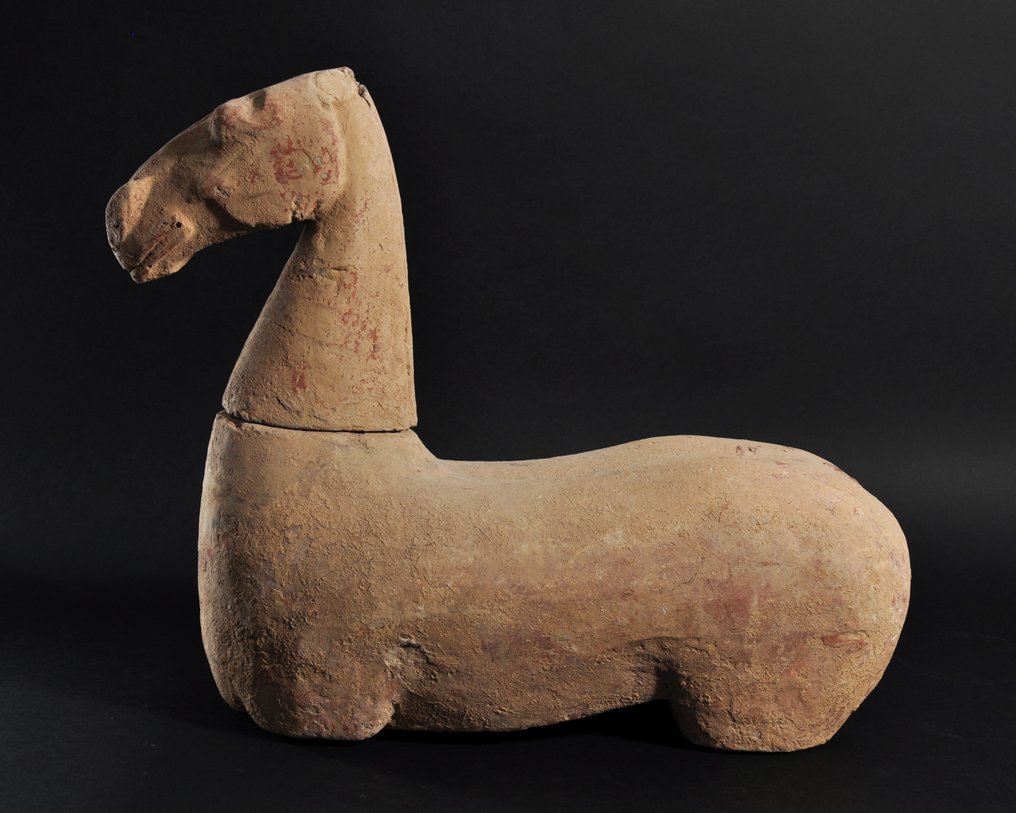
Ancient Chinese, Han dynasty Terracotta Horse body with detachable head with TL test - 43 cm


06
days
17
hours
08
minutes
05
seconds
Current bid
€ 700
Reserve price not met

Expert
Selected by Ruth Garrido Vila
Directed the Ifergan Collection Museum, specialising in Phoenician and Mediterranean archaeology.
Estimate € 2,000 - € 2,500
5 other people are watching this object
 Bidder 4842 Bidder 4842 | €700 | |
|---|---|---|
| Bidder 4842 | €650 | |
| Bidder 4842 | €600 |
Catawiki Buyer Protection
Your payment’s safe with us until you receive your object.View details
Trustpilot 4.4 | 122813 reviews
Rated Excellent on Trustpilot.
Ancient Chinese Han dynasty Terracotta horse body with detachable head, dating to 206 BC–220 AD, length 50 cm, height 43 cm, with a thermoluminescence certificate.
AI-assisted summary
Description from the seller
Han Dynasty. Horse body with detachable head (206 BC–220 AD). Terracotta. Length 50 cm. Height 43 cm. Attached QED Laboratoire thermoluminescence certificate.
The Han dynasty ruled China from 206 BC to 220 AD. Spanning over four centuries, the Han dynasty is considered a golden age in Chinese history, and it has influenced the identity of the Chinese civilization ever since. From the reign of Emperor Wu (141–87 BC) onward, the Chinese court officially sponsored Confucianism in education and court politics. He also opened the Silk Road, establishing trade with the West. The Han dynasty is notable for its concentration on organized ceramic production.
Horses are one of the most powerful symbols in Chinese folklore, being linked to the pure male strength, known as Yang. Horses were also symbol of speed, perseverance, imagination and youthful energy, and they appear to be the most represented subject in the art of imperial China. During the Han Dynasty especially, horses were treated with great esteem, being considered as the foundation of Chinese military power and an important resource for the Chinese state. One of the main reasons behind the promotion of the opening of a commercial route, which will be later knows as Silk Road, was the desire of Han emperors to acquire bigger and sturdier horses.
Attached report of analysis by thermoluminescence carried out by QED laboratory.
Provenance: Purchased by the current owner to an English Ancient Art Gallery (M.A.C).
The Supplier warrants that he obtained this lot legally. Provenance statement seen by Catawiki. Important information. The seller guarantees that he is entitled to ship this lot. The seller will take care that any necessary permits will be arranged. The seller will inform the buyer about this if this takes more than a few days.
Important: For destinations out of Spanish territory: all our objects will be shipped after obtaining CERTIFICATE OF EXPORTATION by Ministry of Culture of Spain. We inform our clients that it may take between 4-8 weeks.
Han Dynasty. Horse body with detachable head (206 BC–220 AD). Terracotta. Length 50 cm. Height 43 cm. Attached QED Laboratoire thermoluminescence certificate.
The Han dynasty ruled China from 206 BC to 220 AD. Spanning over four centuries, the Han dynasty is considered a golden age in Chinese history, and it has influenced the identity of the Chinese civilization ever since. From the reign of Emperor Wu (141–87 BC) onward, the Chinese court officially sponsored Confucianism in education and court politics. He also opened the Silk Road, establishing trade with the West. The Han dynasty is notable for its concentration on organized ceramic production.
Horses are one of the most powerful symbols in Chinese folklore, being linked to the pure male strength, known as Yang. Horses were also symbol of speed, perseverance, imagination and youthful energy, and they appear to be the most represented subject in the art of imperial China. During the Han Dynasty especially, horses were treated with great esteem, being considered as the foundation of Chinese military power and an important resource for the Chinese state. One of the main reasons behind the promotion of the opening of a commercial route, which will be later knows as Silk Road, was the desire of Han emperors to acquire bigger and sturdier horses.
Attached report of analysis by thermoluminescence carried out by QED laboratory.
Provenance: Purchased by the current owner to an English Ancient Art Gallery (M.A.C).
The Supplier warrants that he obtained this lot legally. Provenance statement seen by Catawiki. Important information. The seller guarantees that he is entitled to ship this lot. The seller will take care that any necessary permits will be arranged. The seller will inform the buyer about this if this takes more than a few days.
Important: For destinations out of Spanish territory: all our objects will be shipped after obtaining CERTIFICATE OF EXPORTATION by Ministry of Culture of Spain. We inform our clients that it may take between 4-8 weeks.
Details
Culture
Ancient Chinese, Han dynasty
Century/ Timeframe
206 BC - 220 AD
Name of object
Horse body with detachable head with TL test
Acquired from
Gallery / Antique dealer
Year acquired
2021
Material
Terracotta
Country acquired from
United Kingdom
Condition
Good
Previous owner acquired from
Private collection
Height
43 cm
Previous owner - year acquired
1990
Width
50 cm
Previous owner - country acquired from
United Kingdom
I verify that I have obtained this object legally and that I am allowed to sell it
Yes
Sold by
