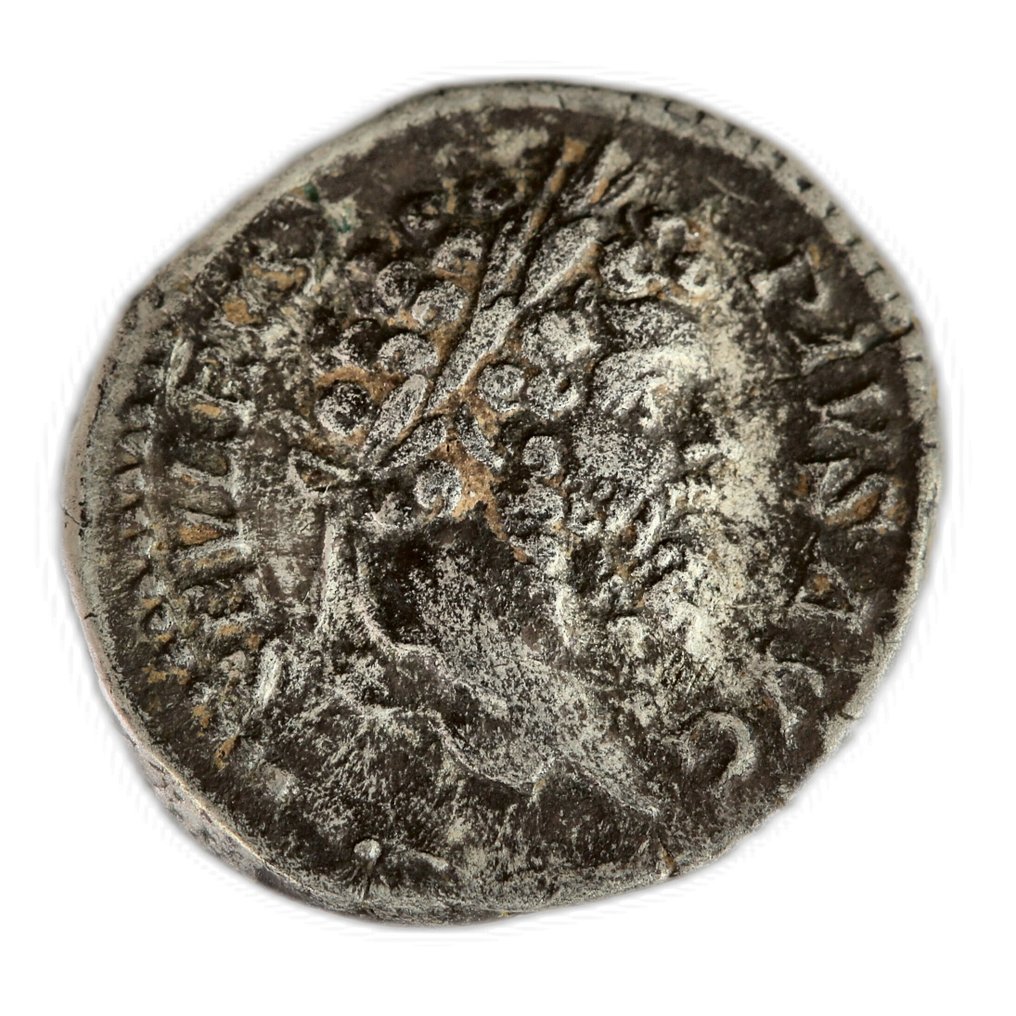
Roman Empire. Septimius Severus (AD 193-211). Denarius Rome - Emperor, togate, holding branch and short transverse sceptre



04
days
09
hours
45
minutes
51
seconds
Starting bid
€ 1
Reserve price not met

Expert
Selected by Alessandro Fiamingo
Holds a master’s degree in art history and a master’s degree in chemistry. Has over ten years of experience as a conservation scientist at the Vatican Museums.
Estimate € 150 - € 200
No bids placed
Catawiki Buyer Protection
Your payment’s safe with us until you receive your object.View details
Trustpilot 4.4 | 122473 reviews
Rated Excellent on Trustpilot.
Silver denarius from the Roman Empire featuring Septimius Severus, with obverse laureate head and the reverse scene of Severus veiled and holding a branch, 18 mm and 3.2 g, ungraded, with Certificate of Authenticity and export licence.
AI-assisted summary
Description from the seller
RULER: Septimius Severus
DATE: 218 - 222 A.D
DENOMINATION: Denarius
MATERIAL: Silver, AR
SIZE & WEIGHT: 18 mm, 3,2 gr
OBVERSE: SEVERVS PIVS AVG, laureate head of Septimius Severus to right.
REVERSE: FVNDATOR PACIS, Septimius Severus, veiled, standing front, head to left, holding branch in his right hand and roll in his left.
REFERENCES: BMC 330; Cohen 205; RIC 265.
Comes with Certificate of Authenticity and Export Licence. If you are from outside the European Union, we will have to apply for the export licence again for your country, this takes 3 to 5 weeks and has a cost of 5% of the hammer price, this amount will be added to the final invoice.
Lucius Septimius Severus (reigned 193–211 CE) was the founder of the powerful Severan dynasty and a highly significant Roman Emperor who emerged victorious from the tumultuous Year of the Five Emperors. Born in Leptis Magna, Tripolitania (modern Libya), he was the first Roman emperor from the province of Africa. Severus followed a traditional senatorial career path until the murder of Emperor Pertinax in 193 CE sparked a civil war. Leveraging his command of the Pannonian legions, he marched on Rome and seized the throne, though he then spent the next four years consolidating his power by defeating two powerful rivals: Pescennius Niger in the East and Clodius Albinus in the West. His decisive victory at the Battle of Lugdunum in 197 CE secured his undisputed control over the entire Roman Empire.
Severus’s reign was characterized by a strong emphasis on the military, recognizing that the army was the true source of imperial power in the turbulent third century. He raised soldiers' pay, granted them new privileges (such as the right to marry while still enlisted), and expanded the number of legions, famously declaring to his sons, "Enrich the soldiers and scorn all others." This policy successfully gained him the unwavering loyalty of the troops, but it placed a massive strain on the imperial treasury and fundamentally shifted the balance of power away from the Senate and towards the army. Administratively, he was a harsh but effective ruler, increasing the efficiency of the civil service and implementing legal reforms based on his own extensive legal training.
The later years of his reign were dedicated to successful military campaigns. He waged a successful war against the Parthian Empire, capturing their capital Ctesiphon and reorganizing the eastern frontier. Towards the end of his life, he traveled to Britain to deal with persistent incursions by the northern tribes. He personally led a massive expedition into Caledonia (Scotland), strengthening and expanding the defenses along Hadrian's Wall and its associated forts. Septimius Severus died in Eboracum (York) in 211 CE, having restored imperial authority and stability after years of civil strife. His final advice to his sons, Caracalla and Geta, was to "Be harmonious, enrich the soldiers, and despise all other men," a maxim that underscored the militaristic nature of his legacy.
Seller's Story
Your Antiquarian offers ancient art and ancient coins. Our main objective is to offer the highest quality at the best price respecting and strictly complying with the laws of heritage protection and UNESCO heritage norms. Therefore, all the pieces that are published come from private collections in which the provenance can be checked or international auctions. All our antiquities and coins are accompanied by their Certificate of Authenticity. We have a no quibble 90 day return policy. At Your Antiquarian we are committed to helping disadvantaged groups and for this reason a portion of each purchase is donated to charities to help people in need.
Translated by Google TranslateRULER: Septimius Severus
DATE: 218 - 222 A.D
DENOMINATION: Denarius
MATERIAL: Silver, AR
SIZE & WEIGHT: 18 mm, 3,2 gr
OBVERSE: SEVERVS PIVS AVG, laureate head of Septimius Severus to right.
REVERSE: FVNDATOR PACIS, Septimius Severus, veiled, standing front, head to left, holding branch in his right hand and roll in his left.
REFERENCES: BMC 330; Cohen 205; RIC 265.
Comes with Certificate of Authenticity and Export Licence. If you are from outside the European Union, we will have to apply for the export licence again for your country, this takes 3 to 5 weeks and has a cost of 5% of the hammer price, this amount will be added to the final invoice.
Lucius Septimius Severus (reigned 193–211 CE) was the founder of the powerful Severan dynasty and a highly significant Roman Emperor who emerged victorious from the tumultuous Year of the Five Emperors. Born in Leptis Magna, Tripolitania (modern Libya), he was the first Roman emperor from the province of Africa. Severus followed a traditional senatorial career path until the murder of Emperor Pertinax in 193 CE sparked a civil war. Leveraging his command of the Pannonian legions, he marched on Rome and seized the throne, though he then spent the next four years consolidating his power by defeating two powerful rivals: Pescennius Niger in the East and Clodius Albinus in the West. His decisive victory at the Battle of Lugdunum in 197 CE secured his undisputed control over the entire Roman Empire.
Severus’s reign was characterized by a strong emphasis on the military, recognizing that the army was the true source of imperial power in the turbulent third century. He raised soldiers' pay, granted them new privileges (such as the right to marry while still enlisted), and expanded the number of legions, famously declaring to his sons, "Enrich the soldiers and scorn all others." This policy successfully gained him the unwavering loyalty of the troops, but it placed a massive strain on the imperial treasury and fundamentally shifted the balance of power away from the Senate and towards the army. Administratively, he was a harsh but effective ruler, increasing the efficiency of the civil service and implementing legal reforms based on his own extensive legal training.
The later years of his reign were dedicated to successful military campaigns. He waged a successful war against the Parthian Empire, capturing their capital Ctesiphon and reorganizing the eastern frontier. Towards the end of his life, he traveled to Britain to deal with persistent incursions by the northern tribes. He personally led a massive expedition into Caledonia (Scotland), strengthening and expanding the defenses along Hadrian's Wall and its associated forts. Septimius Severus died in Eboracum (York) in 211 CE, having restored imperial authority and stability after years of civil strife. His final advice to his sons, Caracalla and Geta, was to "Be harmonious, enrich the soldiers, and despise all other men," a maxim that underscored the militaristic nature of his legacy.
Seller's Story
Your Antiquarian offers ancient art and ancient coins. Our main objective is to offer the highest quality at the best price respecting and strictly complying with the laws of heritage protection and UNESCO heritage norms. Therefore, all the pieces that are published come from private collections in which the provenance can be checked or international auctions. All our antiquities and coins are accompanied by their Certificate of Authenticity. We have a no quibble 90 day return policy. At Your Antiquarian we are committed to helping disadvantaged groups and for this reason a portion of each purchase is donated to charities to help people in need.
Translated by Google TranslateDetails
Era
Before 1400
Culture/region
Roman Empire
Year/Period and Variation
Rome - Emperor, togate, holding branch and short transverse sceptre
Ruler
Septimius Severus (AD 193-211)
Denomination
Denarius
Metal
AR
Condition
Ungraded
Sold by