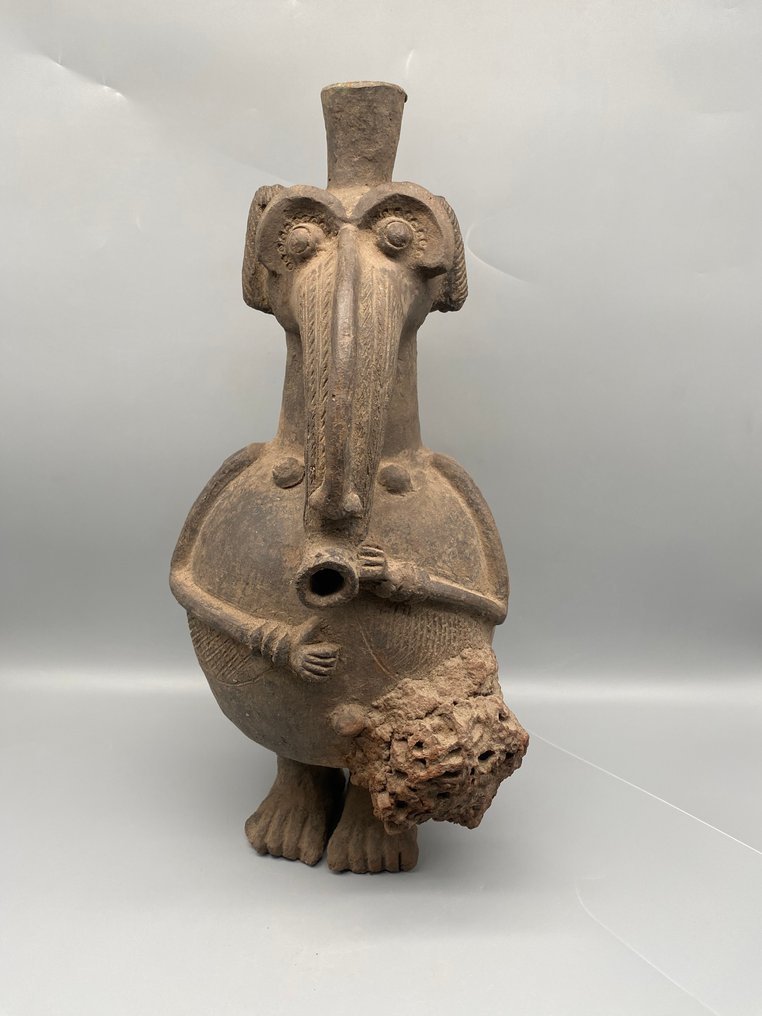
manbila - manbila - Cameroon (No reserve price)
00
days
15
hours
35
minutes
59
seconds
Current bid
€ 51
No reserve price

Julien Gauthier
Expert
Selected by Julien Gauthier

With almost a decade of experience bridging science, museum curation, and traditional blacksmithing, Julien has developed a unique expertise in historical arms, armour, and African art.

Estimate  € 80 - € 120
27 other people are watching this object

frBidder 2701 €51
nlBidder 7594 €46
frBidder 2701 €41

Catawiki Buyer Protection

Your payment’s safe with us until you receive your object.View details

Trustpilot 4.4 | 122385 reviews

Rated Excellent on Trustpilot.

Jarre anthropomorphe from Cameroon, Mambila culture, provenance Private Collection.

AI-assisted summary

Description from the seller

Jarre anthropomorphic
Despite their small number, the thirty thousand
Mambila (or Mambilla, Mambere, Nor,
Torbi, Lagubi, Tagbo, Tongbo, Bang, Ble,
Juli, Bea) (the 'men', in Fulani), settled in the northwest of Cameroon, on both sides of the Cameroon and Nigeria border, and created a large number of masks and statues easily recognizable by their heart-shaped faces. Although the Mambila believe in a creator god named
Chang ou Nama, they only venerate their ancestors. Their leaders were buried in granaries like wheat because they were believed to symbolize prosperity. The Mambila are...
Farmers mainly cultivate coffee. Their masks and statues were not to be seen by women. It was usually the women who made the ceramic vessels.

Jarre anthropomorphic
Despite their small number, the thirty thousand
Mambila (or Mambilla, Mambere, Nor,
Torbi, Lagubi, Tagbo, Tongbo, Bang, Ble,
Juli, Bea) (the 'men', in Fulani), settled in the northwest of Cameroon, on both sides of the Cameroon and Nigeria border, and created a large number of masks and statues easily recognizable by their heart-shaped faces. Although the Mambila believe in a creator god named
Chang ou Nama, they only venerate their ancestors. Their leaders were buried in granaries like wheat because they were believed to symbolize prosperity. The Mambila are...
Farmers mainly cultivate coffee. Their masks and statues were not to be seen by women. It was usually the women who made the ceramic vessels.

Details

Indigenous object name
manbila
No. of items
1
Ethnic group/ culture
manbila
Country of Origin
Cameroon
Period
2000-2010
Material
Terracotta
Sold with stand
No
Condition
Good condition
Height
51 cm
Width
24 cm
Depth
11 cm
Provenance
Private collection
FranceVerified
400
Objects sold
95.83%
Private

Similar objects

For you in

African & Tribal Art