Tamiya + Italeri - Toy Lotto Tamiya 'Germania 1943/45' con 5 kit nuovi da assemblare scala 1:35 + 1 rivista + 1 foto - 1940-1950 - Japan + Italy



04
days
05
hours
57
minutes
37
seconds

28 other people are watching this object
 Bidder 0707 Bidder 0707 | €20 | |
|---|---|---|
 Bidder 7576 Bidder 7576 | €2 |
Catawiki Buyer Protection
Your payment’s safe with us until you receive your object.View details
Trustpilot 4.4 | 123878 reviews
Rated Excellent on Trustpilot.
Description from the seller
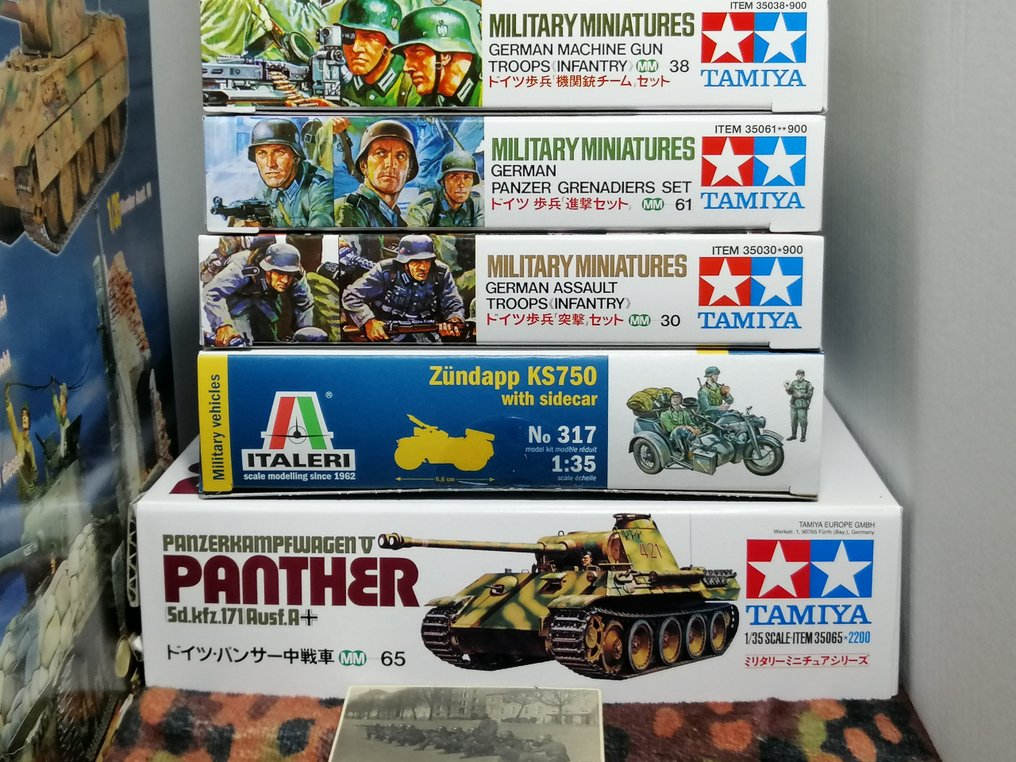
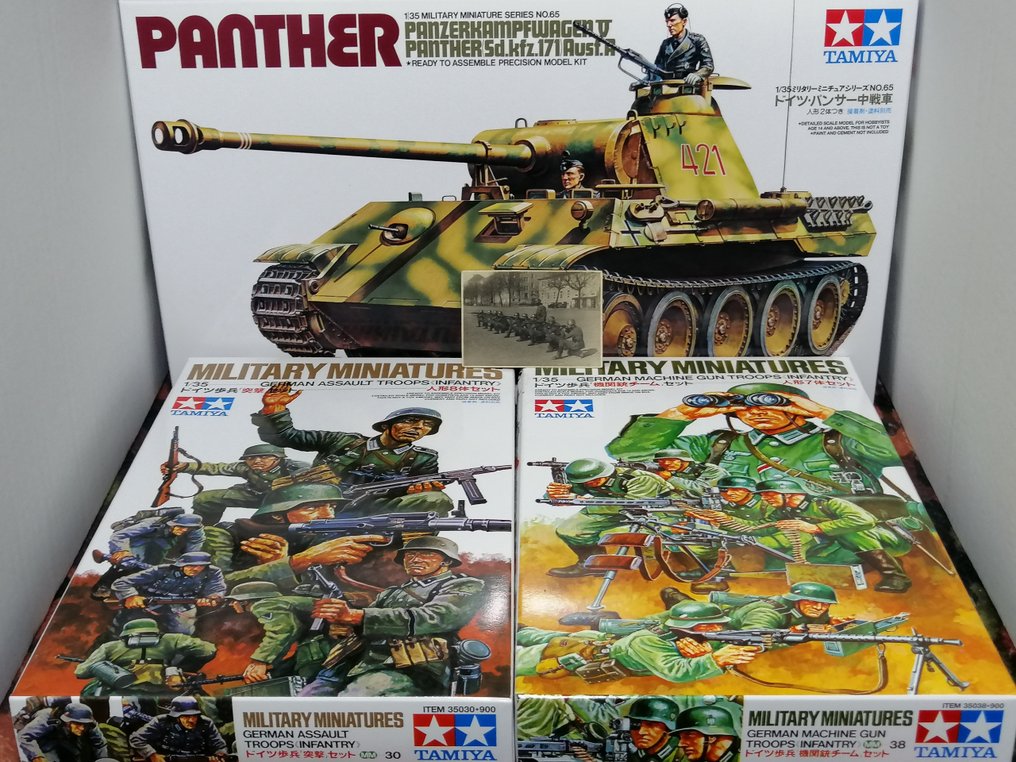
Lot of Tamiya/Italeri models from Germany 1943/1945, with 5 new kits
in plastic for assembly and painting at a 1:35 scale, for
vehicle modelers / German armed forces of the Second World War
World War + one magazine + one original photograph:
1) 1 kit with 1 Panzer + 2 figurines.
1 kit with 1 sidecar + 3 figures
1 kit of grenadiers with 8 figurines
1 assault troops kit with 8 miniatures.
1 machine gunner kit with 7 figurines.
6) A magazine of static modeling
One photograph
The lot in total includes: 1 panzer + 1 sidecar + 28 figurines + 1 magazine + 1 photograph.
Static modeling of military vehicles allows you to immerse yourself in the history and technology of the equipment used in war. You can faithfully reproduce artillery, tanks, half-tracks, tracked and rail vehicles, dedicating many hours to building models and using materials such as plastic, metal, and wood. With this hobby, you can appreciate the beauty and complexity of these vehicles, as well as their strategic importance. Your collection of finished models will be a true miniature museum, telling the story of many conflicts and battles. Discover the pleasure of building your collection of miniature static modeling of military vehicles with static modeling, and immerse yourself in the history and technology of the means used in war.
German Panzerkampfwagen IV 'Panther' (Sd.kfz.171) Ausf. A
Tamiya
- code: 35065
- scala: 1:35
- country: Germany
- period: 1943/1945
Includes: 2 figurines.
New kit / sealed envelopes
Plastic kit to assemble and paint.
glue and colors not included
Manufacturer information
Plastic assembly kit in 1/35 scale depicting the Ausf.A, a variant of the famous Panther tank deployed by Germany at the end of World War II. From the sloped armor to the complex suspensions, the shape is recreated with style. It features movable hatches and numerous accessories such as spare tracks, towing cables, tools, and more. The kit includes a full-figure commander and a torso figure.
Zundapp KS 750 with sidecar
- Italeri
- codice : 317
- scala: 1:35
- country: Germany
- period: 1939/1945
Includes: 3 figurines.
- new/sealed kit
Plastic kit to assemble and paint.
Glue and colors are not included.
German Panzer Grenadiers set
Tamiya
- codice : 35061
- scala: 1:35
- country: Germany
- period: 1939/1945
Includes: 8 figurines.
New kit / sealed envelopes
Plastic kit to assemble and paint.
glue and colors not included
Manufacturer information
Plastic model kit in 1/35 scale depicting German Panzer Grenadiers. The figures are captured in action poses, supporting an armored vehicle in its
Advanced. Include a total of eight characters carrying the rifle.
German machine guns troops infantry
Tamiya
- codice : 35038
- scala: 1:35
- country: Germany
- period: 1939/1945
Includes: 7 figurini
New kit / sealed envelopes
Plastic kit to assemble and paint.
glue and colors not included
Manufacturer information
Plastic model kit in 1/35 scale depicting Second World War German soldiers with MG34 and MG42 machine guns. It includes parts to create three different squads of machine gunners and loaders, plus a commander with binoculars, for a total of seven figures.
German assault troops
Tamiya
- codice : 35030
- scala: 1:35
- country: Germany
- period: 1939/1945
Includes: 8 figurines.
New kit / sealed envelopes
Plastic kit to assemble and paint.
glue and colors not included
Manufacturer information
This is a 1/35 scale plastic model kit depicting German assault troops from World War II. Featuring an officer character leading his troops, soldiers wielding weapons, and other accessories, the set is full of life thanks to realistic poses. The uniforms depicted are from the middle of World War II onward.
Steel Masters
- number: 32
- Year: March/April 2004
Language: German.
- pages: 50
- photo: 115
- dimensions: 11.6 x 8.3 in.
used in good condition
ordinary signs of use and of time
Collection photograph
German army military
- dimensions cm. 4.5 x 6.5
Good condition
ordinary signs of use and of time
Produced in 6,283 units during World War II, in 1943 an unusually fast tank appeared on the European front, standing out among the German mechanized division. This was the medium tank 'Panther', with its formidable attack power and rapid maneuverability, which soon became a source of terror for Allied forces, demonstrating improved offensive and defensive capabilities and precise battlefield maneuvering. It quickly became the main German battle tank. The Tiger I, with its 88mm cannon, might seem superior at first glance to the Panther's 75mm cannon in terms of attack power. However, from the perspective of the armor-piercing projectile, the Panther, equipped with its 70mm caliber KWK 42 anti-tank gun and inclined side armor, delivered much greater real combat power than the Tiger I's 56mm KWK 36 anti-tank gun. The Tiger II tank, which should be called the 'Enhanced Pantera,' was much stronger in attack and defensive capabilities compared to the Panther. However, considering the number of Panthers produced and used during this period, the Panther tank was still the number one.
The main German tanks at the beginning of the war were all unique in the sense that their designs were entirely based on German plans and ideas. However, the Panther was influenced by the Soviet masterpiece tank T-34, which was first seen on the Eastern European front. In early 1942, to combat the T-34, the German army ordered a new tank from Dymler-Benz and M.A.N. companies with the following specifications: weight of 35 tons; speed of 60 km/h; armament of a 75mm cannon; armor 60mm thick on the front hull, 35mm on the rear, and 100mm on the front of the turret. It was also specified that it should be equipped with a Maiback HL210 engine, a 12-cylinder V, water-cooled. In May of the same year, the M.A.N. model was chosen without waiting for a prototype tank to be completed. However, there were two major modifications. First, to meet military demands, much more than the original weight of 35 tons was needed. Second, the military ordered a change in the thickness of the front armor from 60mm to 80mm. Due to these changes, the engine type had to be changed from HL210 to HL230. Therefore, to accommodate this engine, a better transmission was needed, but series production began without this modification, leading to frequent gear malfunctions and related problems. This became the biggest flaw of the Panther. In the same year, Dymler-Benz and Henschel received the order to produce the Panther. Consequently, production was significantly increased, and a total of 6,283 Panthers were produced, second only to P2KW-4 in number. The first series-produced Panther type D was not equipped with a machine gun, but after close combat experience, a 7.92mm MG 34 was added to the right front hull armament starting from its type A. A special feature of the Panther was its left and right steering mechanism. This created interchangeability of movements using the torsion bar system. In 1944, the Panther was further improved from Type A to Type G, with a change in its side shape. It continued its activities against Allied forces during the second half of the war. One of the famous battles it engaged in during this period was probably against the new Soviet heavy tank JS II on the Eastern front. At that time, the Panther was the main tank of Gross Deutschland, the strongest German mechanized division, under the command of General Hasso Von Manteuffel. Reportedly, the Panther destroyed 350 JS II tanks and another 20 armored vehicles in the battle. It was a complete unilateral victory for the Panther and a milestone in military history. The Panther was therefore an extremely balanced tactical tank and should be considered a masterpiece destined to bring the final glory of German war technology. Its glorious name will forever remain in the records of World War II.
The Zundapp KS 750 sidecar was widely used during the Second World War.
Worldwide by the German army on all fronts. The project, at the request of the OKH in 1937.
It was developed simultaneously by Zundapp and BMW, thanks to the boxer twin-cylinder engine.
With 751 cc capable of delivering 26 HP, it could reach a speed of
Maximum of 95 km/h as specified. The gear was a four-speed with the
Reduced in first gear and reverse. Along with the BMW R75, with which it shared many features.
Components are used to perform a wide variety of tasks related to transportation.
The reconnaissance was, however, soon replaced in these tasks by the Kubelwagen.
practice, with less maintenance and easier to produce. It could be armed with
An MG34 machine gun mounted on the sidecar's cart.
- Note: I place great importance on the correct description and good photos of the lot. Photos are part of the lot's description and provide much information about the lot, including its condition and completeness. I always recommend studying the numerous photos carefully. Photos always take precedence over the written text.
Photos of the assembled and painted model are for illustrative purposes only.
Additional costs will be applied to non-continental destinations, including islands and overseas territories.
Tracked shipment
Lot of Tamiya/Italeri models from Germany 1943/1945, with 5 new kits
in plastic for assembly and painting at a 1:35 scale, for
vehicle modelers / German armed forces of the Second World War
World War + one magazine + one original photograph:
1) 1 kit with 1 Panzer + 2 figurines.
1 kit with 1 sidecar + 3 figures
1 kit of grenadiers with 8 figurines
1 assault troops kit with 8 miniatures.
1 machine gunner kit with 7 figurines.
6) A magazine of static modeling
One photograph
The lot in total includes: 1 panzer + 1 sidecar + 28 figurines + 1 magazine + 1 photograph.
Static modeling of military vehicles allows you to immerse yourself in the history and technology of the equipment used in war. You can faithfully reproduce artillery, tanks, half-tracks, tracked and rail vehicles, dedicating many hours to building models and using materials such as plastic, metal, and wood. With this hobby, you can appreciate the beauty and complexity of these vehicles, as well as their strategic importance. Your collection of finished models will be a true miniature museum, telling the story of many conflicts and battles. Discover the pleasure of building your collection of miniature static modeling of military vehicles with static modeling, and immerse yourself in the history and technology of the means used in war.
German Panzerkampfwagen IV 'Panther' (Sd.kfz.171) Ausf. A
Tamiya
- code: 35065
- scala: 1:35
- country: Germany
- period: 1943/1945
Includes: 2 figurines.
New kit / sealed envelopes
Plastic kit to assemble and paint.
glue and colors not included
Manufacturer information
Plastic assembly kit in 1/35 scale depicting the Ausf.A, a variant of the famous Panther tank deployed by Germany at the end of World War II. From the sloped armor to the complex suspensions, the shape is recreated with style. It features movable hatches and numerous accessories such as spare tracks, towing cables, tools, and more. The kit includes a full-figure commander and a torso figure.
Zundapp KS 750 with sidecar
- Italeri
- codice : 317
- scala: 1:35
- country: Germany
- period: 1939/1945
Includes: 3 figurines.
- new/sealed kit
Plastic kit to assemble and paint.
Glue and colors are not included.
German Panzer Grenadiers set
Tamiya
- codice : 35061
- scala: 1:35
- country: Germany
- period: 1939/1945
Includes: 8 figurines.
New kit / sealed envelopes
Plastic kit to assemble and paint.
glue and colors not included
Manufacturer information
Plastic model kit in 1/35 scale depicting German Panzer Grenadiers. The figures are captured in action poses, supporting an armored vehicle in its
Advanced. Include a total of eight characters carrying the rifle.
German machine guns troops infantry
Tamiya
- codice : 35038
- scala: 1:35
- country: Germany
- period: 1939/1945
Includes: 7 figurini
New kit / sealed envelopes
Plastic kit to assemble and paint.
glue and colors not included
Manufacturer information
Plastic model kit in 1/35 scale depicting Second World War German soldiers with MG34 and MG42 machine guns. It includes parts to create three different squads of machine gunners and loaders, plus a commander with binoculars, for a total of seven figures.
German assault troops
Tamiya
- codice : 35030
- scala: 1:35
- country: Germany
- period: 1939/1945
Includes: 8 figurines.
New kit / sealed envelopes
Plastic kit to assemble and paint.
glue and colors not included
Manufacturer information
This is a 1/35 scale plastic model kit depicting German assault troops from World War II. Featuring an officer character leading his troops, soldiers wielding weapons, and other accessories, the set is full of life thanks to realistic poses. The uniforms depicted are from the middle of World War II onward.
Steel Masters
- number: 32
- Year: March/April 2004
Language: German.
- pages: 50
- photo: 115
- dimensions: 11.6 x 8.3 in.
used in good condition
ordinary signs of use and of time
Collection photograph
German army military
- dimensions cm. 4.5 x 6.5
Good condition
ordinary signs of use and of time
Produced in 6,283 units during World War II, in 1943 an unusually fast tank appeared on the European front, standing out among the German mechanized division. This was the medium tank 'Panther', with its formidable attack power and rapid maneuverability, which soon became a source of terror for Allied forces, demonstrating improved offensive and defensive capabilities and precise battlefield maneuvering. It quickly became the main German battle tank. The Tiger I, with its 88mm cannon, might seem superior at first glance to the Panther's 75mm cannon in terms of attack power. However, from the perspective of the armor-piercing projectile, the Panther, equipped with its 70mm caliber KWK 42 anti-tank gun and inclined side armor, delivered much greater real combat power than the Tiger I's 56mm KWK 36 anti-tank gun. The Tiger II tank, which should be called the 'Enhanced Pantera,' was much stronger in attack and defensive capabilities compared to the Panther. However, considering the number of Panthers produced and used during this period, the Panther tank was still the number one.
The main German tanks at the beginning of the war were all unique in the sense that their designs were entirely based on German plans and ideas. However, the Panther was influenced by the Soviet masterpiece tank T-34, which was first seen on the Eastern European front. In early 1942, to combat the T-34, the German army ordered a new tank from Dymler-Benz and M.A.N. companies with the following specifications: weight of 35 tons; speed of 60 km/h; armament of a 75mm cannon; armor 60mm thick on the front hull, 35mm on the rear, and 100mm on the front of the turret. It was also specified that it should be equipped with a Maiback HL210 engine, a 12-cylinder V, water-cooled. In May of the same year, the M.A.N. model was chosen without waiting for a prototype tank to be completed. However, there were two major modifications. First, to meet military demands, much more than the original weight of 35 tons was needed. Second, the military ordered a change in the thickness of the front armor from 60mm to 80mm. Due to these changes, the engine type had to be changed from HL210 to HL230. Therefore, to accommodate this engine, a better transmission was needed, but series production began without this modification, leading to frequent gear malfunctions and related problems. This became the biggest flaw of the Panther. In the same year, Dymler-Benz and Henschel received the order to produce the Panther. Consequently, production was significantly increased, and a total of 6,283 Panthers were produced, second only to P2KW-4 in number. The first series-produced Panther type D was not equipped with a machine gun, but after close combat experience, a 7.92mm MG 34 was added to the right front hull armament starting from its type A. A special feature of the Panther was its left and right steering mechanism. This created interchangeability of movements using the torsion bar system. In 1944, the Panther was further improved from Type A to Type G, with a change in its side shape. It continued its activities against Allied forces during the second half of the war. One of the famous battles it engaged in during this period was probably against the new Soviet heavy tank JS II on the Eastern front. At that time, the Panther was the main tank of Gross Deutschland, the strongest German mechanized division, under the command of General Hasso Von Manteuffel. Reportedly, the Panther destroyed 350 JS II tanks and another 20 armored vehicles in the battle. It was a complete unilateral victory for the Panther and a milestone in military history. The Panther was therefore an extremely balanced tactical tank and should be considered a masterpiece destined to bring the final glory of German war technology. Its glorious name will forever remain in the records of World War II.
The Zundapp KS 750 sidecar was widely used during the Second World War.
Worldwide by the German army on all fronts. The project, at the request of the OKH in 1937.
It was developed simultaneously by Zundapp and BMW, thanks to the boxer twin-cylinder engine.
With 751 cc capable of delivering 26 HP, it could reach a speed of
Maximum of 95 km/h as specified. The gear was a four-speed with the
Reduced in first gear and reverse. Along with the BMW R75, with which it shared many features.
Components are used to perform a wide variety of tasks related to transportation.
The reconnaissance was, however, soon replaced in these tasks by the Kubelwagen.
practice, with less maintenance and easier to produce. It could be armed with
An MG34 machine gun mounted on the sidecar's cart.
- Note: I place great importance on the correct description and good photos of the lot. Photos are part of the lot's description and provide much information about the lot, including its condition and completeness. I always recommend studying the numerous photos carefully. Photos always take precedence over the written text.
Photos of the assembled and painted model are for illustrative purposes only.
Additional costs will be applied to non-continental destinations, including islands and overseas territories.
Tracked shipment
Details
Era
1900-2000
Brand
Tamiya + Italeri
Model/ Name
Lotto Tamiya 'Germania 1943/45' con 5 kit nuovi da assemblare scala 1:35 + 1 rivista + 1 foto
Period
1940-1950
Country of Origin
Japan + Italy
Condition
Mint
Packaging
in unopened polybags, with original box
Material
Plastic
Scale
1:35
Sold by
Disclaimer
The objects comprising this lot are meant exclusively for collectors of military-historical objects. The owner of this website does not have any political and/or other motives than providing a platform that allows third parties to buy or sell auction lots, and assumes no responsibility for their contents.
The objects comprising this lot are meant exclusively for collectors of military-historical objects. The owner of this website does not have any political and/or other motives than providing a platform that allows third parties to buy or sell auction lots, and assumes no responsibility for their contents.