Ancient Roman Bronze Ring - with Dual Evil Eye Motif (No reserve price)

Opens 13:00
Starting bid
€ 1
Add to your favourites to get an alert when the auction starts.

Expert
Selected by Ruth Garrido Vila
Directed the Ifergan Collection Museum, specialising in Phoenician and Mediterranean archaeology.
Estimate € 150 - € 200
Catawiki Buyer Protection
Your payment’s safe with us until you receive your object.View details
Trustpilot 4.4 | 122290 reviews
Rated Excellent on Trustpilot.
Description from the seller
Ancient Roman Bronze Ring with Dual Evil Eye Motif, 1st–3rd Century AD - Top Condition
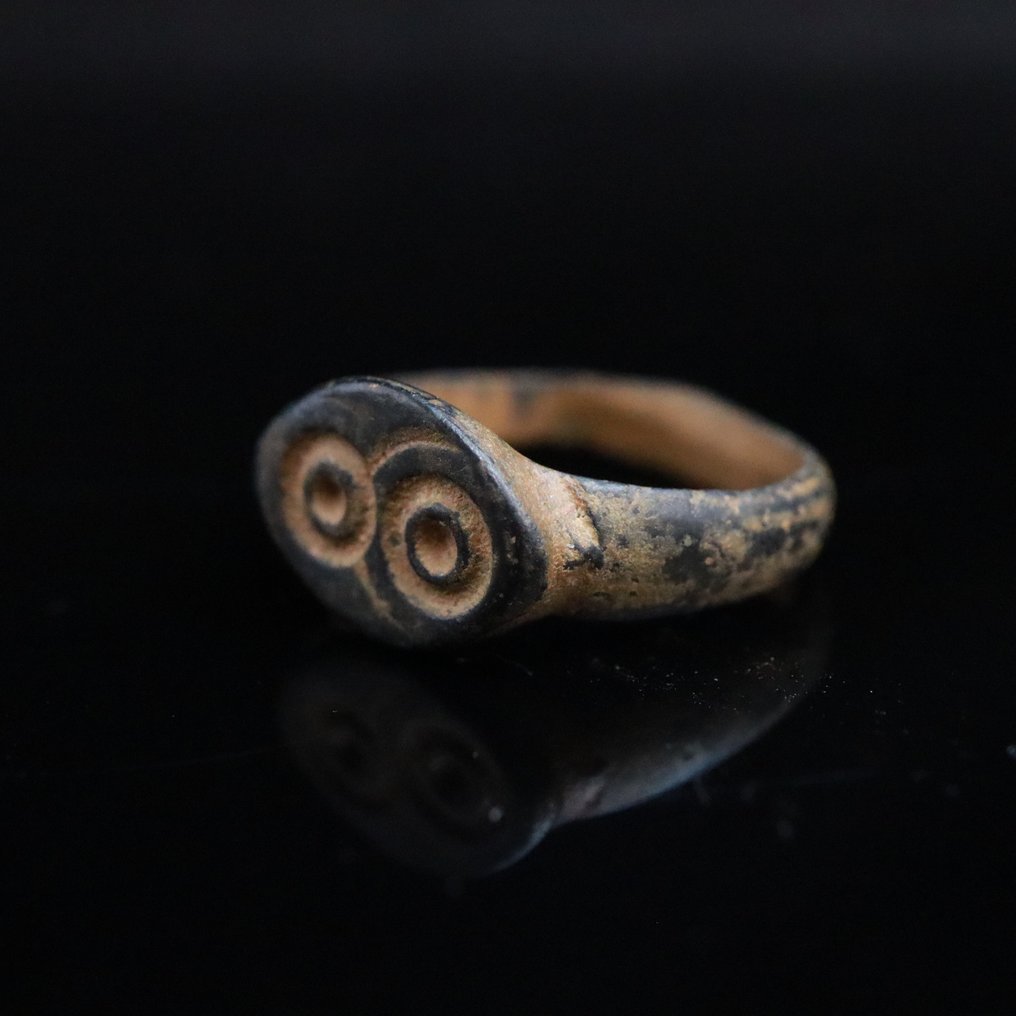
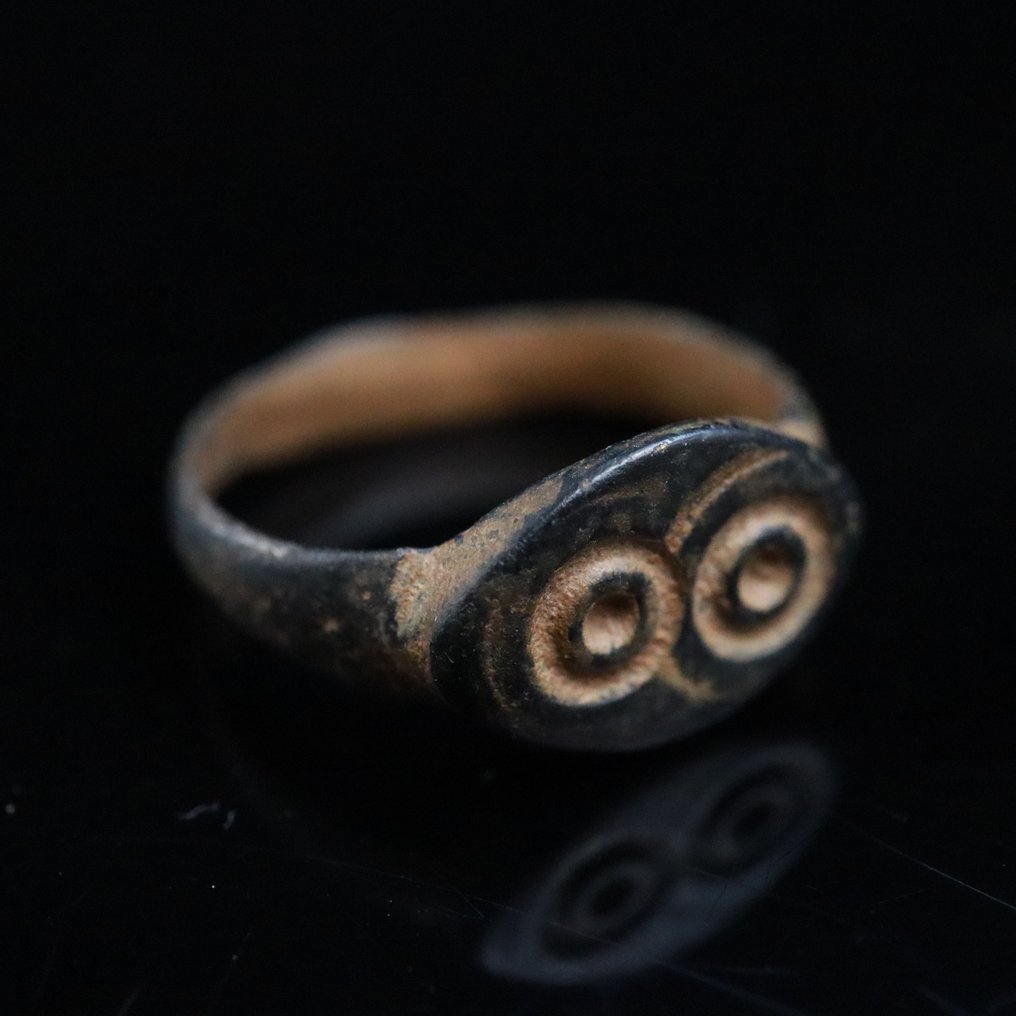
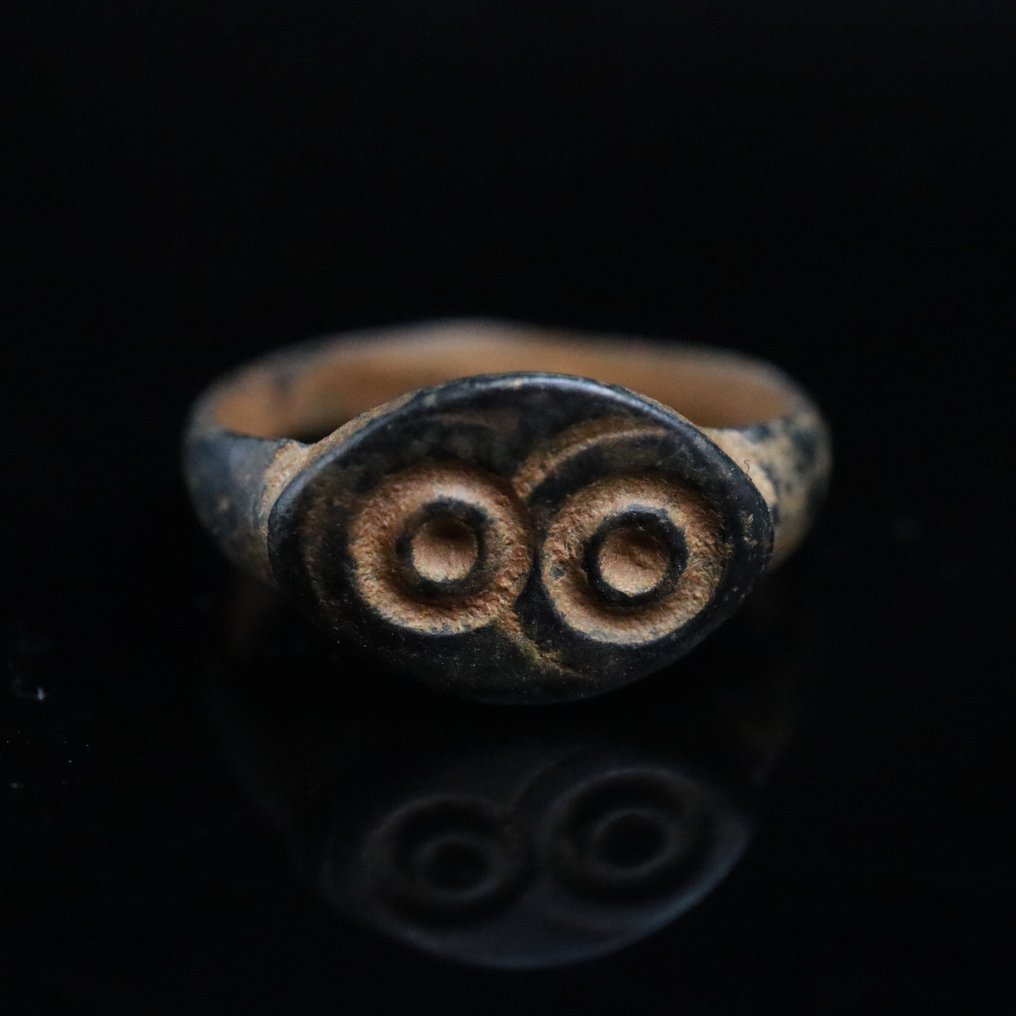
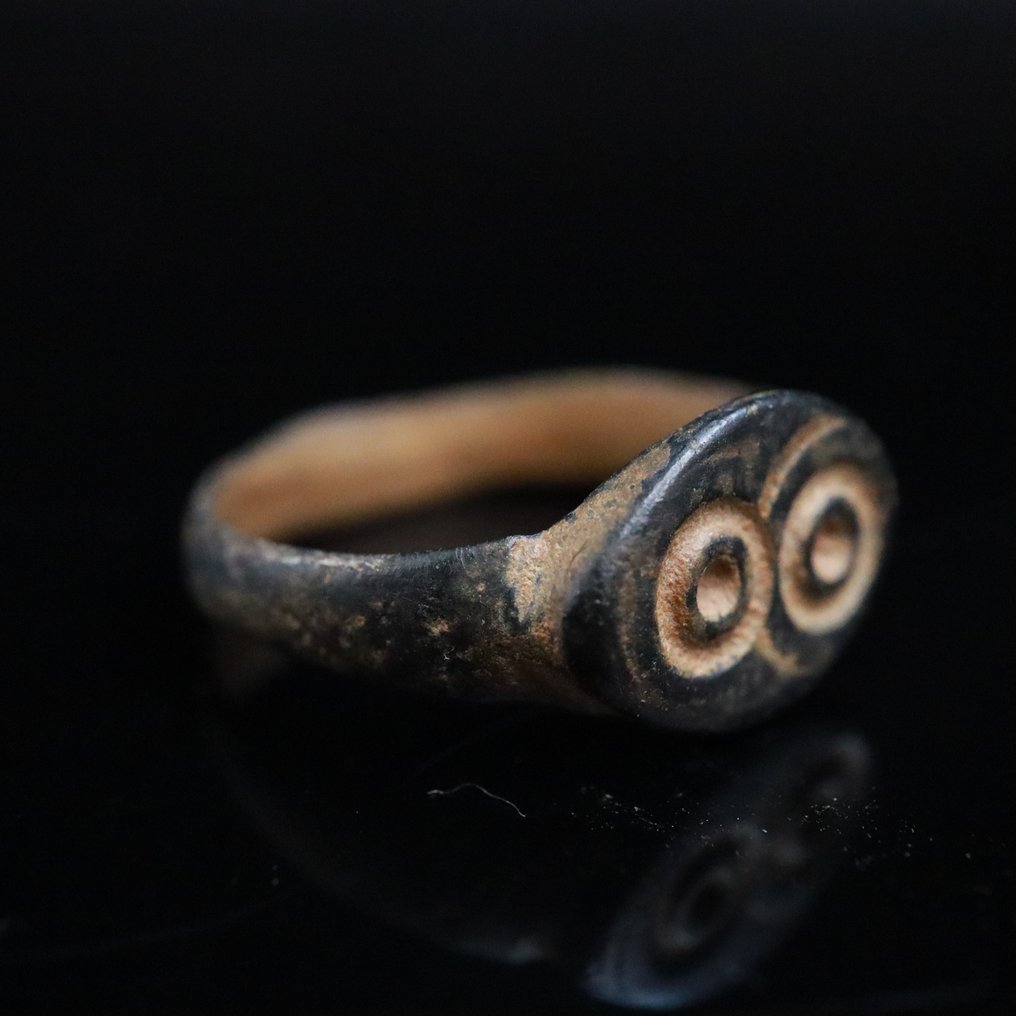
This rare ancient Roman bronze ring, dating to the 1st–3rd century AD, features a simple band with an oval bezel engraved with two punched circular motifs resembling eyes, a classic apotropaic design intended to protect the wearer from harm. The compact size and durable craftsmanship make it a wearable artifact that bridges everyday Roman life with deep-seated superstitious beliefs.
Symbolism & Historical Significance:
Evil Eye Motif: In ancient Roman culture, the evil eye (known as fascinus or oculi malus) was a pervasive belief in the power of envious glances to cause misfortune, illness, or bad luck. To counteract this, people wore amulets or jewelry with eye-like symbols to "stare back" and deflect the malice, turning the gaze upon itself. The dual eyes on this ring amplified this protective intent, symbolizing vigilance and divine safeguarding—often linked to gods like Fascinus (a phallic deity of protection) or associated with broader Mediterranean traditions influenced by Greek and Etruscan customs.
Such motifs were not merely decorative but served as talismans for personal security, reflecting the Romans' blend of rationality and superstition in daily life, where envy (invidia) was seen as a tangible threat in social, military, and commercial contexts.
Connection to Ancient Rome:
Rings like this were common among soldiers, merchants, and civilians across the empire, produced in workshops from Britain to the Levant. The punched technique highlights the era's metalworking efficiency, allowing mass production of protective items. Similar evil eye designs appear in archaeological finds from Pompeii, Roman villas, and military sites, underscoring their role in warding off dangers during travel, battles, or public interactions.
Condition: Top
Intact with a natural sand dark patina and minor earthen deposits from age, preserving the punched eye motifs clearly; the band shows light wear consistent with ancient use, adding to its authentic character.
Dimensions:
Inner Diameter: 16 mm
Weight: 1.96 g
Provenance:
Part of a private European collection, established in the 1980s. A provenance document and declaration of legal origin are available in PDF format upon request.
Note: Please examine the provided images for a detailed impression of the ring. The photos are highly magnified to showcase the details the best way possible; otherwise, the piece is even more beautiful and attractive in person.
Seller's Story
As a second-generation history enthusiast and antique art collector, I have a deep passion for historical artifacts—from prehistoric civilizations to the Medieval era. I love connecting with fellow history lovers and sharing unique, carefully selected pieces. My goal is to find new homes for remarkable items while continuing to expand my own collection. Feel free to explore my selection—I hope you find something special!
Ancient Roman Bronze Ring with Dual Evil Eye Motif, 1st–3rd Century AD - Top Condition
This rare ancient Roman bronze ring, dating to the 1st–3rd century AD, features a simple band with an oval bezel engraved with two punched circular motifs resembling eyes, a classic apotropaic design intended to protect the wearer from harm. The compact size and durable craftsmanship make it a wearable artifact that bridges everyday Roman life with deep-seated superstitious beliefs.
Symbolism & Historical Significance:
Evil Eye Motif: In ancient Roman culture, the evil eye (known as fascinus or oculi malus) was a pervasive belief in the power of envious glances to cause misfortune, illness, or bad luck. To counteract this, people wore amulets or jewelry with eye-like symbols to "stare back" and deflect the malice, turning the gaze upon itself. The dual eyes on this ring amplified this protective intent, symbolizing vigilance and divine safeguarding—often linked to gods like Fascinus (a phallic deity of protection) or associated with broader Mediterranean traditions influenced by Greek and Etruscan customs.
Such motifs were not merely decorative but served as talismans for personal security, reflecting the Romans' blend of rationality and superstition in daily life, where envy (invidia) was seen as a tangible threat in social, military, and commercial contexts.
Connection to Ancient Rome:
Rings like this were common among soldiers, merchants, and civilians across the empire, produced in workshops from Britain to the Levant. The punched technique highlights the era's metalworking efficiency, allowing mass production of protective items. Similar evil eye designs appear in archaeological finds from Pompeii, Roman villas, and military sites, underscoring their role in warding off dangers during travel, battles, or public interactions.
Condition: Top
Intact with a natural sand dark patina and minor earthen deposits from age, preserving the punched eye motifs clearly; the band shows light wear consistent with ancient use, adding to its authentic character.
Dimensions:
Inner Diameter: 16 mm
Weight: 1.96 g
Provenance:
Part of a private European collection, established in the 1980s. A provenance document and declaration of legal origin are available in PDF format upon request.
Note: Please examine the provided images for a detailed impression of the ring. The photos are highly magnified to showcase the details the best way possible; otherwise, the piece is even more beautiful and attractive in person.
Seller's Story
As a second-generation history enthusiast and antique art collector, I have a deep passion for historical artifacts—from prehistoric civilizations to the Medieval era. I love connecting with fellow history lovers and sharing unique, carefully selected pieces. My goal is to find new homes for remarkable items while continuing to expand my own collection. Feel free to explore my selection—I hope you find something special!
Details
Era
Before 1400
Culture
Ancient Roman
Metal
Bronze
Century/ Timeframe
1st - 3rd Century A.D
Acquired from
Private collection
Total weight
1.96 g
Year acquired
2024
Condition
Excellent condition - barely used with minimal signs of wear
Country acquired from
Europe
Previous owner acquired from
Inherited
Title additional information
with Dual Evil Eye Motif
Previous owner - year acquired
1980
Previous owner - country acquired from
Europe
I verify that I have obtained this object legally and that I am allowed to sell it
Yes
Sold by
Disclaimer
The seller was informed by Catawiki about documentation requirements and guarantees the following: - the object was legally obtained, - the seller has the right to sell and/or export the object, as relevant, - the seller will provide the necessary provenance information and arrange required documentation and permits/licenses, as applicable and as per local laws, - the seller will notify the buyer of any delays in obtaining permits/licenses. By bidding, you acknowledge that import documentation may be required depending on your country of residence and that obtaining permits/licenses may cause delays in the delivery of your object.
The seller was informed by Catawiki about documentation requirements and guarantees the following: - the object was legally obtained, - the seller has the right to sell and/or export the object, as relevant, - the seller will provide the necessary provenance information and arrange required documentation and permits/licenses, as applicable and as per local laws, - the seller will notify the buyer of any delays in obtaining permits/licenses. By bidding, you acknowledge that import documentation may be required depending on your country of residence and that obtaining permits/licenses may cause delays in the delivery of your object.
