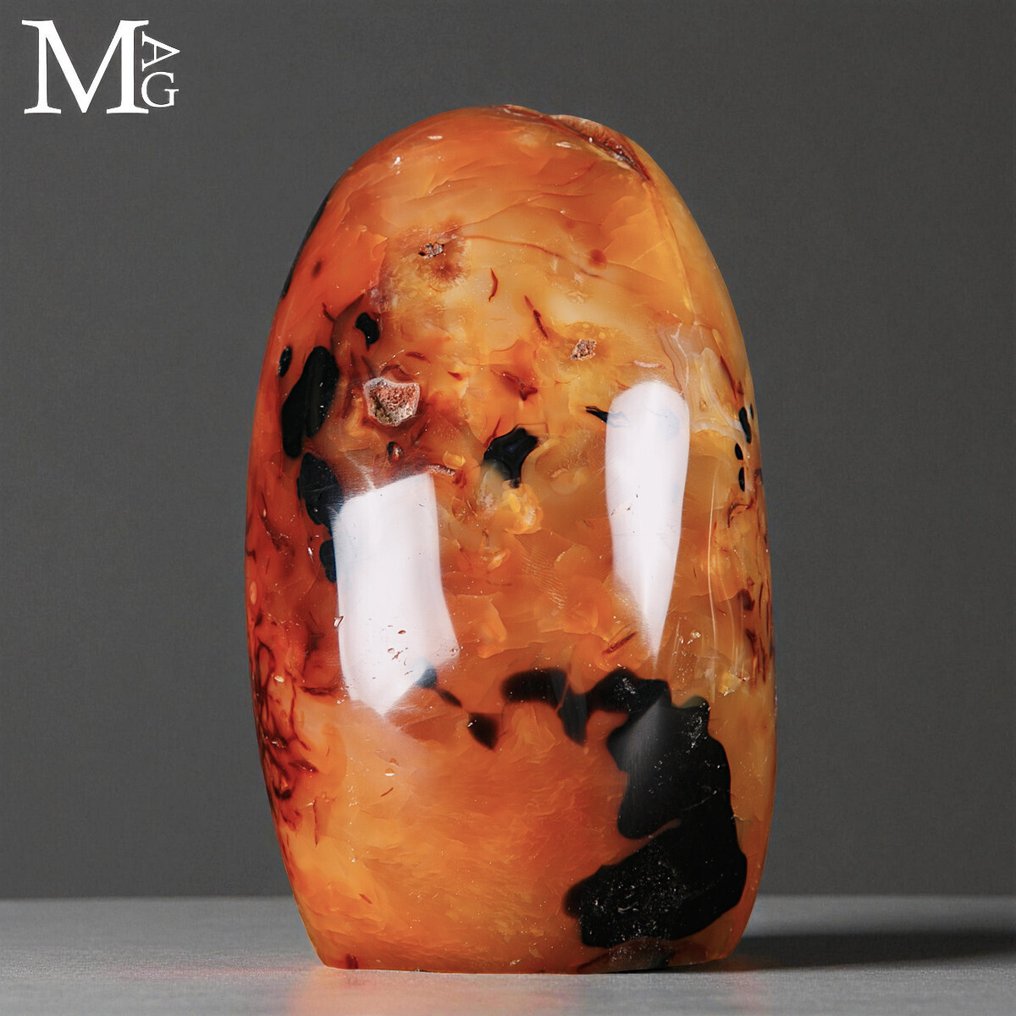
Free Form - Madagascar Carnelian - First Choice - Natural Deep Color - Height: 123 mm - Width: 92 mm- 1398 g




01
day
16
hours
11
minutes
10
seconds
Starting bid
€ 1
Reserve price not met

Expert
Selected by Antonio Rapisarda
Holds a master’s in chemistry with 25 years’ experience in minerals consulting.
Estimate € 150 - € 200
No bids placed
Catawiki Buyer Protection
Your payment’s safe with us until you receive your object.View details
Trustpilot 4.4 | 122813 reviews
Rated Excellent on Trustpilot.
Madagascar, Antsirabe region, Carnelian free form, natural deep color, weight 1398 g, dimensions 123 × 92 × 72 mm.
AI-assisted summary
Description from the seller
In Madagascar, carnelian deposits are mainly found in the Antsirabe region, located in the central part of the country. Here, carnelian forms in sedimentary rocks, particularly in clays and sandstones, where it has been transported by river sedimentation.
The formation of carnelian in Madagascar is linked to volcanic activities that occurred in the past in the area, which caused the deposition of sediment layers in the beds of rivers and lakes. Over millennia, these sediments have been subjected to compression and erosion, leading to the formation of sedimentary rocks rich in minerals, including carnelian.
Today, carnelian is extracted from open-pit mines or underground galleries, where workers search for blocks of precious stone and extract them using cutting and polishing techniques. Thanks to its beauty and quality, Madagascar's carnelian is highly valued in the world of jewelry and craftsmanship, and is often used to create jewelry, art objects, and design pieces.
Seller's Story
The Mineral Art Gallery offers minerals, fossils, shells and natural elements.
Born in Italy in 2017, today she collaborates with international galleries and collectors, she is a direct importer of large minerals and naturalistic collectible elements; deals with the processing to insert them inside the living space. A section of the gallery was dedicated to the Wunderkammer, "chamber of wonders or cabinet of curiosities" in which Mirabilia elements are presented: naturalia and italiania, a union between "the present is the past".
All lots are shipped via DHL Express and Fercam couriers, with insured parcel and tracking.
Translated by Google TranslateIn Madagascar, carnelian deposits are mainly found in the Antsirabe region, located in the central part of the country. Here, carnelian forms in sedimentary rocks, particularly in clays and sandstones, where it has been transported by river sedimentation.
The formation of carnelian in Madagascar is linked to volcanic activities that occurred in the past in the area, which caused the deposition of sediment layers in the beds of rivers and lakes. Over millennia, these sediments have been subjected to compression and erosion, leading to the formation of sedimentary rocks rich in minerals, including carnelian.
Today, carnelian is extracted from open-pit mines or underground galleries, where workers search for blocks of precious stone and extract them using cutting and polishing techniques. Thanks to its beauty and quality, Madagascar's carnelian is highly valued in the world of jewelry and craftsmanship, and is often used to create jewelry, art objects, and design pieces.
Seller's Story
The Mineral Art Gallery offers minerals, fossils, shells and natural elements.
Born in Italy in 2017, today she collaborates with international galleries and collectors, she is a direct importer of large minerals and naturalistic collectible elements; deals with the processing to insert them inside the living space. A section of the gallery was dedicated to the Wunderkammer, "chamber of wonders or cabinet of curiosities" in which Mirabilia elements are presented: naturalia and italiania, a union between "the present is the past".
All lots are shipped via DHL Express and Fercam couriers, with insured parcel and tracking.
Translated by Google TranslateDetails
Mineral Form
Free Form - Madagascar Carnelian - First Choice - Natural Deep Color
Weight
1398 g
Country of Origin
Madagascar
Height
123 mm
Width
92 mm
Depth
72 mm
Sold by