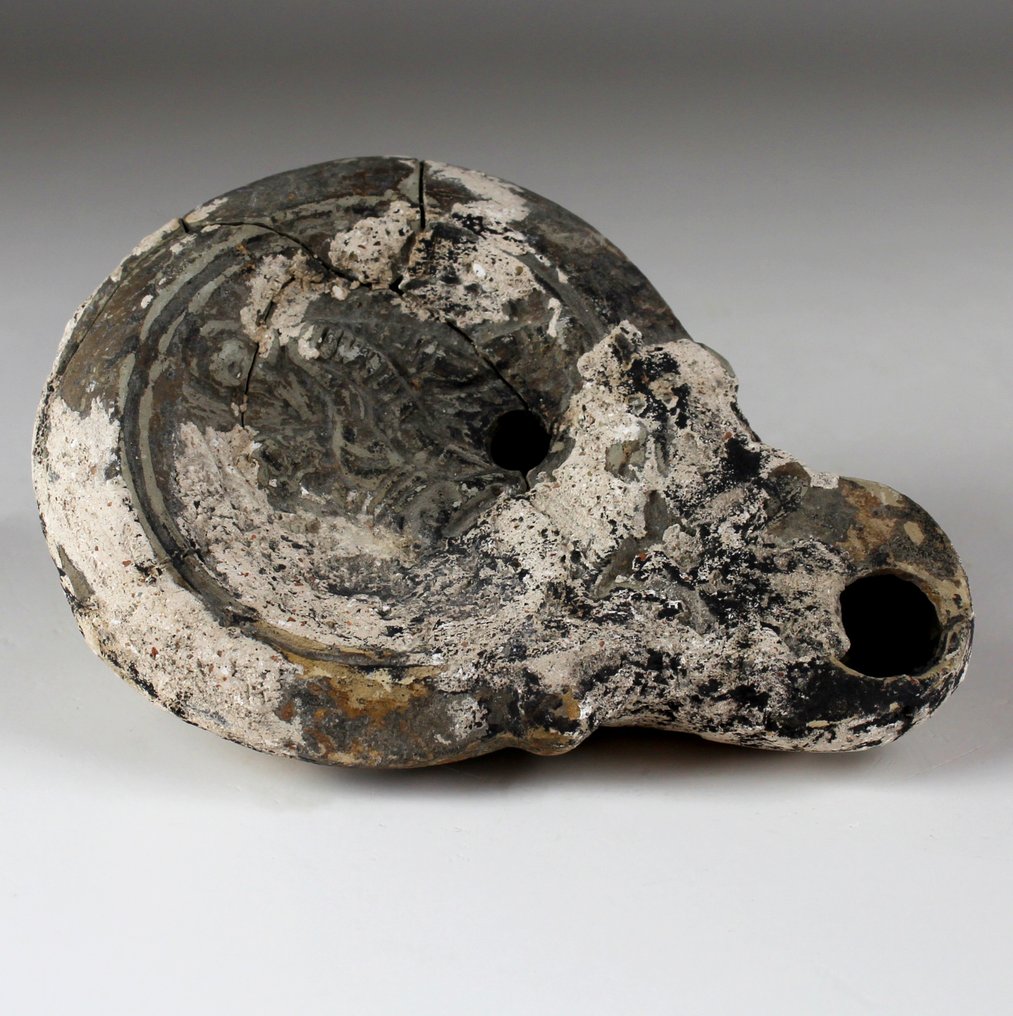
Ancient Roman Terracotta Oil lamp depicting two gladiators, Type Bussière B III 1 b

07
days
05
hours
04
minutes
11
seconds
Starting bid
€ 1
Reserve price not met

Expert
Selected by Ruth Garrido Vila
Directed the Ifergan Collection Museum, specialising in Phoenician and Mediterranean archaeology.
Estimate € 330 - € 400
No bids placed
Catawiki Buyer Protection
Your payment’s safe with us until you receive your object.View details
Trustpilot 4.4 | 123053 reviews
Rated Excellent on Trustpilot.
Ancient Roman oil lamp made of terracotta, depicting two gladiators (Type Bussière B III 1 b), dating to the 1st Century A.D., in good condition (repaired) with dimensions 30 mm × 80 mm × 114 mm, from a French private collection and acquired in 2020s, with Certificate of Authenticity and export licence.
AI-assisted summary
Description from the seller
ITEM: Oil lamp depicting two gladiators, Type Bussière B III 1 b
MATERIAL: Pottery
CULTURE: Roman
PERIOD: 1st Century A.D
DIMENSIONS: 30 mm x 80 mm x 114 mm
CONDITION: Good condition, repaired
PROVENANCE: Ex French private collection, acquired between 1970 - 1990
PARALLEL: MUSEO NACIONAL DE ARTE ROMANO, Inventario CE00898. Yale Art Museum, Accession number 1913.633
Roman oil lamps featuring erotic scenes constitute a fascinating and distinct category within the vast corpus of ancient Roman pottery and lighting devices. These lamps, typically molded from terracotta, frequently display depictions of sexual acts, explicit encounters, or suggestive imagery. Far from being marginal or hidden objects, such lamps were relatively common throughout the Roman Imperial period, especially from the 1st to 3rd centuries CE. Their widespread discovery across all strata of Roman society—from urban homes to military camps—suggests a more open and integrated approach to sexuality in Roman culture than might be perceived in many modern contexts. The scenes, often molded in low relief on the discus (the central upper surface of the lamp), could range from explicit copulation to more subtle depictions of genitalia or figures engaged in amorous play, offering a glimpse into the visual culture of Roman sensuality.
The function and context of these erotic lamps were diverse, reflecting the multifaceted role of sexuality in Roman life. While some may have been used in brothels or private chambers for intimate gatherings, it is clear from archaeological contexts that they were also found in seemingly ordinary domestic settings. They served as conversation pieces, humorous gifts, or even expressions of personal taste. The erotic imagery was often imbued with elements of fertility symbolism and the worship of deities like Venus and Priapus, making them suitable offerings in certain cultic contexts or as votive gifts. Furthermore, their presence in tombs suggests an apotropaic function, where explicit imagery was believed to ward off evil or ensure fertility and continuity in the afterlife.
The production of these lamps was efficient, utilizing standardized clay molds that allowed for the replication of popular designs, indicating a robust demand. The artistic quality varied, but many exhibit considerable skill in capturing dynamic and detailed scenes within the small circular space of the lamp's discus. Scholars debate the precise social implications of these objects—whether they were seen as purely functional items with added flair, expressions of bawdy humor, or deeper reflections of Roman attitudes towards sensuality and the human body. Regardless, Roman oil lamps with erotic scenes provide invaluable archaeological and iconographic evidence for understanding the pervasive and often uninhibited nature of sexual representation in the daily lives of ancient Romans, challenging modern perceptions of ancient morality.
Comes with Certificate of Authenticity and Export license
If you bid outside the European Union and win the item, we will have to apply for an export licence for your country and shipping will take 3 to 5 weeks.
Seller's Story
Your Antiquarian offers ancient art and ancient coins. Our main objective is to offer the highest quality at the best price respecting and strictly complying with the laws of heritage protection and UNESCO heritage norms. Therefore, all the pieces that are published come from private collections in which the provenance can be checked or international auctions. All our antiquities and coins are accompanied by their Certificate of Authenticity. We have a no quibble 90 day return policy. At Your Antiquarian we are committed to helping disadvantaged groups and for this reason a portion of each purchase is donated to charities to help people in need.
Translated by Google TranslateITEM: Oil lamp depicting two gladiators, Type Bussière B III 1 b
MATERIAL: Pottery
CULTURE: Roman
PERIOD: 1st Century A.D
DIMENSIONS: 30 mm x 80 mm x 114 mm
CONDITION: Good condition, repaired
PROVENANCE: Ex French private collection, acquired between 1970 - 1990
PARALLEL: MUSEO NACIONAL DE ARTE ROMANO, Inventario CE00898. Yale Art Museum, Accession number 1913.633
Roman oil lamps featuring erotic scenes constitute a fascinating and distinct category within the vast corpus of ancient Roman pottery and lighting devices. These lamps, typically molded from terracotta, frequently display depictions of sexual acts, explicit encounters, or suggestive imagery. Far from being marginal or hidden objects, such lamps were relatively common throughout the Roman Imperial period, especially from the 1st to 3rd centuries CE. Their widespread discovery across all strata of Roman society—from urban homes to military camps—suggests a more open and integrated approach to sexuality in Roman culture than might be perceived in many modern contexts. The scenes, often molded in low relief on the discus (the central upper surface of the lamp), could range from explicit copulation to more subtle depictions of genitalia or figures engaged in amorous play, offering a glimpse into the visual culture of Roman sensuality.
The function and context of these erotic lamps were diverse, reflecting the multifaceted role of sexuality in Roman life. While some may have been used in brothels or private chambers for intimate gatherings, it is clear from archaeological contexts that they were also found in seemingly ordinary domestic settings. They served as conversation pieces, humorous gifts, or even expressions of personal taste. The erotic imagery was often imbued with elements of fertility symbolism and the worship of deities like Venus and Priapus, making them suitable offerings in certain cultic contexts or as votive gifts. Furthermore, their presence in tombs suggests an apotropaic function, where explicit imagery was believed to ward off evil or ensure fertility and continuity in the afterlife.
The production of these lamps was efficient, utilizing standardized clay molds that allowed for the replication of popular designs, indicating a robust demand. The artistic quality varied, but many exhibit considerable skill in capturing dynamic and detailed scenes within the small circular space of the lamp's discus. Scholars debate the precise social implications of these objects—whether they were seen as purely functional items with added flair, expressions of bawdy humor, or deeper reflections of Roman attitudes towards sensuality and the human body. Regardless, Roman oil lamps with erotic scenes provide invaluable archaeological and iconographic evidence for understanding the pervasive and often uninhibited nature of sexual representation in the daily lives of ancient Romans, challenging modern perceptions of ancient morality.
Comes with Certificate of Authenticity and Export license
If you bid outside the European Union and win the item, we will have to apply for an export licence for your country and shipping will take 3 to 5 weeks.
Seller's Story
Your Antiquarian offers ancient art and ancient coins. Our main objective is to offer the highest quality at the best price respecting and strictly complying with the laws of heritage protection and UNESCO heritage norms. Therefore, all the pieces that are published come from private collections in which the provenance can be checked or international auctions. All our antiquities and coins are accompanied by their Certificate of Authenticity. We have a no quibble 90 day return policy. At Your Antiquarian we are committed to helping disadvantaged groups and for this reason a portion of each purchase is donated to charities to help people in need.
Translated by Google TranslateDetails
Culture
Ancient Roman
Century/ Timeframe
1st Century A.D
Name of object
Oil lamp depicting two gladiators, Type Bussière B III 1 b
Acquired from
Private collection
Year acquired
2024
Material
Terracotta
Country acquired from
France
Condition
Good
Previous owner acquired from
Antique market
Previous owner - year acquired
1970
Previous owner - country acquired from
France
I verify that I have obtained this object legally and that I am allowed to sell it
Yes
Sold by
Disclaimer
The seller was informed by Catawiki about documentation requirements and guarantees the following: - the object was legally obtained, - the seller has the right to sell and/or export the object, as relevant, - the seller will provide the necessary provenance information and arrange required documentation and permits/licenses, as applicable and as per local laws, - the seller will notify the buyer of any delays in obtaining permits/licenses. By bidding, you acknowledge that import documentation may be required depending on your country of residence and that obtaining permits/licenses may cause delays in the delivery of your object.
The seller was informed by Catawiki about documentation requirements and guarantees the following: - the object was legally obtained, - the seller has the right to sell and/or export the object, as relevant, - the seller will provide the necessary provenance information and arrange required documentation and permits/licenses, as applicable and as per local laws, - the seller will notify the buyer of any delays in obtaining permits/licenses. By bidding, you acknowledge that import documentation may be required depending on your country of residence and that obtaining permits/licenses may cause delays in the delivery of your object.
