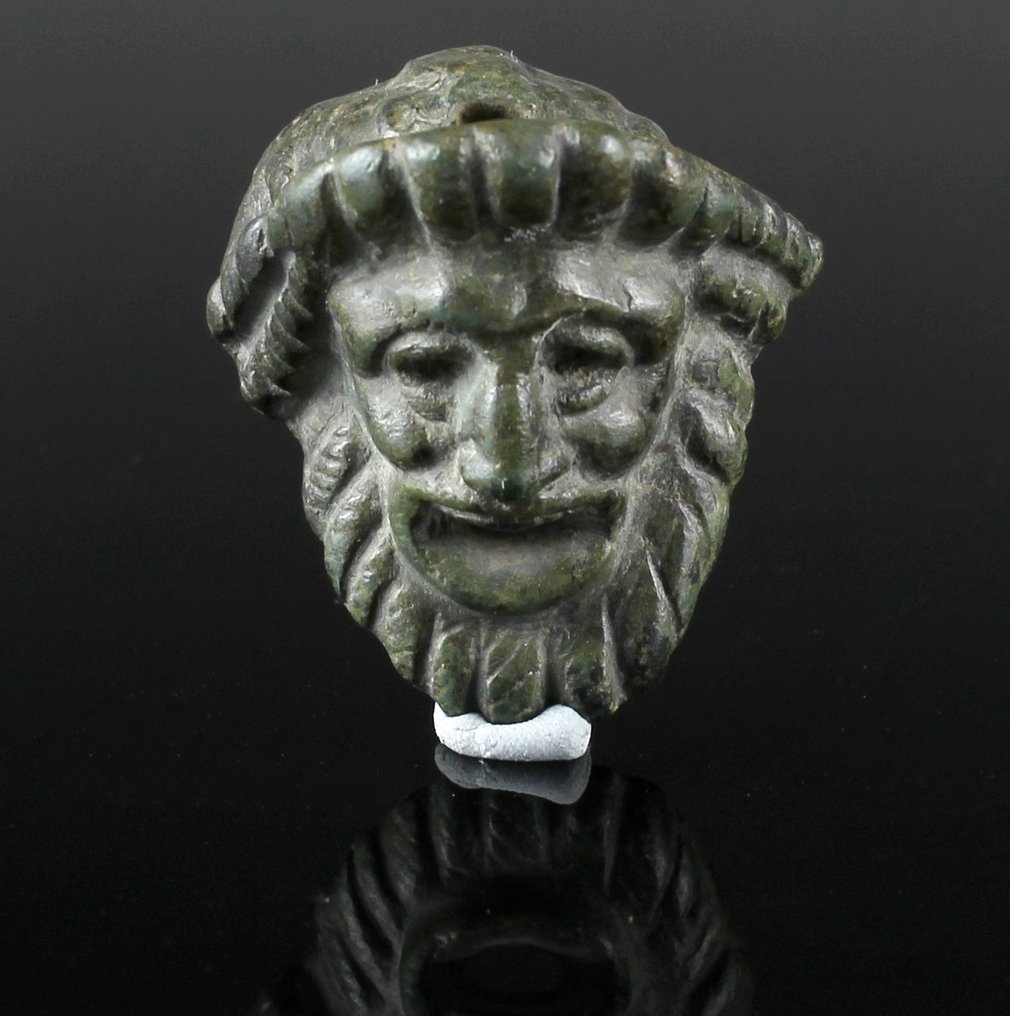
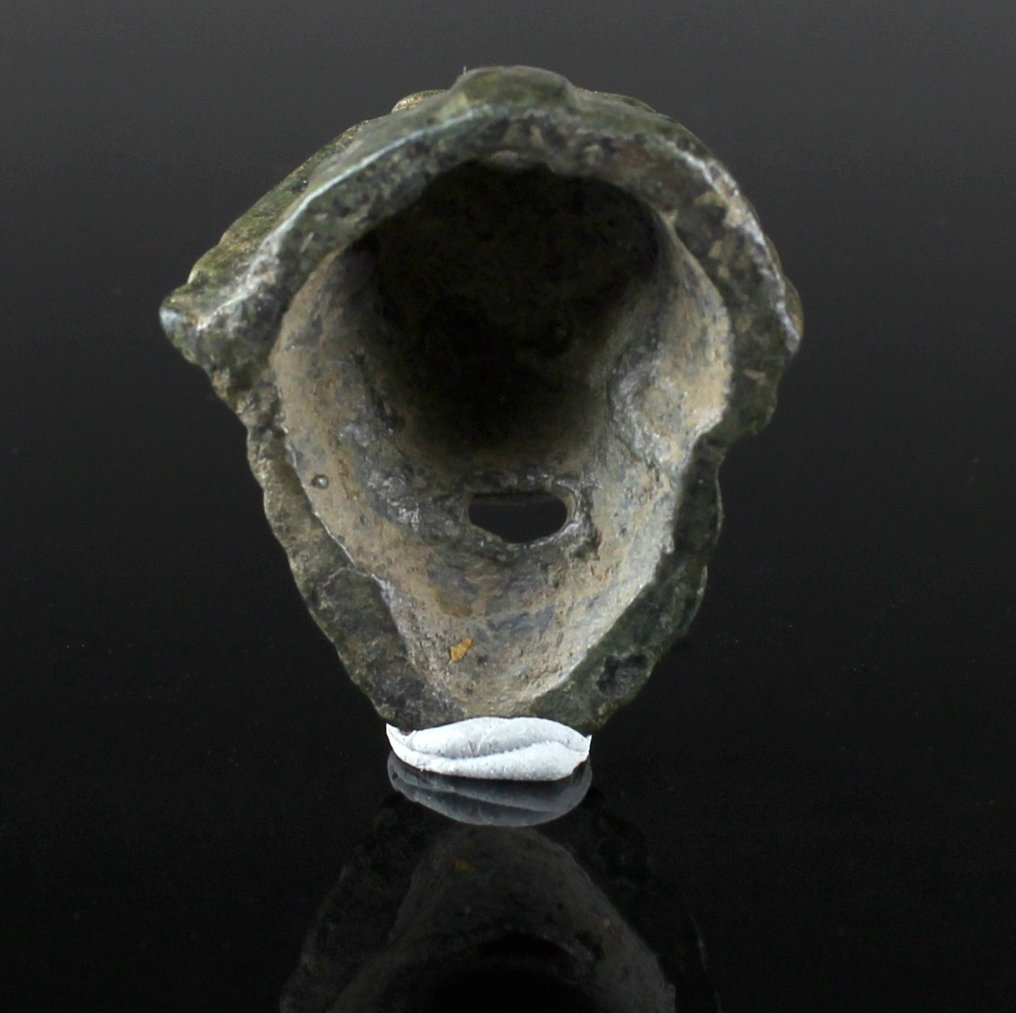
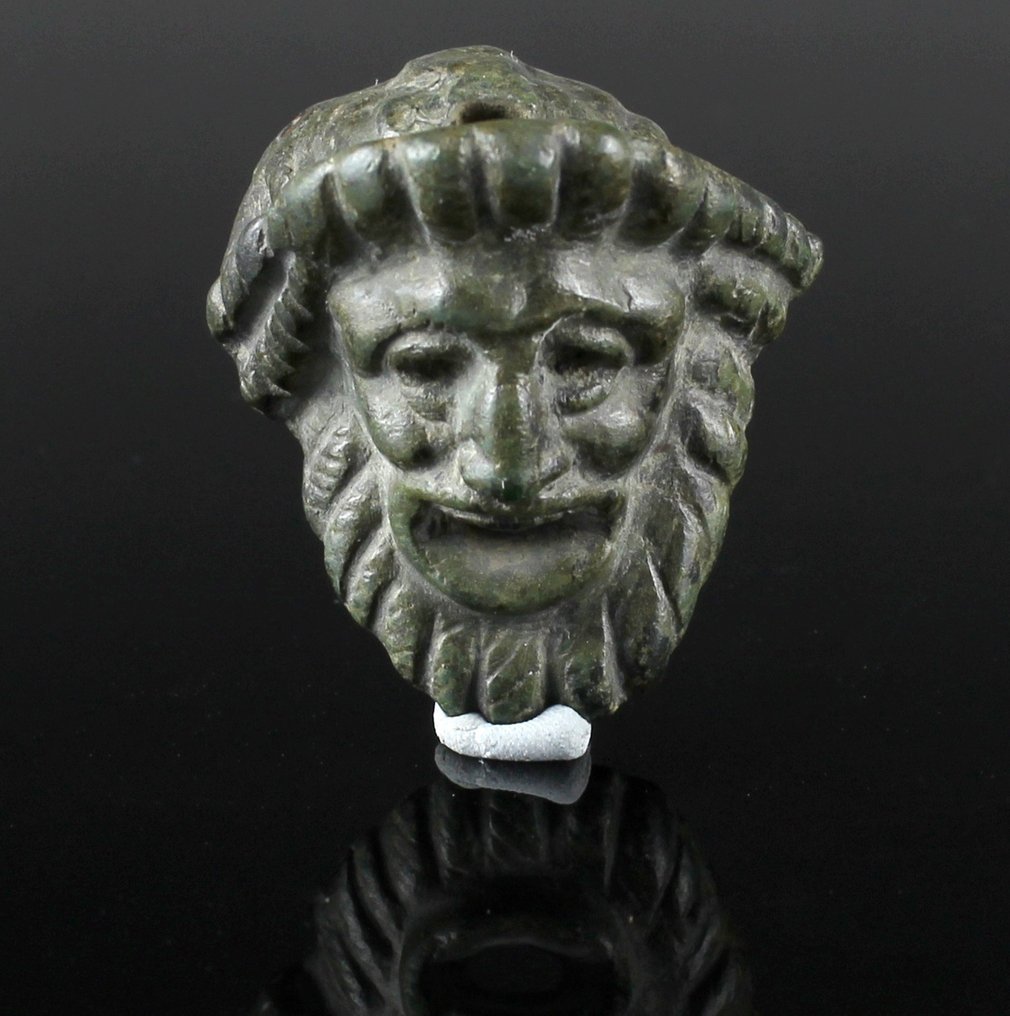
Ancient Roman Bronze Theatre mask head applique
Opens Sunday
Starting bid
€ 1
Add to your favourites to get an alert when the auction starts.

Expert
Selected by Ruth Garrido Vila
Directed the Ifergan Collection Museum, specialising in Phoenician and Mediterranean archaeology.
Estimate € 400 - € 500
Catawiki Buyer Protection
Your payment’s safe with us until you receive your object.View details
Trustpilot 4.4 | 122290 reviews
Rated Excellent on Trustpilot.
Description from the seller
ITEM: Theatre mask head applique
MATERIAL: Bronze
CULTURE: Roman
PERIOD: 1st - 3rd Century A.D
DIMENSIONS: 39 mm x 36 mm
CONDITION: Good condition
PROVENANCE: Ex German private collection, acquired before 1980s
The Roman theatre mask, or persona, was a fundamental element of dramatic performance, derived from its Greek predecessor but often featuring more pronounced and exaggerated features. These masks served several critical purposes in the large, open-air Roman theatres. Primarily, they allowed a small company of actors to swiftly portray multiple roles, including different ages, genders (as women were generally prohibited from the stage), and social types. Beyond character differentiation, the masks were designed for clarity in vast auditoriums. Their large, bold, and often grotesque expressions—such as the anguished downturned mouth for tragedy or the large, upturned smile for comedy—allowed audiences thousands of feet away to instantly recognize the character's emotion, social status, and role in the narrative.
The construction and features of the masks were highly specialized, varying significantly between the genres of comedy and tragedy. In Roman Comedy (like fabula palliata), the masks visually codified stock characters or archetypes, such as the miles gloriosus (braggart soldier), the cunning slave, the foolish old man (senex), or the young lover. These comedic masks were often characterized by bizarre face shapes, protruding foreheads, and mischievous, smiling expressions. In contrast, Tragedy masks displayed profound expressions of sorrow, stoicism, or nobility, often featuring high-combed hair known as the onkos to give the actor a towering, dramatic stature.
While the vivid terracotta or marble masks seen in museums today offer a clear visual record, the actual masks worn by Roman actors were made from lightweight, perishable materials like linen, cork, wood, and even animal hair. This was necessary for the actors' comfort and ability to move during long performances. Crucially, the masks were also acoustic tools; the large, open mouths, which became more exaggerated over time, were thought to help amplify or "resonate" (personare in Latin, giving us the word persona) the actor's voice, projecting it effectively across the vast audience space and compensating for the loss of subtle facial expressions.
Comes with Certificate of Authenticity and Export license
If you bid outside the European Union and win the item, we will have to apply for an export licence for your country and shipping will take 3 to 5 weeks.
Seller's Story
Your Antiquarian offers ancient art and ancient coins. Our main objective is to offer the highest quality at the best price respecting and strictly complying with the laws of heritage protection and UNESCO heritage norms. Therefore, all the pieces that are published come from private collections in which the provenance can be checked or international auctions. All our antiquities and coins are accompanied by their Certificate of Authenticity. We have a no quibble 90 day return policy. At Your Antiquarian we are committed to helping disadvantaged groups and for this reason a portion of each purchase is donated to charities to help people in need.
Translated by Google TranslateITEM: Theatre mask head applique
MATERIAL: Bronze
CULTURE: Roman
PERIOD: 1st - 3rd Century A.D
DIMENSIONS: 39 mm x 36 mm
CONDITION: Good condition
PROVENANCE: Ex German private collection, acquired before 1980s
The Roman theatre mask, or persona, was a fundamental element of dramatic performance, derived from its Greek predecessor but often featuring more pronounced and exaggerated features. These masks served several critical purposes in the large, open-air Roman theatres. Primarily, they allowed a small company of actors to swiftly portray multiple roles, including different ages, genders (as women were generally prohibited from the stage), and social types. Beyond character differentiation, the masks were designed for clarity in vast auditoriums. Their large, bold, and often grotesque expressions—such as the anguished downturned mouth for tragedy or the large, upturned smile for comedy—allowed audiences thousands of feet away to instantly recognize the character's emotion, social status, and role in the narrative.
The construction and features of the masks were highly specialized, varying significantly between the genres of comedy and tragedy. In Roman Comedy (like fabula palliata), the masks visually codified stock characters or archetypes, such as the miles gloriosus (braggart soldier), the cunning slave, the foolish old man (senex), or the young lover. These comedic masks were often characterized by bizarre face shapes, protruding foreheads, and mischievous, smiling expressions. In contrast, Tragedy masks displayed profound expressions of sorrow, stoicism, or nobility, often featuring high-combed hair known as the onkos to give the actor a towering, dramatic stature.
While the vivid terracotta or marble masks seen in museums today offer a clear visual record, the actual masks worn by Roman actors were made from lightweight, perishable materials like linen, cork, wood, and even animal hair. This was necessary for the actors' comfort and ability to move during long performances. Crucially, the masks were also acoustic tools; the large, open mouths, which became more exaggerated over time, were thought to help amplify or "resonate" (personare in Latin, giving us the word persona) the actor's voice, projecting it effectively across the vast audience space and compensating for the loss of subtle facial expressions.
Comes with Certificate of Authenticity and Export license
If you bid outside the European Union and win the item, we will have to apply for an export licence for your country and shipping will take 3 to 5 weeks.
Seller's Story
Your Antiquarian offers ancient art and ancient coins. Our main objective is to offer the highest quality at the best price respecting and strictly complying with the laws of heritage protection and UNESCO heritage norms. Therefore, all the pieces that are published come from private collections in which the provenance can be checked or international auctions. All our antiquities and coins are accompanied by their Certificate of Authenticity. We have a no quibble 90 day return policy. At Your Antiquarian we are committed to helping disadvantaged groups and for this reason a portion of each purchase is donated to charities to help people in need.
Translated by Google TranslateDetails
Culture
Ancient Roman
Century/ Timeframe
1st - 3rd Century A.D
Name of object
Theatre mask head applique
Acquired from
Private collection
Year acquired
2025
Material
Bronze
Country acquired from
Germany
Condition
Good
Previous owner acquired from
Antique market
Previous owner - year acquired
1980
Previous owner - country acquired from
Germany
I verify that I have obtained this object legally and that I am allowed to sell it
Yes
Sold by
Disclaimer
The seller was informed by Catawiki about documentation requirements and guarantees the following: - the object was legally obtained, - the seller has the right to sell and/or export the object, as relevant, - the seller will provide the necessary provenance information and arrange required documentation and permits/licenses, as applicable and as per local laws, - the seller will notify the buyer of any delays in obtaining permits/licenses. By bidding, you acknowledge that import documentation may be required depending on your country of residence and that obtaining permits/licenses may cause delays in the delivery of your object.
The seller was informed by Catawiki about documentation requirements and guarantees the following: - the object was legally obtained, - the seller has the right to sell and/or export the object, as relevant, - the seller will provide the necessary provenance information and arrange required documentation and permits/licenses, as applicable and as per local laws, - the seller will notify the buyer of any delays in obtaining permits/licenses. By bidding, you acknowledge that import documentation may be required depending on your country of residence and that obtaining permits/licenses may cause delays in the delivery of your object.
