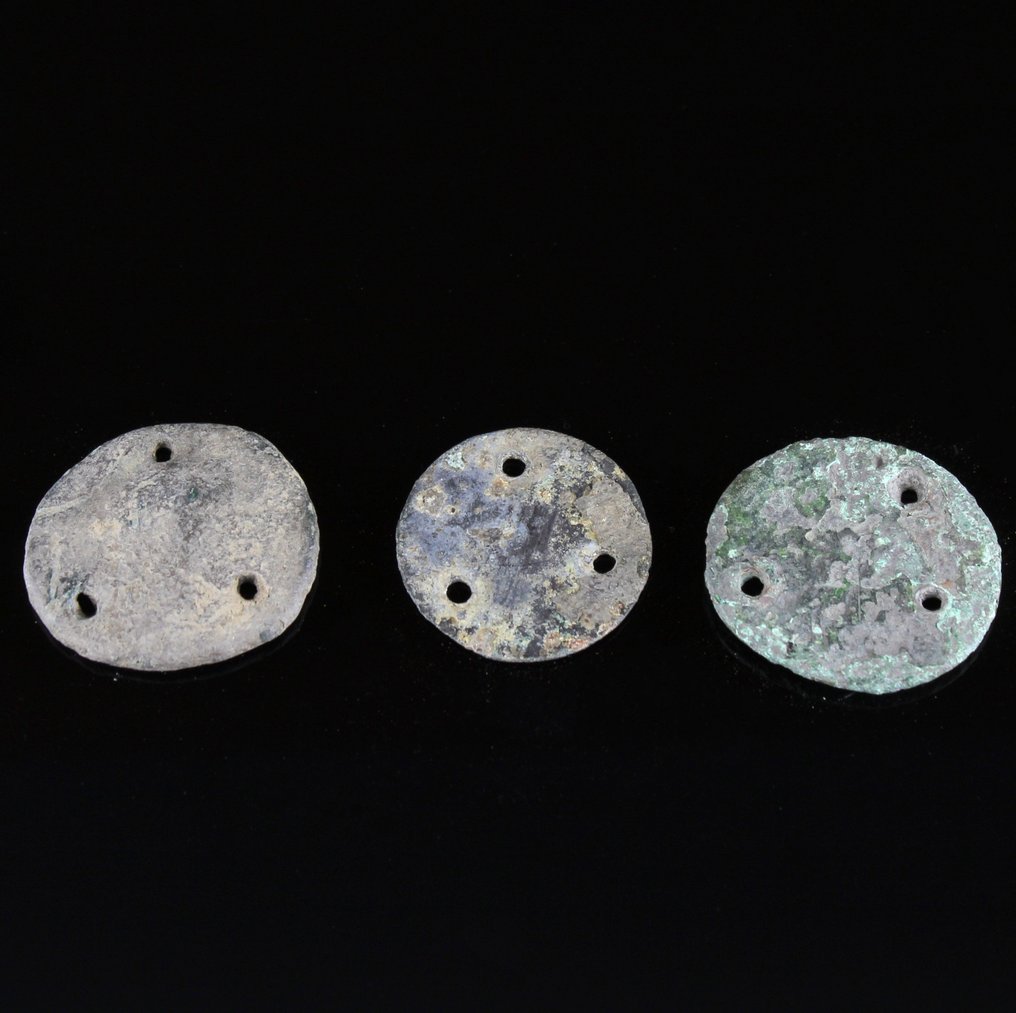
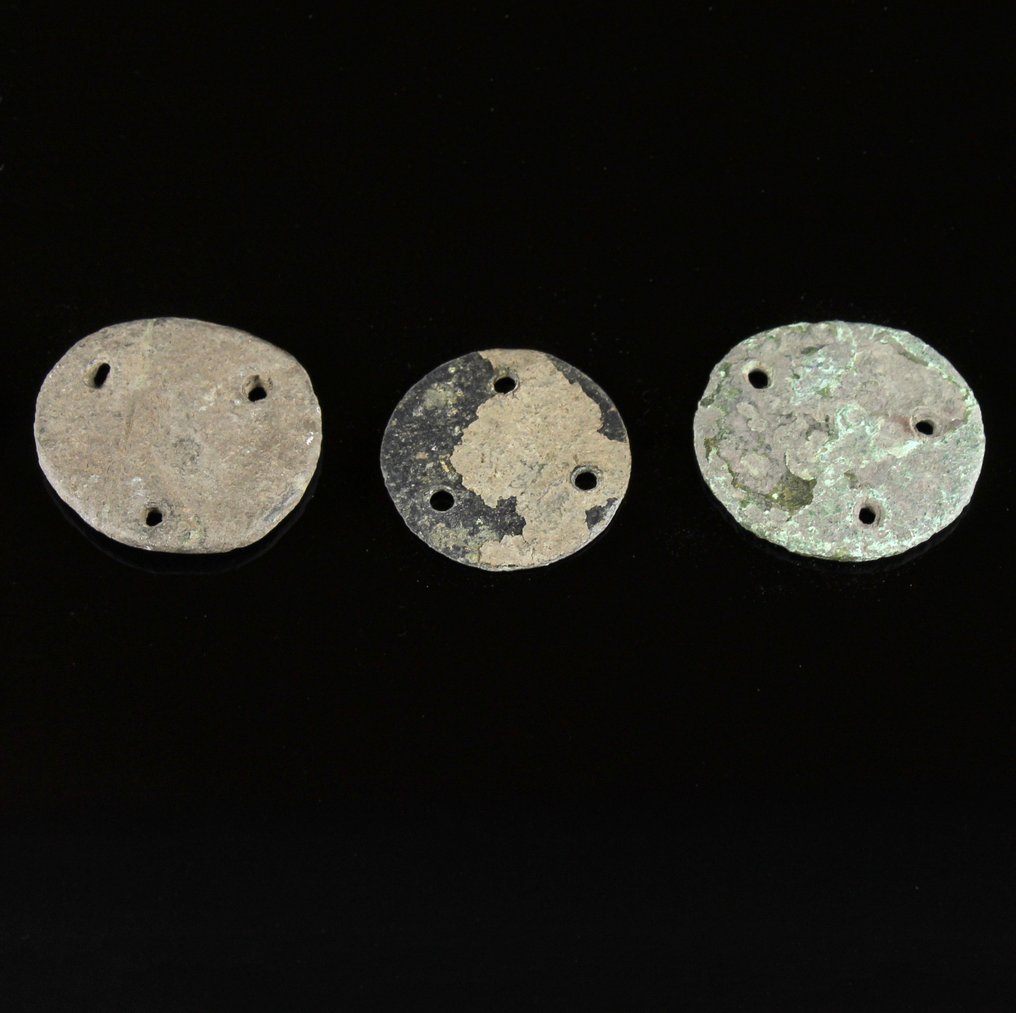
Ancient Roman Bronze Coins reused as Lorica Squamata (3 pieces)

10
days
03
hours
03
minutes
57
seconds
Starting bid
€ 1
Reserve price not met

Expert
Selected by Ruth Garrido Vila
Directed the Ifergan Collection Museum, specialising in Phoenician and Mediterranean archaeology.
Estimate € 150 - € 200
No bids placed
Catawiki Buyer Protection
Your payment’s safe with us until you receive your object.View details
Trustpilot 4.4 | 122986 reviews
Rated Excellent on Trustpilot.
Three bronze coins reused as lorica squamata from Ancient Roman culture, dating to the 1st–3rd century AD, with 22–27 mm diameter, in good condition, originating from an American private collection (acquired 1980s–1990s), with Certificate of Authenticity and Export license.
AI-assisted summary
Description from the seller
ITEM: Coins reused as Lorica Squamata (3 pieces)
MATERIAL: Bronze
CULTURE: Roman
PERIOD: 1st - 3rd Century A.D
DIMENSIONS: 22 mm to 27 mm diameter
CONDITION: Good condition
PROVENANCE: Ex American private collection, acquired between 1980s - 1990s
The Lorica Squamata, or Roman scale armor, was typically constructed from thousands of small, overlapping metal scales (squamae) sewn or wired onto a flexible backing of leather or fabric. While the vast majority of these scales were purpose-made from bronze or iron sheets, the resourcefulness of Roman military logistics and the desire for ready repair and recycling sometimes led to the improvisation of materials. In exceptional cases, archaeological evidence suggests that small, worn, or low-denomination bronze coins, especially during periods of economic instability or when official supplies were scarce, could be pressed into service as substitutes for the standard scales. This practice was a practical example of the Roman principle of re-use and repair, turning obsolete or devalued currency into essential protective gear.
The repurposing of coins for lorica squamata is a compelling illustration of late Roman military expediency, particularly in frontier or less-supplied regions where the immediate need for armor repair outweighed the need for numismatic value. Unlike the custom-crafted scales, which had standardized dimensions and multiple punched holes for wiring, the coins would have required modifications, typically one or more holes drilled or punched into the edge or face to facilitate their attachment to the armor's backing. When arranged and overlapped correctly, the inherent shape and metal composition of the bronze coinage offered a viable, if slightly heavier, protective layer. While no complete armor made entirely of coins is known, the presence of modified coins in association with armor fragments points to their occasional, opportunistic inclusion.
These coin-scales are significant as historical artifacts because they bridge the fields of military history and numismatics, providing a tangible link between the Roman economy and its military hardware. They show that in the life of a legionary, particularly towards the later stages of the Empire, the intrinsic value of a piece of metal—whether as currency or as protection—could be fluid. The image or portrait stamped on the coin, originally a symbol of imperial authority, would thus become part of a soldier's personal defense, demonstrating a pragmatic adaptation of available materials to maintain the functional integrity of a complex piece of equipment like the lorica squamata.
Comes with Certificate of Authenticity and Export license
If you bid outside the European Union and win the item, we will have to apply for an export licence for your country and shipping will take 3 to 5 weeks.
Seller's Story
Your Antiquarian offers ancient art and ancient coins. Our main objective is to offer the highest quality at the best price respecting and strictly complying with the laws of heritage protection and UNESCO heritage norms. Therefore, all the pieces that are published come from private collections in which the provenance can be checked or international auctions. All our antiquities and coins are accompanied by their Certificate of Authenticity. We have a no quibble 90 day return policy. At Your Antiquarian we are committed to helping disadvantaged groups and for this reason a portion of each purchase is donated to charities to help people in need.
Translated by Google TranslateITEM: Coins reused as Lorica Squamata (3 pieces)
MATERIAL: Bronze
CULTURE: Roman
PERIOD: 1st - 3rd Century A.D
DIMENSIONS: 22 mm to 27 mm diameter
CONDITION: Good condition
PROVENANCE: Ex American private collection, acquired between 1980s - 1990s
The Lorica Squamata, or Roman scale armor, was typically constructed from thousands of small, overlapping metal scales (squamae) sewn or wired onto a flexible backing of leather or fabric. While the vast majority of these scales were purpose-made from bronze or iron sheets, the resourcefulness of Roman military logistics and the desire for ready repair and recycling sometimes led to the improvisation of materials. In exceptional cases, archaeological evidence suggests that small, worn, or low-denomination bronze coins, especially during periods of economic instability or when official supplies were scarce, could be pressed into service as substitutes for the standard scales. This practice was a practical example of the Roman principle of re-use and repair, turning obsolete or devalued currency into essential protective gear.
The repurposing of coins for lorica squamata is a compelling illustration of late Roman military expediency, particularly in frontier or less-supplied regions where the immediate need for armor repair outweighed the need for numismatic value. Unlike the custom-crafted scales, which had standardized dimensions and multiple punched holes for wiring, the coins would have required modifications, typically one or more holes drilled or punched into the edge or face to facilitate their attachment to the armor's backing. When arranged and overlapped correctly, the inherent shape and metal composition of the bronze coinage offered a viable, if slightly heavier, protective layer. While no complete armor made entirely of coins is known, the presence of modified coins in association with armor fragments points to their occasional, opportunistic inclusion.
These coin-scales are significant as historical artifacts because they bridge the fields of military history and numismatics, providing a tangible link between the Roman economy and its military hardware. They show that in the life of a legionary, particularly towards the later stages of the Empire, the intrinsic value of a piece of metal—whether as currency or as protection—could be fluid. The image or portrait stamped on the coin, originally a symbol of imperial authority, would thus become part of a soldier's personal defense, demonstrating a pragmatic adaptation of available materials to maintain the functional integrity of a complex piece of equipment like the lorica squamata.
Comes with Certificate of Authenticity and Export license
If you bid outside the European Union and win the item, we will have to apply for an export licence for your country and shipping will take 3 to 5 weeks.
Seller's Story
Your Antiquarian offers ancient art and ancient coins. Our main objective is to offer the highest quality at the best price respecting and strictly complying with the laws of heritage protection and UNESCO heritage norms. Therefore, all the pieces that are published come from private collections in which the provenance can be checked or international auctions. All our antiquities and coins are accompanied by their Certificate of Authenticity. We have a no quibble 90 day return policy. At Your Antiquarian we are committed to helping disadvantaged groups and for this reason a portion of each purchase is donated to charities to help people in need.
Translated by Google TranslateDetails
Culture
Ancient Roman
Century/ Timeframe
1st - 3rd Century A.D
Name of object
Coins reused as Lorica Squamata (3 pieces)
Acquired from
Private collection
Year acquired
2025
Material
Bronze
Country acquired from
United States
Condition
Good
Previous owner acquired from
Antique market
Previous owner - year acquired
1980
Previous owner - country acquired from
Germany
I verify that I have obtained this object legally and that I am allowed to sell it
Yes
Sold by
Disclaimer
The seller was informed by Catawiki about documentation requirements and guarantees the following: - the object was legally obtained, - the seller has the right to sell and/or export the object, as relevant, - the seller will provide the necessary provenance information and arrange required documentation and permits/licenses, as applicable and as per local laws, - the seller will notify the buyer of any delays in obtaining permits/licenses. By bidding, you acknowledge that import documentation may be required depending on your country of residence and that obtaining permits/licenses may cause delays in the delivery of your object.
The seller was informed by Catawiki about documentation requirements and guarantees the following: - the object was legally obtained, - the seller has the right to sell and/or export the object, as relevant, - the seller will provide the necessary provenance information and arrange required documentation and permits/licenses, as applicable and as per local laws, - the seller will notify the buyer of any delays in obtaining permits/licenses. By bidding, you acknowledge that import documentation may be required depending on your country of residence and that obtaining permits/licenses may cause delays in the delivery of your object.
