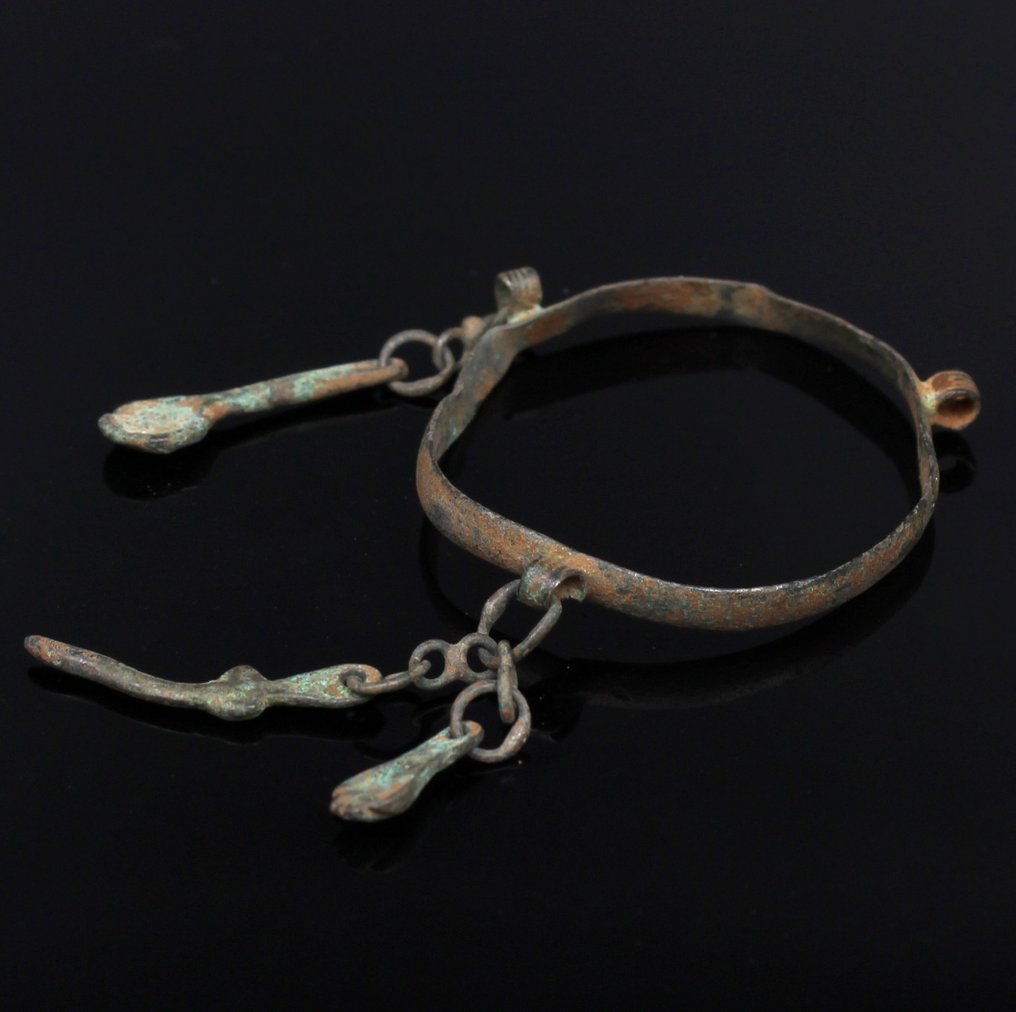
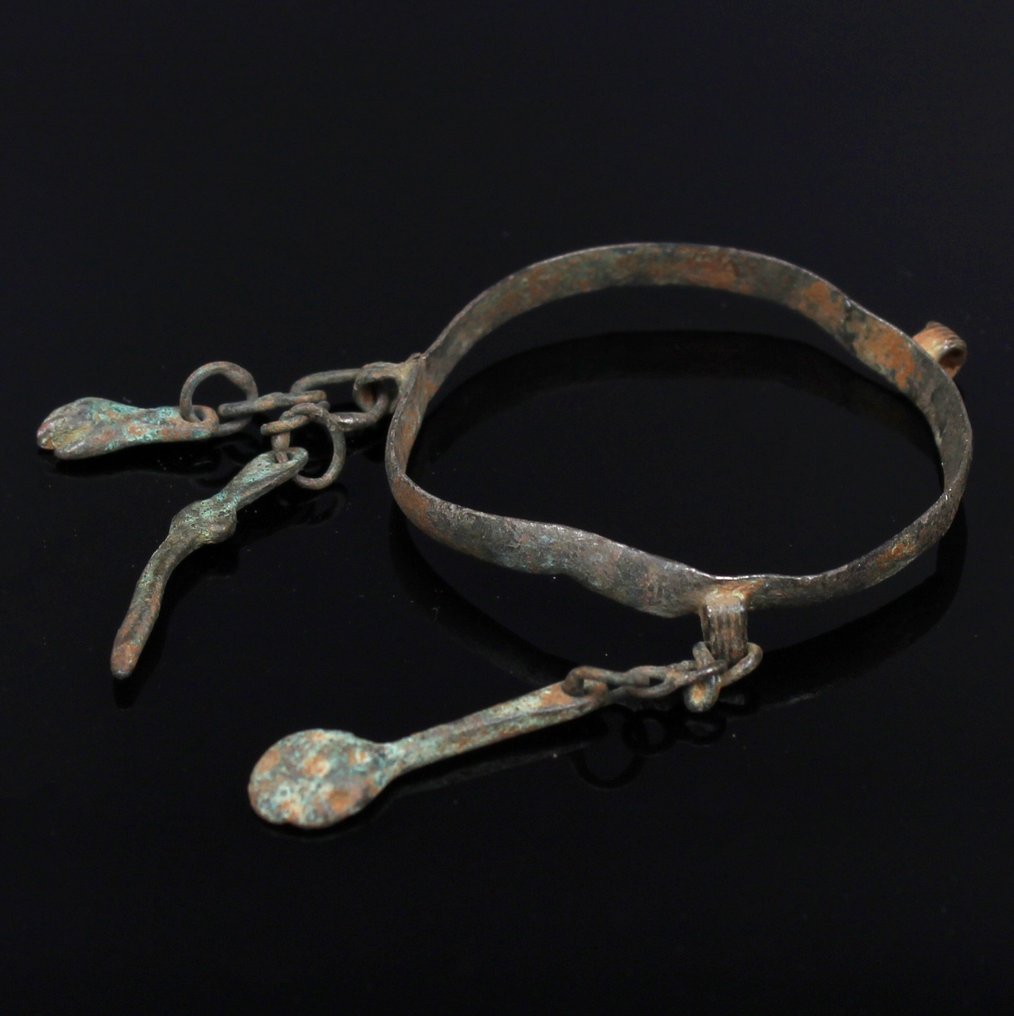
Ancient Roman Bronze Pendant with charms, amulets and figurines, RARE

00
days
04
hours
49
minutes
53
seconds
Current bid
€ 55
Reserve price not met

Expert
Selected by Peter Reynaers
Has nearly 30 years’ experience and moderated multiple online art research groups.
Estimate € 200 - € 250
8 other people are watching this object
 Bidder 8411 Bidder 8411 | €55 | |
|---|---|---|
| Bidder 8411 | €50 | |
| Bidder 8411 | €45 | |
Catawiki Buyer Protection
Your payment’s safe with us until you receive your object.View details
Trustpilot 4.4 | 123113 reviews
Rated Excellent on Trustpilot.
Pendant with charms, amulets and figurines, bronze, from Ancient Rome, 85 mm by 46 mm, in good condition, dating to the 2nd–4th century A.D., from an English private collection, acquired in 2024, with a Certificate of Authenticity and export license.
AI-assisted summary
Description from the seller
ITEM: Pendant with charms, amulets and figurines
MATERIAL: Bronze
CULTURE: Roman
PERIOD: 2nd - 4th Century A.D
DIMENSIONS: 85 mm x 46 mm
CONDITION: Good condition
PROVENANCE: Ex English private collection, acquired before 1990s
The concept of wearing a pendant adorned with a collection of smaller objects—charms, amulets, and figurines—was a widespread practice throughout the Roman world, serving a critical role in personal protection, superstition, and social signaling. These composite pendants were not merely decorative; each attached element, known collectively as bulla contents, or simply as lunulae (crescent moons) or phalli (penile amulets) when referring to the most common types, was chosen specifically for its perceived power to ward off the evil eye (malum oculus) or to attract good fortune. Often, these objects were strung together or attached to a main pendant or brooch, creating a miniature, wearable repository of protective magic that accompanied the wearer in all facets of daily life, from the military camp to the domestic sphere.
The selection of objects on a single pendant was highly individualized, drawing from a shared Roman vocabulary of protective symbols. Among the most popular charms were the phallic amulet (fascinum), considered the most potent defense against malevolent forces; the luna (crescent moon), particularly favored by women and girls, symbolizing protection, femininity, and fertility; and miniature figurines of deities like Hercules or Fortuna, invoking their specific protective domains. These items were often made of inexpensive materials like bronze, jet, bone, or even glass, ensuring their availability across various social strata. The multiplicity of charms was likely seen as a form of over-insurance, covering the wearer against a wide array of potential misfortunes and ensuring continuous divine favor.
These charm pendants were especially significant in the lives of children, particularly young boys, who wore the
Comes with Certificate of Authenticity and Export license
If you bid outside the European Union and win the item, we will have to apply for an export licence for your country and shipping will take 3 to 5 weeks.
Seller's Story
Your Antiquarian offers ancient art and ancient coins. Our main objective is to offer the highest quality at the best price respecting and strictly complying with the laws of heritage protection and UNESCO heritage norms. Therefore, all the pieces that are published come from private collections in which the provenance can be checked or international auctions. All our antiquities and coins are accompanied by their Certificate of Authenticity. We have a no quibble 90 day return policy. At Your Antiquarian we are committed to helping disadvantaged groups and for this reason a portion of each purchase is donated to charities to help people in need.
Translated by Google TranslateITEM: Pendant with charms, amulets and figurines
MATERIAL: Bronze
CULTURE: Roman
PERIOD: 2nd - 4th Century A.D
DIMENSIONS: 85 mm x 46 mm
CONDITION: Good condition
PROVENANCE: Ex English private collection, acquired before 1990s
The concept of wearing a pendant adorned with a collection of smaller objects—charms, amulets, and figurines—was a widespread practice throughout the Roman world, serving a critical role in personal protection, superstition, and social signaling. These composite pendants were not merely decorative; each attached element, known collectively as bulla contents, or simply as lunulae (crescent moons) or phalli (penile amulets) when referring to the most common types, was chosen specifically for its perceived power to ward off the evil eye (malum oculus) or to attract good fortune. Often, these objects were strung together or attached to a main pendant or brooch, creating a miniature, wearable repository of protective magic that accompanied the wearer in all facets of daily life, from the military camp to the domestic sphere.
The selection of objects on a single pendant was highly individualized, drawing from a shared Roman vocabulary of protective symbols. Among the most popular charms were the phallic amulet (fascinum), considered the most potent defense against malevolent forces; the luna (crescent moon), particularly favored by women and girls, symbolizing protection, femininity, and fertility; and miniature figurines of deities like Hercules or Fortuna, invoking their specific protective domains. These items were often made of inexpensive materials like bronze, jet, bone, or even glass, ensuring their availability across various social strata. The multiplicity of charms was likely seen as a form of over-insurance, covering the wearer against a wide array of potential misfortunes and ensuring continuous divine favor.
These charm pendants were especially significant in the lives of children, particularly young boys, who wore the
Comes with Certificate of Authenticity and Export license
If you bid outside the European Union and win the item, we will have to apply for an export licence for your country and shipping will take 3 to 5 weeks.
Seller's Story
Your Antiquarian offers ancient art and ancient coins. Our main objective is to offer the highest quality at the best price respecting and strictly complying with the laws of heritage protection and UNESCO heritage norms. Therefore, all the pieces that are published come from private collections in which the provenance can be checked or international auctions. All our antiquities and coins are accompanied by their Certificate of Authenticity. We have a no quibble 90 day return policy. At Your Antiquarian we are committed to helping disadvantaged groups and for this reason a portion of each purchase is donated to charities to help people in need.
Translated by Google TranslateDetails
Culture
Ancient Roman
Century/ Timeframe
2nd - 4th Century A.D
Name of object
Pendant with charms, amulets and figurines, RARE
Acquired from
Private collection
Year acquired
2024
Material
Bronze
Country acquired from
United Kingdom
Condition
Good
Previous owner acquired from
Antique market
Previous owner - year acquired
1990
Previous owner - country acquired from
United Kingdom
I verify that I have obtained this object legally and that I am allowed to sell it
Yes
Sold by
Disclaimer
The seller was informed by Catawiki about documentation requirements and guarantees the following: - the object was legally obtained, - the seller has the right to sell and/or export the object, as relevant, - the seller will provide the necessary provenance information and arrange required documentation and permits/licenses, as applicable and as per local laws, - the seller will notify the buyer of any delays in obtaining permits/licenses. By bidding, you acknowledge that import documentation may be required depending on your country of residence and that obtaining permits/licenses may cause delays in the delivery of your object.
The seller was informed by Catawiki about documentation requirements and guarantees the following: - the object was legally obtained, - the seller has the right to sell and/or export the object, as relevant, - the seller will provide the necessary provenance information and arrange required documentation and permits/licenses, as applicable and as per local laws, - the seller will notify the buyer of any delays in obtaining permits/licenses. By bidding, you acknowledge that import documentation may be required depending on your country of residence and that obtaining permits/licenses may cause delays in the delivery of your object.
