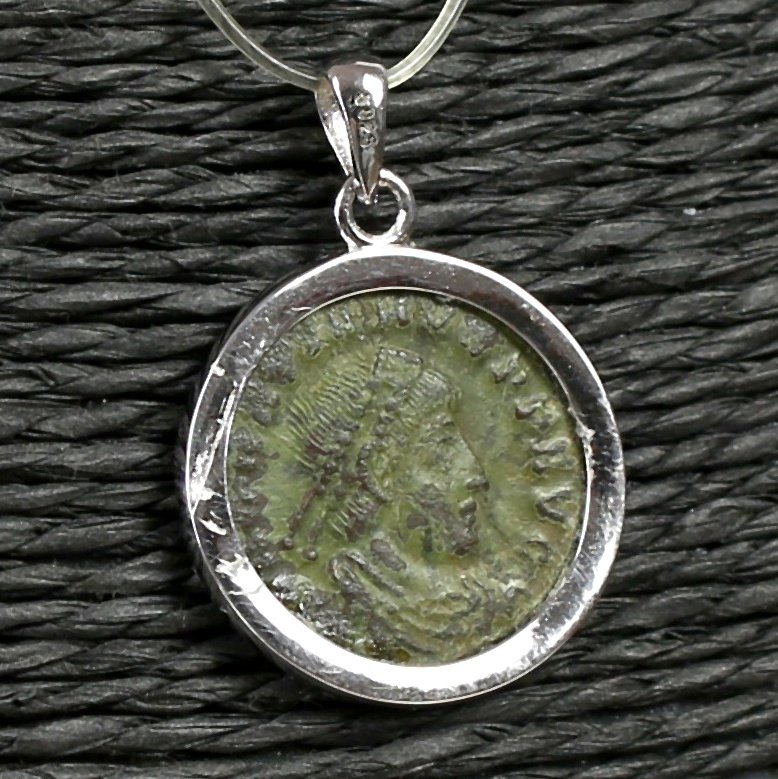
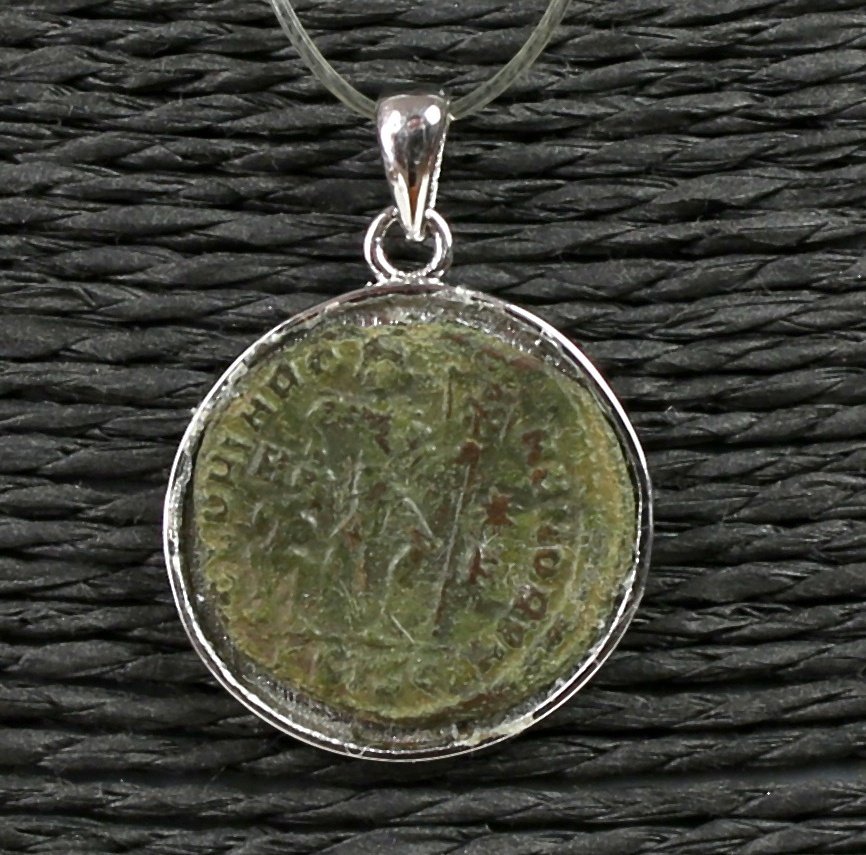
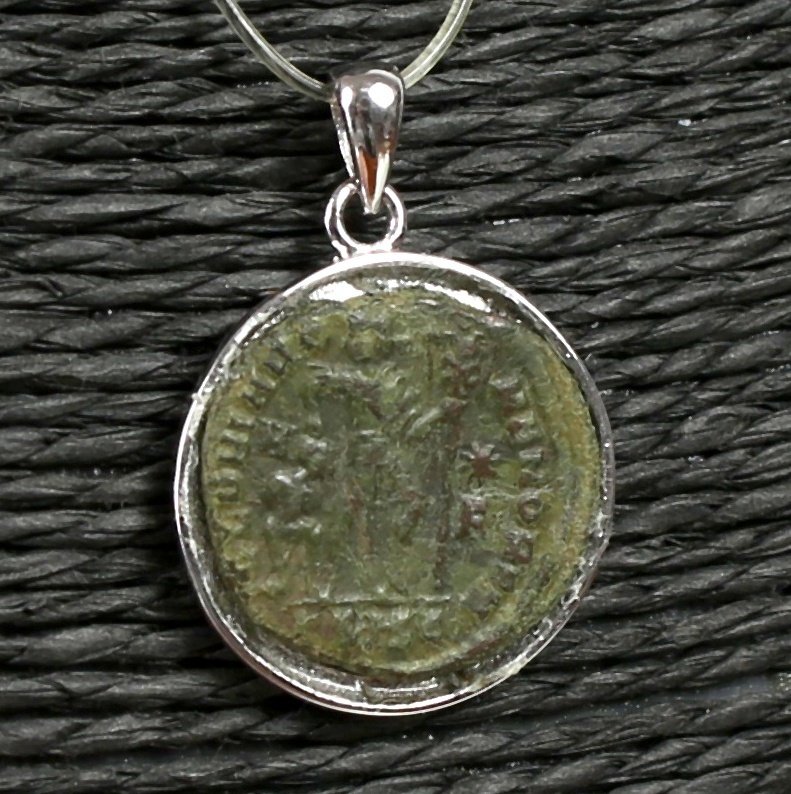
Modern Silver Pendant with Valentinian I coin (No reserve price)

08
days
20
hours
40
minutes
23
seconds
Current bid
€ 1
No reserve price

Expert
Selected by Ruth Garrido Vila
Directed the Ifergan Collection Museum, specialising in Phoenician and Mediterranean archaeology.
Estimate € 250 - € 300
6 other people are watching this object
 Bidder 9626 Bidder 9626 | €1 |
|---|
Catawiki Buyer Protection
Your payment’s safe with us until you receive your object.View details
Trustpilot 4.4 | 122910 reviews
Rated Excellent on Trustpilot.
Pendant with Valentinian I coin, 20 mm diameter, silver with a bronze coin, in good condition, mounted in a modern circular silver setting, from a Belgian private collection, with Certificate of Authenticity.
AI-assisted summary
Description from the seller
ITEM: Pendant with Valentinian I coin
MATERIAL: Silver and bronze
CULTURE: Roman
PERIOD: 4th Century A.D
DIMENSIONS: 20 mm diameter
CONDITION: Good condition. Original coin within a modern handmade circular silver setting.
PROVENANCE: Ex Belgian private collection, acquired in the 1990s (Coin)
Comes with Certificate of Authenticity.
COIN DESCRIPTION: "Valentinian I, Siscia, Obv: DN VALENTINIANVS PF AVG GLORIA ROMANORUM, Mintmark BSISC, Ref: RIC IX Siscia 14a, Type XVI"
Valentinian I (reigned 364–375 CE) was a powerful and capable Roman emperor who rose from humble origins in Pannonia to rule the Western Roman Empire during a critical period of external threats. Proclaimed emperor by the army in 364 CE, he immediately addressed the growing strategic complexity of the vast empire by appointing his less experienced brother, Valens, as co-emperor, entrusting him with the East while retaining the West for himself. This division, which became increasingly entrenched, allowed Valentinian to focus his formidable energy and military expertise entirely on the security and defense of the western provinces, particularly the vulnerable Rhine and Danube frontiers, earning him the reputation as one of the last truly impressive Western emperors.
Valentinian's primary legacy is his tireless military dedication and frontier fortification. He was almost constantly campaigning, personally leading successful wars against the Alamanni across the Rhine and the Quadi and Sarmatians along the Danube. He oversaw an impressive program of fort building and reinforcement along the northern borders, demonstrating a strategic commitment to defense that went beyond mere reaction. Furthermore, he dispatched his brilliant general, Count Theodosius the Elder, to Britain, where he successfully quelled the widespread threat known as the Great Conspiracy, which involved the Picts, Scots, and Saxons. This strategic focus made his reign a period of relative security for the West, even as the empire faced relentless pressure.
Beyond his military achievements, Valentinian was a committed, though often harsh, administrator with a noted concern for the welfare of the lower classes. He introduced the office of the Defender of the Plebs (Defensor Civitatis) to protect the poor from corrupt officials and extortion. Though a Nicene Christian, he maintained a policy of broad religious toleration in the West, refusing to interfere in doctrinal disputes, unlike his Arian brother, Valens, in the East. Unfortunately, his effectiveness was marred by a violent temper, which ultimately proved fatal. In 375 CE, while meeting with envoys from the Quadi, Valentinian reportedly suffered a fatal stroke during a furious tirade, bringing an abrupt end to his vital and active reign and leaving the West to his young sons, Gratian and Valentinian II, thus establishing the Valentinianic Dynasty.
Seller's Story
Your Antiquarian offers ancient art and ancient coins. Our main objective is to offer the highest quality at the best price respecting and strictly complying with the laws of heritage protection and UNESCO heritage norms. Therefore, all the pieces that are published come from private collections in which the provenance can be checked or international auctions. All our antiquities and coins are accompanied by their Certificate of Authenticity. We have a no quibble 90 day return policy. At Your Antiquarian we are committed to helping disadvantaged groups and for this reason a portion of each purchase is donated to charities to help people in need.
Translated by Google TranslateITEM: Pendant with Valentinian I coin
MATERIAL: Silver and bronze
CULTURE: Roman
PERIOD: 4th Century A.D
DIMENSIONS: 20 mm diameter
CONDITION: Good condition. Original coin within a modern handmade circular silver setting.
PROVENANCE: Ex Belgian private collection, acquired in the 1990s (Coin)
Comes with Certificate of Authenticity.
COIN DESCRIPTION: "Valentinian I, Siscia, Obv: DN VALENTINIANVS PF AVG GLORIA ROMANORUM, Mintmark BSISC, Ref: RIC IX Siscia 14a, Type XVI"
Valentinian I (reigned 364–375 CE) was a powerful and capable Roman emperor who rose from humble origins in Pannonia to rule the Western Roman Empire during a critical period of external threats. Proclaimed emperor by the army in 364 CE, he immediately addressed the growing strategic complexity of the vast empire by appointing his less experienced brother, Valens, as co-emperor, entrusting him with the East while retaining the West for himself. This division, which became increasingly entrenched, allowed Valentinian to focus his formidable energy and military expertise entirely on the security and defense of the western provinces, particularly the vulnerable Rhine and Danube frontiers, earning him the reputation as one of the last truly impressive Western emperors.
Valentinian's primary legacy is his tireless military dedication and frontier fortification. He was almost constantly campaigning, personally leading successful wars against the Alamanni across the Rhine and the Quadi and Sarmatians along the Danube. He oversaw an impressive program of fort building and reinforcement along the northern borders, demonstrating a strategic commitment to defense that went beyond mere reaction. Furthermore, he dispatched his brilliant general, Count Theodosius the Elder, to Britain, where he successfully quelled the widespread threat known as the Great Conspiracy, which involved the Picts, Scots, and Saxons. This strategic focus made his reign a period of relative security for the West, even as the empire faced relentless pressure.
Beyond his military achievements, Valentinian was a committed, though often harsh, administrator with a noted concern for the welfare of the lower classes. He introduced the office of the Defender of the Plebs (Defensor Civitatis) to protect the poor from corrupt officials and extortion. Though a Nicene Christian, he maintained a policy of broad religious toleration in the West, refusing to interfere in doctrinal disputes, unlike his Arian brother, Valens, in the East. Unfortunately, his effectiveness was marred by a violent temper, which ultimately proved fatal. In 375 CE, while meeting with envoys from the Quadi, Valentinian reportedly suffered a fatal stroke during a furious tirade, bringing an abrupt end to his vital and active reign and leaving the West to his young sons, Gratian and Valentinian II, thus establishing the Valentinianic Dynasty.
Seller's Story
Your Antiquarian offers ancient art and ancient coins. Our main objective is to offer the highest quality at the best price respecting and strictly complying with the laws of heritage protection and UNESCO heritage norms. Therefore, all the pieces that are published come from private collections in which the provenance can be checked or international auctions. All our antiquities and coins are accompanied by their Certificate of Authenticity. We have a no quibble 90 day return policy. At Your Antiquarian we are committed to helping disadvantaged groups and for this reason a portion of each purchase is donated to charities to help people in need.
Translated by Google TranslateDetails
Culture
Modern Silver
Century/ Timeframe
4th Century A.D
Name of object
Pendant with Valentinian I coin
Acquired from
Private collection
Year acquired
2025
Country acquired from
Belgium
Condition
Good
Previous owner acquired from
Antique market
Previous owner - year acquired
1990
Previous owner - country acquired from
Belgium
I verify that I have obtained this object legally and that I am allowed to sell it
Yes
Sold by
Disclaimer
The seller was informed by Catawiki about documentation requirements and guarantees the following: - the object was legally obtained, - the seller has the right to sell and/or export the object, as relevant, - the seller will provide the necessary provenance information and arrange required documentation and permits/licenses, as applicable and as per local laws, - the seller will notify the buyer of any delays in obtaining permits/licenses. By bidding, you acknowledge that import documentation may be required depending on your country of residence and that obtaining permits/licenses may cause delays in the delivery of your object.
The seller was informed by Catawiki about documentation requirements and guarantees the following: - the object was legally obtained, - the seller has the right to sell and/or export the object, as relevant, - the seller will provide the necessary provenance information and arrange required documentation and permits/licenses, as applicable and as per local laws, - the seller will notify the buyer of any delays in obtaining permits/licenses. By bidding, you acknowledge that import documentation may be required depending on your country of residence and that obtaining permits/licenses may cause delays in the delivery of your object.
