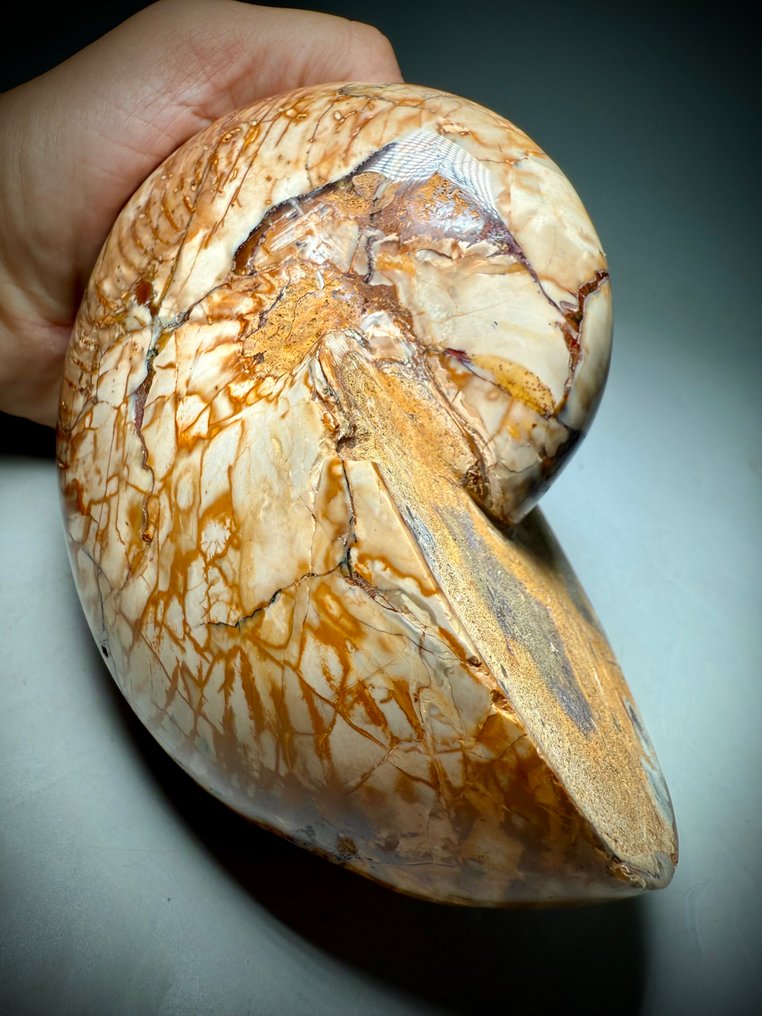
Huge polished fossil nautilus with iridescent shine - Fossilised shell - Cymatoceras sp. (No reserve price)




Opens 16:00
Starting bid
€ 1
Add to your favourites to get an alert when the auction starts.

Catawiki Buyer Protection
Your payment’s safe with us until you receive your object.View details
Trustpilot 4.4 | 122910 reviews
Rated Excellent on Trustpilot.
Description from the seller
This stunning 14.5 cm wide Polished Nautilus Fossil displays gorgeous striped brown, caramel, and cream patterns.
This Cretaceous Period fossil is 120 million years old.
Well displayed on a thick metal support.
The specimen is very heavy.
These nautiloids are much rarer than the ammonites so frequently seen.
A nautilus's shell is made up of two layers. The inner layer has the iridescent shine, while the outer layer provides protection from external forces.
Inside the shell are septa that divide the living area of the shell into compartments and help the animal maintain balance and position in the water column.
Nautilus are 'living fossils': species similar to this one still exist in our oceans!
The nautilus is a free-swimming mollusk related to the squid or octopus, but with a hard, multi-chambered spiraling shell.
Note: near the support's hole, the conch layers are missing.
Seller's Story
Don & Donna Fossils finally moved to Spain.
We are a Don & Donna Fossils, a couple united by the love of exploration, field research, professional preparation and museum display of fossils from all over the world.
This formula, combined with a desire to improve, makes us a winning team dedicated to our Fossil World.
Larisa is been passionate about fossils since was a child. Her strengths are perfectionism, perseverance and creativity, hence her ability to work and prepare these fossils as authentic, unique and aesthetic as possible. The pieces with which she is famous and which she boast the most are spiny ammonites.
I, Don, started fossil hunting in 1987, going from a passionate collector to a professional preparator and researcher. In all these years I have traveled searching for fossils in many parts of the world.
Our fossils are present in private collections in the United States, Singapore, Taiwan, as well as in prestigious museums in the Uk, China and Japan.
Quality in the preparation of the material and seriousness in managing the shipment in the best possible way distinguish us.
Don & Donna
This stunning 14.5 cm wide Polished Nautilus Fossil displays gorgeous striped brown, caramel, and cream patterns.
This Cretaceous Period fossil is 120 million years old.
Well displayed on a thick metal support.
The specimen is very heavy.
These nautiloids are much rarer than the ammonites so frequently seen.
A nautilus's shell is made up of two layers. The inner layer has the iridescent shine, while the outer layer provides protection from external forces.
Inside the shell are septa that divide the living area of the shell into compartments and help the animal maintain balance and position in the water column.
Nautilus are 'living fossils': species similar to this one still exist in our oceans!
The nautilus is a free-swimming mollusk related to the squid or octopus, but with a hard, multi-chambered spiraling shell.
Note: near the support's hole, the conch layers are missing.
Seller's Story
Don & Donna Fossils finally moved to Spain.
We are a Don & Donna Fossils, a couple united by the love of exploration, field research, professional preparation and museum display of fossils from all over the world.
This formula, combined with a desire to improve, makes us a winning team dedicated to our Fossil World.
Larisa is been passionate about fossils since was a child. Her strengths are perfectionism, perseverance and creativity, hence her ability to work and prepare these fossils as authentic, unique and aesthetic as possible. The pieces with which she is famous and which she boast the most are spiny ammonites.
I, Don, started fossil hunting in 1987, going from a passionate collector to a professional preparator and researcher. In all these years I have traveled searching for fossils in many parts of the world.
Our fossils are present in private collections in the United States, Singapore, Taiwan, as well as in prestigious museums in the Uk, China and Japan.
Quality in the preparation of the material and seriousness in managing the shipment in the best possible way distinguish us.
Don & Donna
Details
Specimen
Huge polished fossil nautilus with iridescent shine
Scientific name
Cymatoceras sp.
Country of Origin
Madagascar
Geological Period
Cretaceous (145 - 66 million years)
Condition
Enhanced
Treatment
Polished
Sold by
