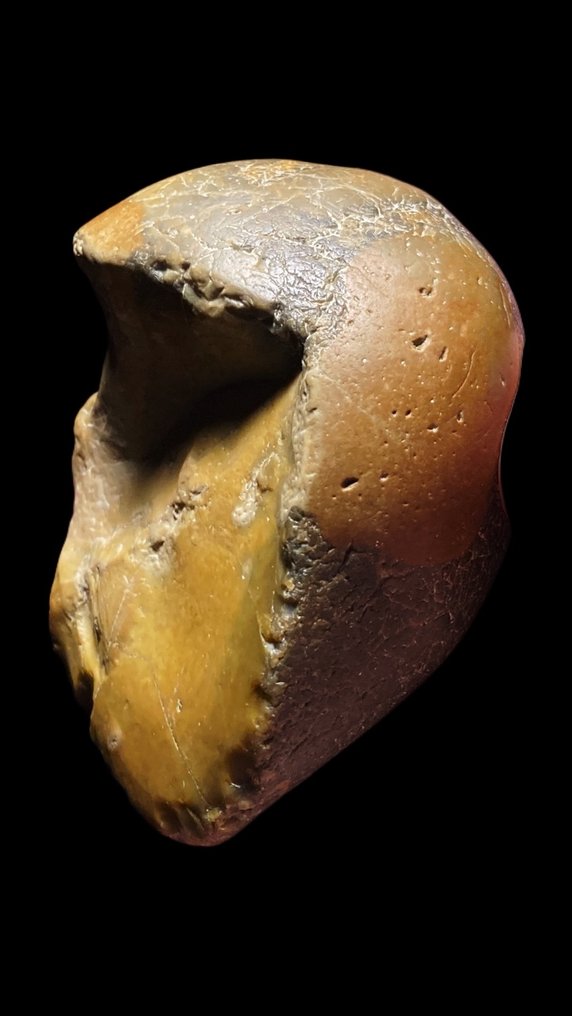
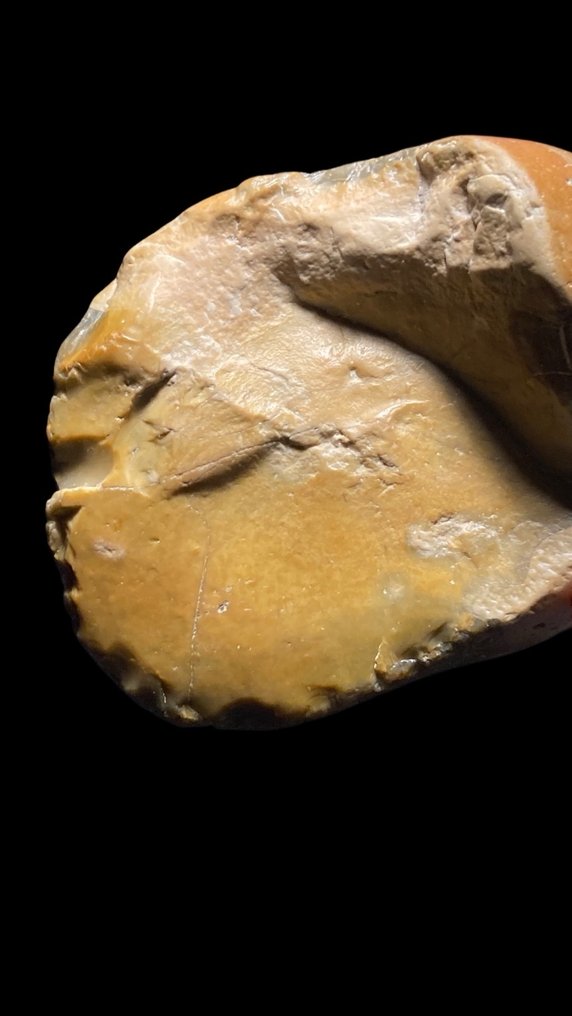
Paleolithic Flint Unifacial Pebble Chopper - 8 cm (No reserve price)



Opens 17:00
Starting bid
€ 1
Add to your favourites to get an alert when the auction starts.

Expert
Selected by Peter Reynaers
Has nearly 30 years’ experience and moderated multiple online art research groups.
Estimate € 150 - € 200
Catawiki Buyer Protection
Your payment’s safe with us until you receive your object.View details
Trustpilot 4.4 | 123077 reviews
Rated Excellent on Trustpilot.
Description from the seller
A robust prehistoric unifacial chopper made from a natural river flint pebble, showing clear early stone-tool technology. The piece features a well-defined working edge with sequential negative flake scars and a large ergonomic thumb/finger hollow on the opposite side, indicating comfortable hand-held use during heavy cutting, scraping, or bone-processing tasks.
The cortex is beautifully preserved with an old river patina typical for material collected from ancient Pleistocene terraces. The active edge displays intentional shaping rather than random geological fracturing, and the tool sits naturally in the hand — a classic hallmark of early Mode 1/Mode 2 functionality.
This is a solid, carefully selected pebble tool with excellent preservation, highly representative of early Palaeolithic heavy-duty workmanship.
Dimensions: approx. 8.0 × 6.0 × 4.5 cm
Weight: 304 g
Condition: Excellent, intact, with stable ancient patina
Type: Unifacial chopper / heavy side scraper
This is a solid, carefully selected pebble tool with excellent preservation, highly representative of early Palaeolithic heavy-duty workmanship.
Provenance:
Found in the Netherlands (river terrace gravels).
Stone objects of this prehistoric type have been collected and held in private collections in the Netherlands since before 1999.
This specific item was acquired directly by the current owner in 2024–2025, the Netherlands, and has since formed part of a private collection.
From the private collection of H.L., the Netherlands.
Legally obtained from publicly accessible river gravel deposits with no protected archaeological context.
No excavation was carried out.
No permit or authorization from the Cultural Heritage Agency of the Netherlands (RCE) is required for ownership or sale.
The object requires no export license for transport within the EU. International shipping follows standard regulations for archaeological stone artifacts, which do not involve restricted materials. The item will be carefully packed using protective materials and shipped with full tracking to ensure safe and secure delivery.
A robust prehistoric unifacial chopper made from a natural river flint pebble, showing clear early stone-tool technology. The piece features a well-defined working edge with sequential negative flake scars and a large ergonomic thumb/finger hollow on the opposite side, indicating comfortable hand-held use during heavy cutting, scraping, or bone-processing tasks.
The cortex is beautifully preserved with an old river patina typical for material collected from ancient Pleistocene terraces. The active edge displays intentional shaping rather than random geological fracturing, and the tool sits naturally in the hand — a classic hallmark of early Mode 1/Mode 2 functionality.
This is a solid, carefully selected pebble tool with excellent preservation, highly representative of early Palaeolithic heavy-duty workmanship.
Dimensions: approx. 8.0 × 6.0 × 4.5 cm
Weight: 304 g
Condition: Excellent, intact, with stable ancient patina
Type: Unifacial chopper / heavy side scraper
This is a solid, carefully selected pebble tool with excellent preservation, highly representative of early Palaeolithic heavy-duty workmanship.
Provenance:
Found in the Netherlands (river terrace gravels).
Stone objects of this prehistoric type have been collected and held in private collections in the Netherlands since before 1999.
This specific item was acquired directly by the current owner in 2024–2025, the Netherlands, and has since formed part of a private collection.
From the private collection of H.L., the Netherlands.
Legally obtained from publicly accessible river gravel deposits with no protected archaeological context.
No excavation was carried out.
No permit or authorization from the Cultural Heritage Agency of the Netherlands (RCE) is required for ownership or sale.
The object requires no export license for transport within the EU. International shipping follows standard regulations for archaeological stone artifacts, which do not involve restricted materials. The item will be carefully packed using protective materials and shipped with full tracking to ensure safe and secure delivery.
Details
Culture
Paleolithic
Century/ Timeframe
Lower–Middle Paleolithic, ca. 300,000–100,000 BCE
Name of object
Unifacial Pebble Chopper
Acquired from
Private collection
Year acquired
2024
Material
Flint
Country acquired from
Netherlands
Condition
Excellent
Previous owner acquired from
Private collection
Height
8 cm
Previous owner - year acquired
1998
Width
6 cm
Previous owner - country acquired from
Netherlands
Depth
4.5 cm
I verify that I have obtained this object legally and that I am allowed to sell it
Yes
Sold by
