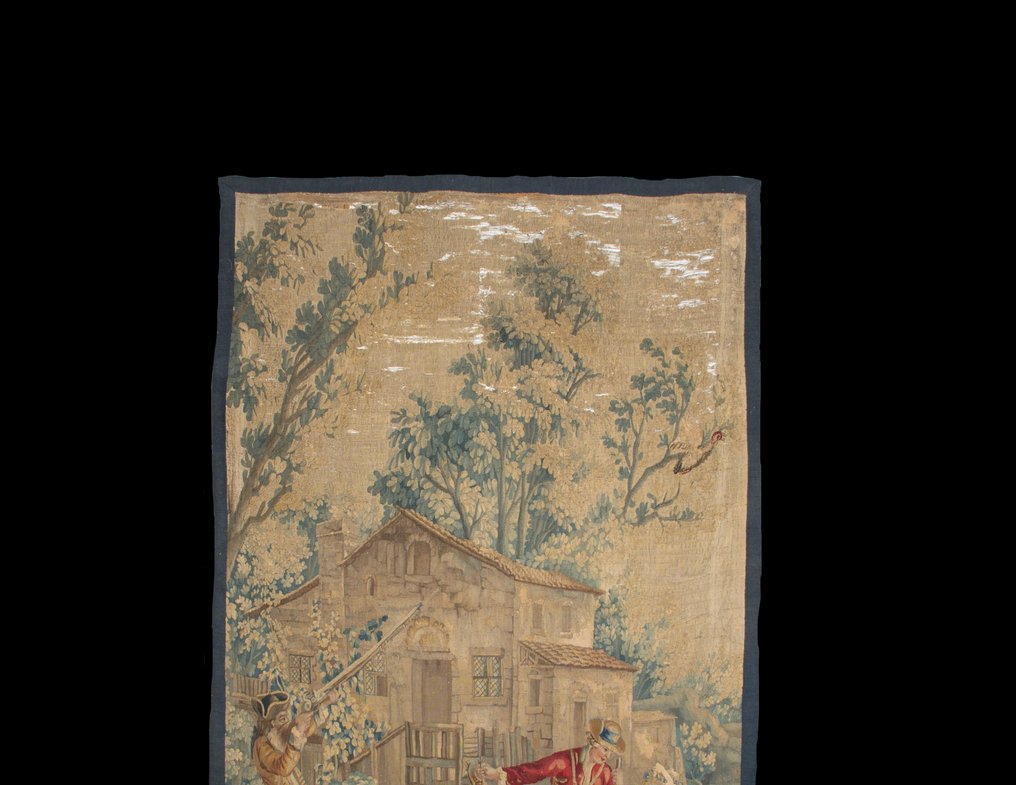
Manufacture Royale d'Aubusson d'après Jean-Baptiste Huet - Tapestry - 2.3 m - 1.38 m - Hunting stop scene


04
days
17
hours
35
minutes
07
seconds
Current bid
€ 1
Reserve price not met

Expert
Selected by Dési van Rhee
Over 20 years' experience in antiques with a background in art history.
Estimate € 1,800 - € 2,800
5 other people are watching this object
 Bidder 7390 Bidder 7390 | €1 |
|---|
Catawiki Buyer Protection
Your payment’s safe with us until you receive your object.View details
Trustpilot 4.4 | 122630 reviews
Rated Excellent on Trustpilot.
An 18th‑century Aubusson tapestry from France, woven in wool and silk, depicting a hunting halt scene, attributed to the Aubusson circle around Huet and Julliard, measuring 2.30 m high by 1.38 m wide, made by Manufacture Royale d'Aubusson.
AI-assisted summary
Description from the seller
18th-century Aubusson tapestry – Hunting stop scene
Beautiful Aubusson tapestry in wool and silk, dating from the 18th century, depicting a scene of a hunting halt in front of a rustic dwelling.
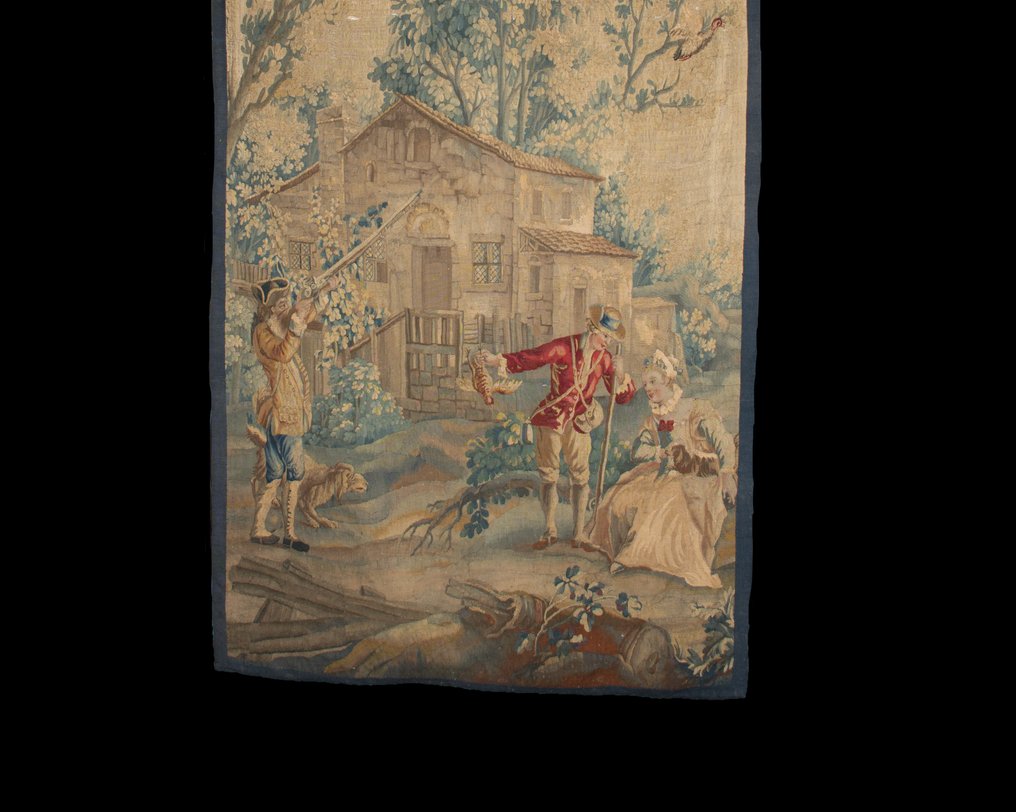
In the foreground, a pair of hunters converse. One of them, dressed in an embroidered red coat, presents freshly caught game, while a seated lady, elegantly dressed, listens while holding a pastoral staff.
On the left, a hunting companion is shooting at a flying bird, accompanied by a trained dog.
The background shows a stone country house nestled in a leafy landscape with fresh foliage, typical of French greenery from the era. The scene illustrates the narrative and friendly spirit dear to the manufactories of Aubusson.
The attribution of this tapestry to the circle of painter-cartonnists active in Aubusson in the second half of the 18th century, notably around Jacques-Nicolas Julliard and Pierre Dumonsil, is justified by several matching characteristics.
As in the Moulin de Charenton (mentioned by Chevalier, pp. 147-148, Les Tapisserie d'Aubusson et de Felletin), we find here:
A monumental rural house occupying the center of the composition, articulated around a staircase, with picturesque frameworks and volumes.
A foreground animated with elegantly dressed characters, whose narrative attitude—halt, conversation, presentation of the game—responds to the charming theatricality of rustic amusements.
A landscape style made up of flexible leafy masses, characteristic of the tapestries supplied to Aubusson after 1755.
In both works, rustic architecture is not merely decorative but a narrative focal point around which the relationships between hunting, sociability, and noble leisure are built.
This iconographic kinship, combined with the treatment of the landscape and figures, allows us to place our tapestry within the same tradition as the Moulin de Charenton, that is, within the pastoral language disseminated in Aubusson under the influence of Huet and Boucher, relayed by Julliard and the local painters who assisted them.
Thus, without being able to name a specific missing panel, the stylistic and thematic consistency allows for a convincing association with this group of works, confirming an attribution to the aubussonnais circle active between 1755 and 1780.
A beautiful decorative example of Aubusson production, combining an elegant landscape, picturesque architecture, and a narration of rural courtesy.
The tapestry is in good condition in its lower part. In the upper part, a few weaknesses in the silks are noticeable, as shown in the photographs.
Provenance: private collection.
18th-century Aubusson tapestry – Hunting stop scene
Beautiful Aubusson tapestry in wool and silk, dating from the 18th century, depicting a scene of a hunting halt in front of a rustic dwelling.
In the foreground, a pair of hunters converse. One of them, dressed in an embroidered red coat, presents freshly caught game, while a seated lady, elegantly dressed, listens while holding a pastoral staff.
On the left, a hunting companion is shooting at a flying bird, accompanied by a trained dog.
The background shows a stone country house nestled in a leafy landscape with fresh foliage, typical of French greenery from the era. The scene illustrates the narrative and friendly spirit dear to the manufactories of Aubusson.
The attribution of this tapestry to the circle of painter-cartonnists active in Aubusson in the second half of the 18th century, notably around Jacques-Nicolas Julliard and Pierre Dumonsil, is justified by several matching characteristics.
As in the Moulin de Charenton (mentioned by Chevalier, pp. 147-148, Les Tapisserie d'Aubusson et de Felletin), we find here:
A monumental rural house occupying the center of the composition, articulated around a staircase, with picturesque frameworks and volumes.
A foreground animated with elegantly dressed characters, whose narrative attitude—halt, conversation, presentation of the game—responds to the charming theatricality of rustic amusements.
A landscape style made up of flexible leafy masses, characteristic of the tapestries supplied to Aubusson after 1755.
In both works, rustic architecture is not merely decorative but a narrative focal point around which the relationships between hunting, sociability, and noble leisure are built.
This iconographic kinship, combined with the treatment of the landscape and figures, allows us to place our tapestry within the same tradition as the Moulin de Charenton, that is, within the pastoral language disseminated in Aubusson under the influence of Huet and Boucher, relayed by Julliard and the local painters who assisted them.
Thus, without being able to name a specific missing panel, the stylistic and thematic consistency allows for a convincing association with this group of works, confirming an attribution to the aubussonnais circle active between 1755 and 1780.
A beautiful decorative example of Aubusson production, combining an elegant landscape, picturesque architecture, and a narration of rural courtesy.
The tapestry is in good condition in its lower part. In the upper part, a few weaknesses in the silks are noticeable, as shown in the photographs.
Provenance: private collection.
Details
Era
1400-1900
Title additional information
Hunting stop scene
Material
Silk, Wool
Manufacturer/ Brand
Manufacture Royale d'Aubusson
Designer/Artist/Maker
d'après Jean-Baptiste Huet
Country of Origin
France
Height
2.3 m
Width
1.38 m
Condition
Good condition - used with small signs of aging & blemishes
Estimated period
1750-1800