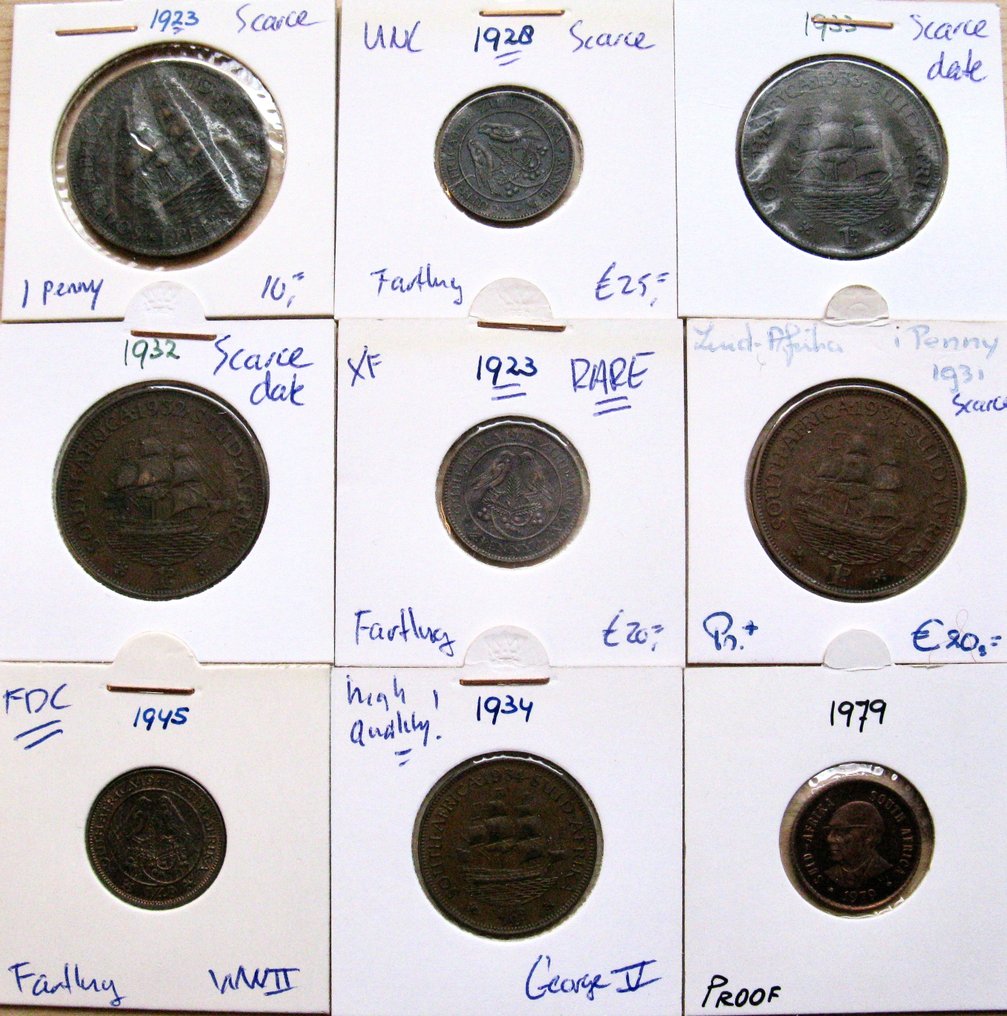
South Africa. 200+ Coins Incl. 20+ SILVER. 1895-2016 Amazing collection. no double coins in the lot (No reserve price)




05
days
15
hours
57
minutes
18
seconds

30 other people are watching this object
 Bidder 7457 Bidder 7457 | €123 | |
|---|---|---|
 Bidder 2020 Bidder 2020 | €113 | |
 Bidder 5124 Bidder 5124 | €103 | |
Catawiki Buyer Protection
Your payment’s safe with us until you receive your object.View details
Trustpilot 4.4 | 122529 reviews
Rated Excellent on Trustpilot.
Ungraded South Africa silver coin collection with 200+ coins, including 20+ silver pieces and several pre-1950 issues, all in coin holders, with no double coins in the lot.
AI-assisted summary
Description from the seller
South Africa - Amazing collection, no double coins in the lot, including 20+ (!) silver coins and several "OLDER" pieces minted before 1950 (approx. 20%). Total amount 200 + coins all in coin holders.
Must be seen, please have a look at the pictures !
Fantastic lot of coins to sort out. Total more than 200 pieces starting from 1895 up to present, including many silver ones (20+ incl. Paul Kruger and other "better" pieces) and a large amount of older coins minted before 1950 (approx. 20% of the lot).
What you see is what you get. No reserve price.
Please have a look at our other Catawiki auction lots for more coin collections. and/or add us to your favourites to find our future auction lots easily.
Bid with confidence. AG-Worldcoins, over 7000 lots sold on Catawiki. High feedback score.
Please evaluate this lot with reference to the images provided.
Will be sent via registered mail.
I charge only 1x shipping costs when you buy multiple lots in the same auction.
You are welcome to bid on my other items:
https://veiling.catawiki.nl/aanbod/hamaca
extra info:
The Republic of South Africa, located at the southern tip of Africa, has an area of 471,445 sq. mi. (1,221,043 sq. km.) . Capitals: Administrative, Pretoria; Legislative, Cape Town; Judicial, Bloemfontein. Manufacturing, mining and agriculture are the principal industries. Exports include wool, diamonds, gold, and metallic ores.
Portuguese navigator Bartholomew Diaz became the first European to sight the region of South Africa when he rounded the Cape of Good Hope in 1488, but throughout the 16th century the only white men to come ashore were the survivors of ships wrecked while attempting the stormy Cape passage. Jan van Riebeeck of the Dutch East India Company established the first permanent settlement in 1652. In subsequent decades additional Dutch, German and Huguenot refugees from France settled in the Cape area to form the Afrikaner segment of today’s population.
Great Britain captured the Cape colony in 1795, and again in 1806, receiving permanent title in 1814. To escape British political rule and cultural dominance, many Afrikaner farmers (Boers) migrated northward (the Great Trek) beginning in 1836, and established the independent Boer Republics of the Transvaal (the South African Republic, Zuid Afrikaansche Republic) in 1852, and the Orange Free State in 1854. British political intrigues against the two republics, coupled with the discovery of diamonds and gold in the Boer-settled regions, led to the bitter Boer Wars (1880-81, 1899-1902) and incorporation of the Boer republics into the British Empire.
On May 31, 1910, the two former Boer Republics (Transvaal and Orange Free State) were joined with the British colonies of Cape of Good Hope and Natal to form the Union of South Africa, a dominion of the British Empire. In 1934 the Union
achieved status as a sovereign state within the British Empire. Political integration of the various colonies did not still the conflict between the Afrikaners and the English-speaking groups, which continued to have a significant impact on political developments. A resurgence of Afrikaner nationalism in the 1940s and 1950s led to a referendum in the white community authorizing the relinquishment of dominion status and the establishment of a republic. The decision took effect on May 31, 1961. The Republic of South Africa withdrew from the British
Commonwealth in Oct. 1961.
The apartheid era ended April 27, 1994 with the first
democratic election for all people of South Africa. Nelson Mandela was inaugurated President May 10, 1994, and South Africa was readmitted into the Commonwealth of Nations. Walvis Bay, former enclave of Cape Province, transferred to Namibia.
South African coins and currency bear inscriptions in tribal languages, Afrikaans and English.
South Africa - Amazing collection, no double coins in the lot, including 20+ (!) silver coins and several "OLDER" pieces minted before 1950 (approx. 20%). Total amount 200 + coins all in coin holders.
Must be seen, please have a look at the pictures !
Fantastic lot of coins to sort out. Total more than 200 pieces starting from 1895 up to present, including many silver ones (20+ incl. Paul Kruger and other "better" pieces) and a large amount of older coins minted before 1950 (approx. 20% of the lot).
What you see is what you get. No reserve price.
Please have a look at our other Catawiki auction lots for more coin collections. and/or add us to your favourites to find our future auction lots easily.
Bid with confidence. AG-Worldcoins, over 7000 lots sold on Catawiki. High feedback score.
Please evaluate this lot with reference to the images provided.
Will be sent via registered mail.
I charge only 1x shipping costs when you buy multiple lots in the same auction.
You are welcome to bid on my other items:
https://veiling.catawiki.nl/aanbod/hamaca
extra info:
The Republic of South Africa, located at the southern tip of Africa, has an area of 471,445 sq. mi. (1,221,043 sq. km.) . Capitals: Administrative, Pretoria; Legislative, Cape Town; Judicial, Bloemfontein. Manufacturing, mining and agriculture are the principal industries. Exports include wool, diamonds, gold, and metallic ores.
Portuguese navigator Bartholomew Diaz became the first European to sight the region of South Africa when he rounded the Cape of Good Hope in 1488, but throughout the 16th century the only white men to come ashore were the survivors of ships wrecked while attempting the stormy Cape passage. Jan van Riebeeck of the Dutch East India Company established the first permanent settlement in 1652. In subsequent decades additional Dutch, German and Huguenot refugees from France settled in the Cape area to form the Afrikaner segment of today’s population.
Great Britain captured the Cape colony in 1795, and again in 1806, receiving permanent title in 1814. To escape British political rule and cultural dominance, many Afrikaner farmers (Boers) migrated northward (the Great Trek) beginning in 1836, and established the independent Boer Republics of the Transvaal (the South African Republic, Zuid Afrikaansche Republic) in 1852, and the Orange Free State in 1854. British political intrigues against the two republics, coupled with the discovery of diamonds and gold in the Boer-settled regions, led to the bitter Boer Wars (1880-81, 1899-1902) and incorporation of the Boer republics into the British Empire.
On May 31, 1910, the two former Boer Republics (Transvaal and Orange Free State) were joined with the British colonies of Cape of Good Hope and Natal to form the Union of South Africa, a dominion of the British Empire. In 1934 the Union
achieved status as a sovereign state within the British Empire. Political integration of the various colonies did not still the conflict between the Afrikaners and the English-speaking groups, which continued to have a significant impact on political developments. A resurgence of Afrikaner nationalism in the 1940s and 1950s led to a referendum in the white community authorizing the relinquishment of dominion status and the establishment of a republic. The decision took effect on May 31, 1961. The Republic of South Africa withdrew from the British
Commonwealth in Oct. 1961.
The apartheid era ended April 27, 1994 with the first
democratic election for all people of South Africa. Nelson Mandela was inaugurated President May 10, 1994, and South Africa was readmitted into the Commonwealth of Nations. Walvis Bay, former enclave of Cape Province, transferred to Namibia.
South African coins and currency bear inscriptions in tribal languages, Afrikaans and English.
Details
Era
1400-1900
Over 200 years old
No
Country/province
South Africa
Year/Period and Variation
1895-2016 Amazing collection. no double coins in the lot
Denomination
200+ Coins Incl. 20+ SILVER.
Precious metal
Silver
Condition
Ungraded
Theme
Silver history SA Mandela Paul Kruger rare coins colonial interesting high quality Rare scarce coins
Sold by