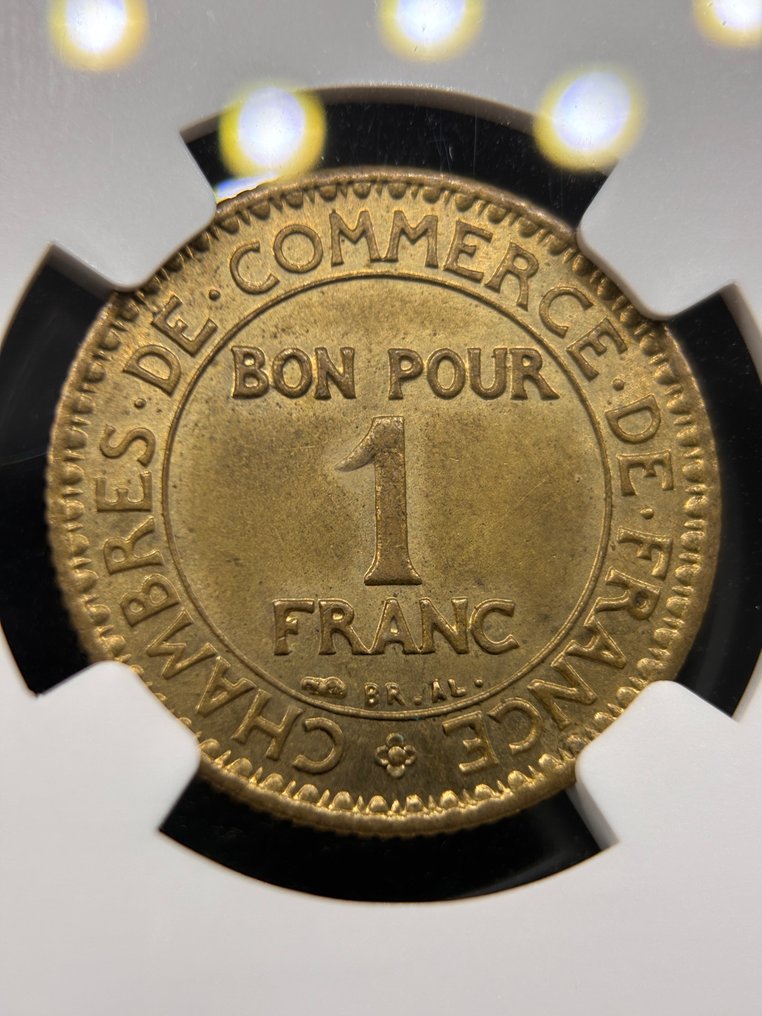
France. 1 Franc 1921 Chambres de Commerce. NGC MS63 (No reserve price)



06
days
00
hours
58
minutes
30
seconds

6 other people are watching this object
 Bidder 4829 Bidder 4829 | €1 |
|---|
Catawiki Buyer Protection
Your payment’s safe with us until you receive your object.View details
Trustpilot 4.4 | 122713 reviews
Rated Excellent on Trustpilot.
1921 France 1 Franc Chambre de Commerce aluminium-bronze token, MS63 by NGC (cert. 8613644-031); not legal tender but circulated as a temporary postwar token during the Third Republic, weight 4 g.
AI-assisted summary
Description from the seller
1921 French 1 Franc Chambre de Commerce Coin
Highlights:
1. As a temporary token during France's postwar economic shortages after WWI, it symbolizes the collaboration between government and business, witnessing the Third Republic's reconstruction and currency stabilization, making it ideal for history enthusiasts.
2. The obverse features Mercury, the god of commerce, signifying trade and peace; the reverse emphasizes commerce and industry, with its simple yet elegant patterns making it a classic example of coin design.
3. Despite the large mintage, but high-grade specimens (e.g., MS63) are scarce and can reach 80-150 euros or more, offering appreciation potential.
Coin Story:
This coin is a product of France's post-World War I (1914-1918) economic recovery period. Due to severe postwar silver coin shortages and inflation, the French government was unable to produce sufficient currency promptly, so it authorized the French Chambers of Commerce federation to mint temporary aluminum-bronze coins starting in 1920, including the 1 Franc denomination. This "Bon pour 1 Franc" (equivalent to 1 Franc) token was not official legal tender but was widely accepted for daily circulation, helping stabilize the postwar economy. It was gradually replaced by state-minted coins by 1927. It symbolizes the collaboration between government and business, reflecting the transitional phase of the Third Republic's reconstruction, with the design featuring Mercury, the god of commerce, signifying trade and peace.
Rarity:
Due to the large mintage, this coin is very common in lower grades (VF or XF). However, high-grade specimens (MS-63, uncirculated) are scarcer, as the material is prone to oxidation and scratches, leading to significant wear during use. Overall survival is high, but perfectly preserved examples, especially with original luster or toning, are much less common.
1921 French 1 Franc Chambre de Commerce Coin
Highlights:
1. As a temporary token during France's postwar economic shortages after WWI, it symbolizes the collaboration between government and business, witnessing the Third Republic's reconstruction and currency stabilization, making it ideal for history enthusiasts.
2. The obverse features Mercury, the god of commerce, signifying trade and peace; the reverse emphasizes commerce and industry, with its simple yet elegant patterns making it a classic example of coin design.
3. Despite the large mintage, but high-grade specimens (e.g., MS63) are scarce and can reach 80-150 euros or more, offering appreciation potential.
Coin Story:
This coin is a product of France's post-World War I (1914-1918) economic recovery period. Due to severe postwar silver coin shortages and inflation, the French government was unable to produce sufficient currency promptly, so it authorized the French Chambers of Commerce federation to mint temporary aluminum-bronze coins starting in 1920, including the 1 Franc denomination. This "Bon pour 1 Franc" (equivalent to 1 Franc) token was not official legal tender but was widely accepted for daily circulation, helping stabilize the postwar economy. It was gradually replaced by state-minted coins by 1927. It symbolizes the collaboration between government and business, reflecting the transitional phase of the Third Republic's reconstruction, with the design featuring Mercury, the god of commerce, signifying trade and peace.
Rarity:
Due to the large mintage, this coin is very common in lower grades (VF or XF). However, high-grade specimens (MS-63, uncirculated) are scarcer, as the material is prone to oxidation and scratches, leading to significant wear during use. Overall survival is high, but perfectly preserved examples, especially with original luster or toning, are much less common.
Details
Era
1900-2000
Country/province
France
Year/Period and Variation
1921 Chambres de Commerce. NGC MS63
Denomination
1 Franc
Condition
Graded by NGC
Certification number
8613644-031
Weight
4 g
Number of items
1
Theme
History
Coin type
World Coins (non Euro coins pre-2000)
Sold by