Apostle Portrait 'Saint James the Greater' - Wood, Linen - 1750-1800 - Saint James the Greater
09
days
10
hours
54
minutes
01
second

8 other people are watching this object
 Bidder 0727 Bidder 0727 | €3 | |
|---|---|---|
 Bidder 1725 Bidder 1725 | €2 |
Catawiki Buyer Protection
Your payment’s safe with us until you receive your object.View details
Trustpilot 4.4 | 122385 reviews
Rated Excellent on Trustpilot.
Description from the seller
Short Version
Apostle Portrait 'Saint James the Greater'
Oil on canvas, probably 18th century, mounted on stretcher frame.
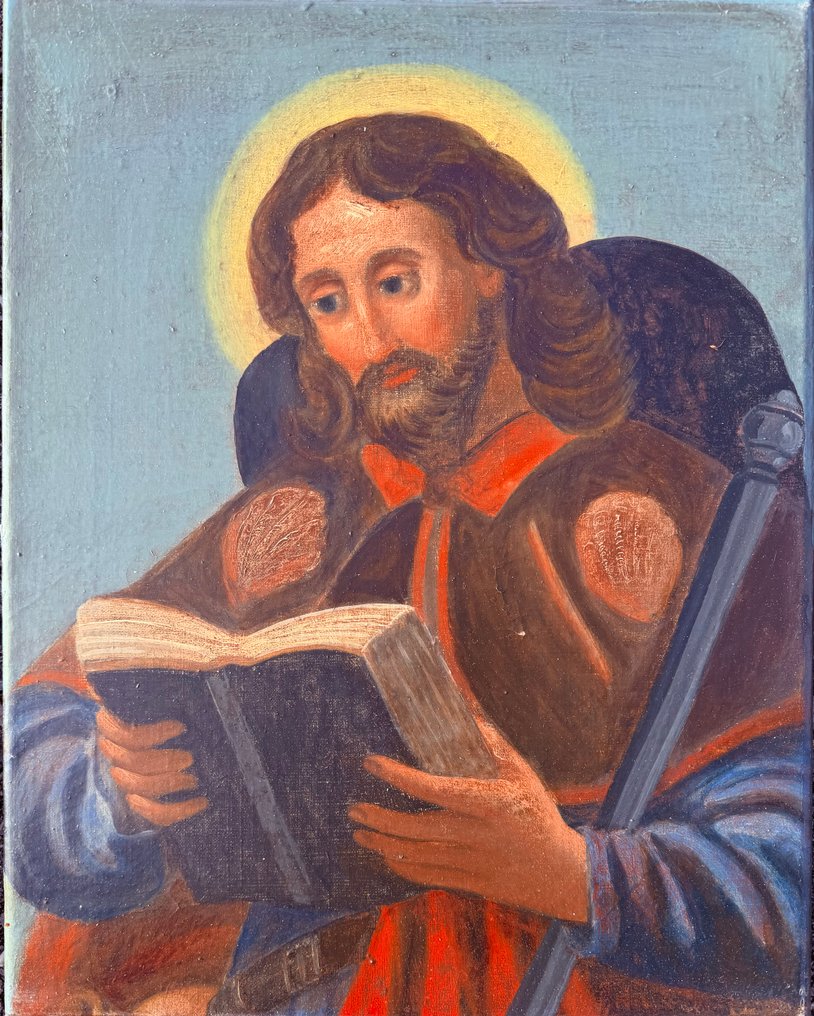
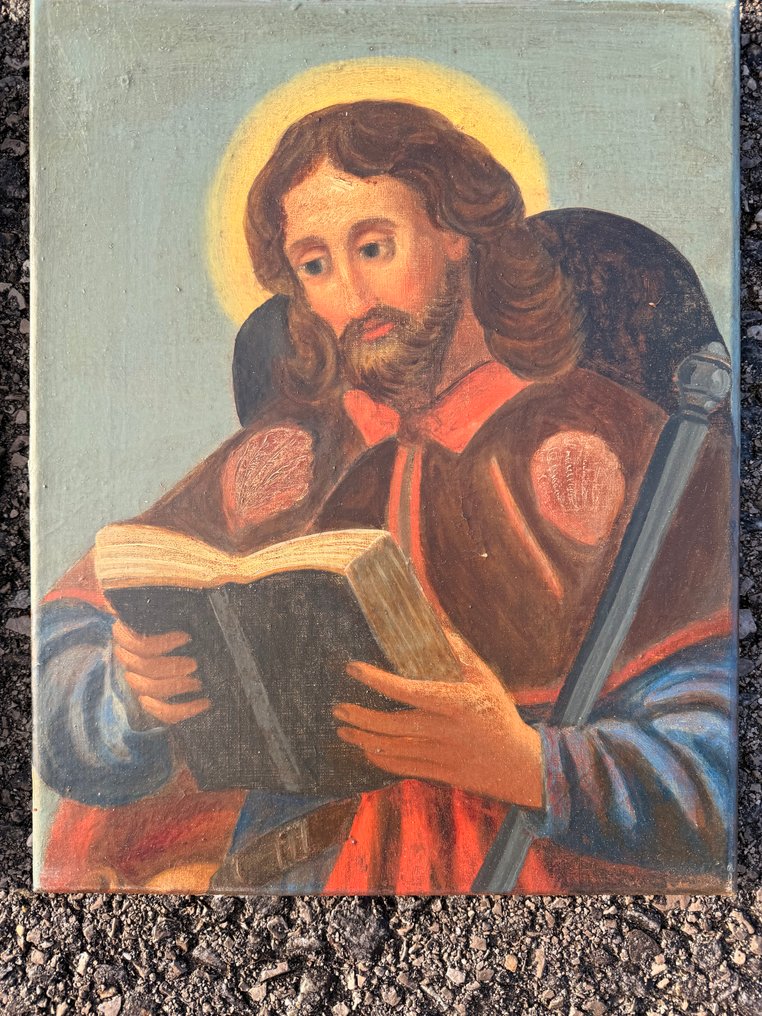
A half-length portrait of Saint James the Greater (Apostle Jacobus), clearly identified by the attributes of a pilgrim's staff and an open book. The apostle is depicted in a light brown-beige robe, reading in a meditative posture. The work is executed in oil on canvas, consistent with the devotional style of late Baroque to early Neoclassicism.
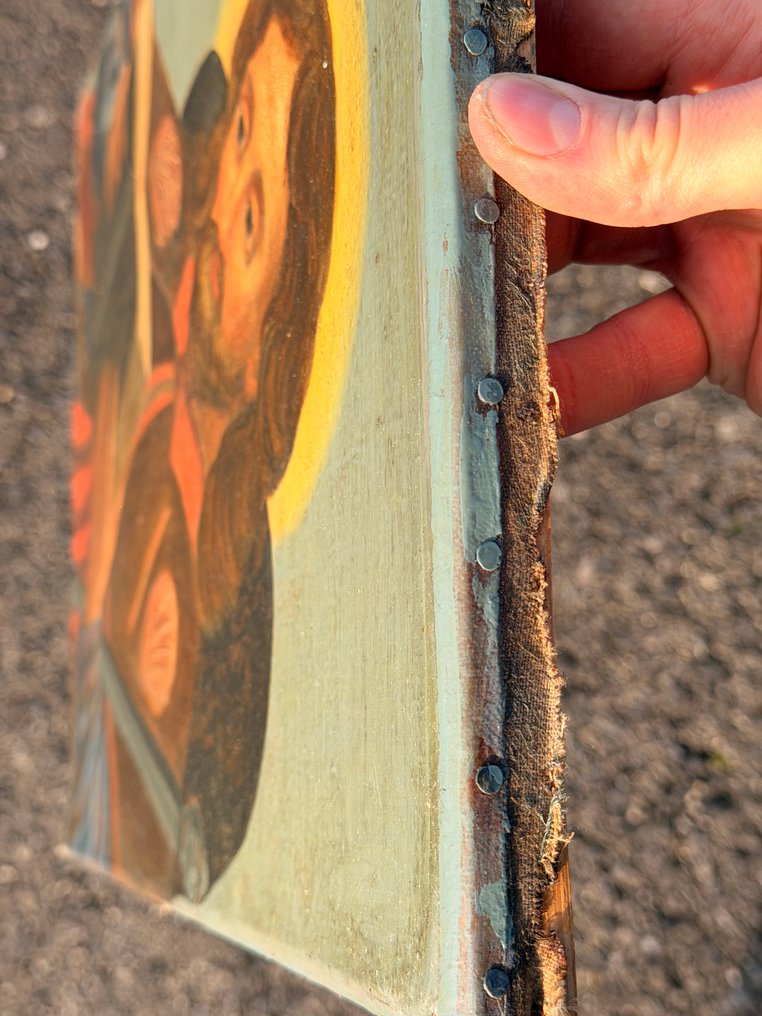
The painting is mounted on a later, professionally executed stretcher frame. It is in good, authentic condition with age-related craquelure and patina. It was originally part of a set of four apostle depictions which are now available for auction in my Catawiki profile.
Dimensions: approximately 50 × 40 cm (19.7 x 15.7 inches).
Shipping Note: If you bid on more than one auction of the Four Apostles, you only pay for shipping once.
Long Version
Title
Apostle Portrait 'Saint James the Greater'
Oil on canvas, probably 18th century, mounted on stretcher frame.
If you bid on more than one auction of the 4 apostles, you only pay shipping once! So, whether you buy 1, 2, 3, or all 4 paintings, you only pay the shipping cost one time.
This painting was originally part of a set of four apostle depictions. You have the opportunity to acquire each of these four works individually in the separate auctions listed in my profile. The final image of the gallery also shows all four pieces of the series.
Based on the distinctive iconographic attributes — namely the pilgrim’s staff and the open book — the figure can be confidently identified as Saint James the Greater (Apostle Jacobus). In Christian art, James is frequently portrayed as a pilgrim, often holding a staff, reflecting his role as the patron saint of pilgrims and his association with the Camino de Santiago. The contemplative pose while reading a sacred text further aligns with traditional depictions of the apostle.
Dimensions
Approx. 50 × 40 cm
(measured using the iPhone Measure App, therefore slight deviations are possible)
Object
Oil painting on canvas, likely created during the 18th century.
Mounted on a later stretcher frame, executed in a clean and professional manner.
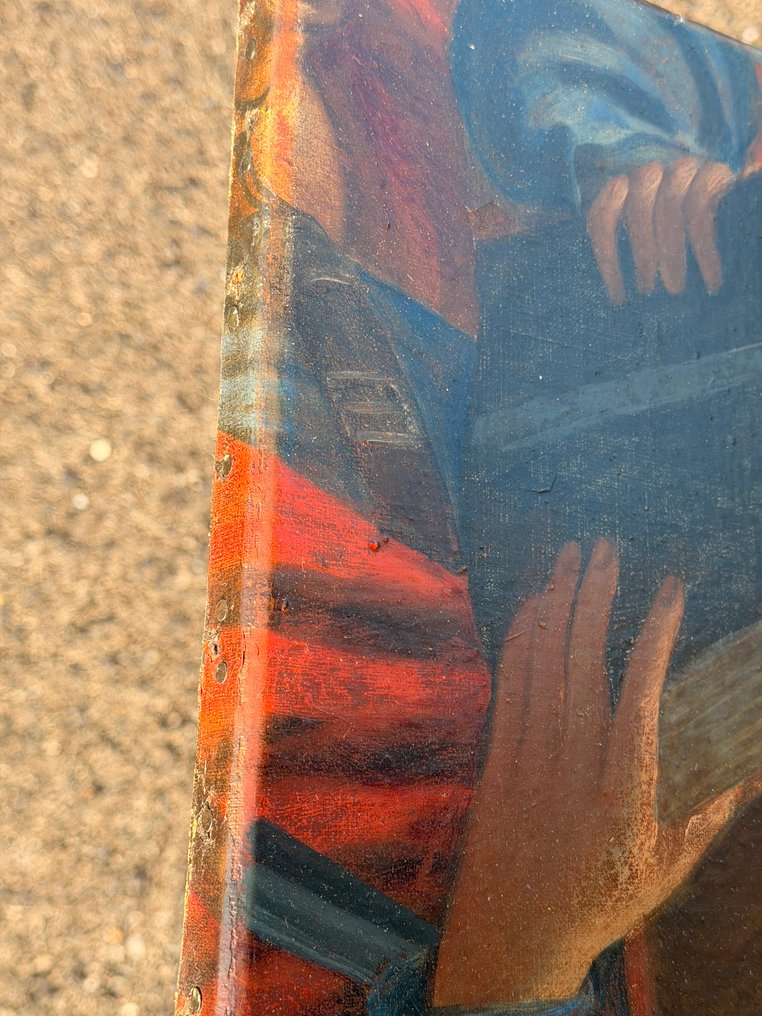
The surface displays age-typical craquelure and a natural patina that gives the painting the characteristic appearance of historical ecclesiastical art.
Depiction
Presented is a half-length portrait of Saint James the Greater in a serene, meditative posture. The apostle is turned slightly to the right, his gaze directed downward toward an open book — presumably a Gospel or sacred scripture, symbolizing devotion and apostolic authority.
The saint wears a light brown-beige robe accented with darker, vertically flowing folds. The drapery is broadly modeled, typical of Baroque workshop painting, giving the figure a sculptural presence. Subtle highlights along the robe’s edges emphasize the contours and rhythm of the cloth.
James is depicted with:
a full beard and moustache
a high, slightly receding forehead
Expressive, large eyes that convey concentration and humility.
Softly styled brown hair that flows naturally to the sides.
These features align with traditional portrayals of the apostle as a mature, steadfast follower of Christ.
In his left hand, James holds an open book with a strikingly red-edged binding — a detail typical of devotional manuscripts in European ecclesiastical art. His right hand grasps a pilgrim’s staff, the most recognized attribute of Saint James the Greater. This object associates him directly with Christian pilgrimage traditions and the legendary missionary journeys attributed to him.
A subtle, luminous halo surrounds his head, blending gently into the neutral background, reinforcing his sacred identity.
The background itself is restrained, presenting soft, atmospheric grey and ochre tones that keep the focus firmly on the apostle.
Technique and Style
The painting exhibits stylistic characteristics of the late Baroque with early Neoclassical tendencies.
Faces and hands: created with soft transitions, fine layering, and warm flesh tones.
Garments: broad, rhythmic drapery with light-dark contrasts typical of 17th–18th century ecclesiastical workshop production.
• Color palette: earthy browns contrasted by the vivid red edge of the book, creating a visually compelling focal point.
Lighting: a soft, ambient illumination subtly highlights forehead, nose, and hands.
• Background: atmospheric and unobtrusive, designed to emphasize the sacred presence of the figure.
The execution suggests the hand of a skilled religious workshop painter familiar with the iconography of apostolic cycles.
Dating and Context
Though unsigned, the stylistic and technical qualities suggest an 18th-century origin. During this period, a series of apostle portraits were often commissioned for:
churches and chapels
monastic institutions
Private devotional rooms
• altarpiece ensembles
The composition follows classical apostle iconography:
• half-length figure
• three-quarter turn
• clear saintly attributes (pilgrim’s staff)
• sacred text (book)
• contemplative, inward-focused expression
This approach reflects the Baroque ideal of combining spiritual intensity with approachable human warmth.
Stylistic Classification
The painting fits into the Central or Southern European sacred art tradition of the late 17th to 18th century. The expressive face, clear lighting, and robust drapery treatment correspond to established models found in monastic and parochial devotional painting.
Compositional elements adhere to classical norms:
• isolated figure without narrative setting
• symbolic attributes prominently featured
• neutral background
• emphasis on gesture, reading, and quiet devotion
These features collectively produce a calm, spiritually focused portrait resonant with the theological symbolism of Saint James.
Framing
The work is currently mounted on a later stretcher frame.
No original historical frame is included.
The canvas lies stable and would easily accommodate additional framing.
Condition
• Canvas: structurally stable, no visible tears or losses
• Paint layer: fine craquelure consistent with the age
• Surface: matte, with authentic patina
• Edges: slight abrasion consistent with age, not disturbing
• Overall: a well-preserved example of 18th-century devotional painting
Based on photographic evaluation, no intrusive restorations or overpainting are visible.
Art Historical Significance and Interpretation
As a depiction of Saint James the Greater, this work carries strong theological and cultural symbolism. James is one of the central figures of early Christianity — missionary, apostle, and patron saint of pilgrims. His presence in apostolic cycles emphasizes themes of steadfastness, journeying, and spiritual perseverance.
The open book symbolizes scriptural teaching and apostolic authority, while the staff links the figure to one of the most important pilgrimage traditions in Christian Europe — the Camino de Santiago.
This painting exemplifies:
• the devotional aesthetics of 18th-century sacred art
• the importance of apostolic cycles in church interiors
• the combination of spiritual expression and classical iconography
Conclusion
A finely executed and spiritually resonant 18th-century portrait of Saint James the Greater, with clear iconographic attributes and classic Baroque stylistic features.
Title: Apostle Portrait “Saint James the Greater”
Artist: Unknown, 18th-century workshop painter
Technique: Oil on canvas
Date: Probably 18th century
Mounting: Later stretcher frame
Condition: Good, authentic patina
Significance: Part of a traditional apostolic cycle, typical for late Baroque to early Neoclassical sacred art.
Short Version
Apostle Portrait 'Saint James the Greater'
Oil on canvas, probably 18th century, mounted on stretcher frame.
A half-length portrait of Saint James the Greater (Apostle Jacobus), clearly identified by the attributes of a pilgrim's staff and an open book. The apostle is depicted in a light brown-beige robe, reading in a meditative posture. The work is executed in oil on canvas, consistent with the devotional style of late Baroque to early Neoclassicism.
The painting is mounted on a later, professionally executed stretcher frame. It is in good, authentic condition with age-related craquelure and patina. It was originally part of a set of four apostle depictions which are now available for auction in my Catawiki profile.
Dimensions: approximately 50 × 40 cm (19.7 x 15.7 inches).
Shipping Note: If you bid on more than one auction of the Four Apostles, you only pay for shipping once.
Long Version
Title
Apostle Portrait 'Saint James the Greater'
Oil on canvas, probably 18th century, mounted on stretcher frame.
If you bid on more than one auction of the 4 apostles, you only pay shipping once! So, whether you buy 1, 2, 3, or all 4 paintings, you only pay the shipping cost one time.
This painting was originally part of a set of four apostle depictions. You have the opportunity to acquire each of these four works individually in the separate auctions listed in my profile. The final image of the gallery also shows all four pieces of the series.
Based on the distinctive iconographic attributes — namely the pilgrim’s staff and the open book — the figure can be confidently identified as Saint James the Greater (Apostle Jacobus). In Christian art, James is frequently portrayed as a pilgrim, often holding a staff, reflecting his role as the patron saint of pilgrims and his association with the Camino de Santiago. The contemplative pose while reading a sacred text further aligns with traditional depictions of the apostle.
Dimensions
Approx. 50 × 40 cm
(measured using the iPhone Measure App, therefore slight deviations are possible)
Object
Oil painting on canvas, likely created during the 18th century.
Mounted on a later stretcher frame, executed in a clean and professional manner.
The surface displays age-typical craquelure and a natural patina that gives the painting the characteristic appearance of historical ecclesiastical art.
Depiction
Presented is a half-length portrait of Saint James the Greater in a serene, meditative posture. The apostle is turned slightly to the right, his gaze directed downward toward an open book — presumably a Gospel or sacred scripture, symbolizing devotion and apostolic authority.
The saint wears a light brown-beige robe accented with darker, vertically flowing folds. The drapery is broadly modeled, typical of Baroque workshop painting, giving the figure a sculptural presence. Subtle highlights along the robe’s edges emphasize the contours and rhythm of the cloth.
James is depicted with:
a full beard and moustache
a high, slightly receding forehead
Expressive, large eyes that convey concentration and humility.
Softly styled brown hair that flows naturally to the sides.
These features align with traditional portrayals of the apostle as a mature, steadfast follower of Christ.
In his left hand, James holds an open book with a strikingly red-edged binding — a detail typical of devotional manuscripts in European ecclesiastical art. His right hand grasps a pilgrim’s staff, the most recognized attribute of Saint James the Greater. This object associates him directly with Christian pilgrimage traditions and the legendary missionary journeys attributed to him.
A subtle, luminous halo surrounds his head, blending gently into the neutral background, reinforcing his sacred identity.
The background itself is restrained, presenting soft, atmospheric grey and ochre tones that keep the focus firmly on the apostle.
Technique and Style
The painting exhibits stylistic characteristics of the late Baroque with early Neoclassical tendencies.
Faces and hands: created with soft transitions, fine layering, and warm flesh tones.
Garments: broad, rhythmic drapery with light-dark contrasts typical of 17th–18th century ecclesiastical workshop production.
• Color palette: earthy browns contrasted by the vivid red edge of the book, creating a visually compelling focal point.
Lighting: a soft, ambient illumination subtly highlights forehead, nose, and hands.
• Background: atmospheric and unobtrusive, designed to emphasize the sacred presence of the figure.
The execution suggests the hand of a skilled religious workshop painter familiar with the iconography of apostolic cycles.
Dating and Context
Though unsigned, the stylistic and technical qualities suggest an 18th-century origin. During this period, a series of apostle portraits were often commissioned for:
churches and chapels
monastic institutions
Private devotional rooms
• altarpiece ensembles
The composition follows classical apostle iconography:
• half-length figure
• three-quarter turn
• clear saintly attributes (pilgrim’s staff)
• sacred text (book)
• contemplative, inward-focused expression
This approach reflects the Baroque ideal of combining spiritual intensity with approachable human warmth.
Stylistic Classification
The painting fits into the Central or Southern European sacred art tradition of the late 17th to 18th century. The expressive face, clear lighting, and robust drapery treatment correspond to established models found in monastic and parochial devotional painting.
Compositional elements adhere to classical norms:
• isolated figure without narrative setting
• symbolic attributes prominently featured
• neutral background
• emphasis on gesture, reading, and quiet devotion
These features collectively produce a calm, spiritually focused portrait resonant with the theological symbolism of Saint James.
Framing
The work is currently mounted on a later stretcher frame.
No original historical frame is included.
The canvas lies stable and would easily accommodate additional framing.
Condition
• Canvas: structurally stable, no visible tears or losses
• Paint layer: fine craquelure consistent with the age
• Surface: matte, with authentic patina
• Edges: slight abrasion consistent with age, not disturbing
• Overall: a well-preserved example of 18th-century devotional painting
Based on photographic evaluation, no intrusive restorations or overpainting are visible.
Art Historical Significance and Interpretation
As a depiction of Saint James the Greater, this work carries strong theological and cultural symbolism. James is one of the central figures of early Christianity — missionary, apostle, and patron saint of pilgrims. His presence in apostolic cycles emphasizes themes of steadfastness, journeying, and spiritual perseverance.
The open book symbolizes scriptural teaching and apostolic authority, while the staff links the figure to one of the most important pilgrimage traditions in Christian Europe — the Camino de Santiago.
This painting exemplifies:
• the devotional aesthetics of 18th-century sacred art
• the importance of apostolic cycles in church interiors
• the combination of spiritual expression and classical iconography
Conclusion
A finely executed and spiritually resonant 18th-century portrait of Saint James the Greater, with clear iconographic attributes and classic Baroque stylistic features.
Title: Apostle Portrait “Saint James the Greater”
Artist: Unknown, 18th-century workshop painter
Technique: Oil on canvas
Date: Probably 18th century
Mounting: Later stretcher frame
Condition: Good, authentic patina
Significance: Part of a traditional apostolic cycle, typical for late Baroque to early Neoclassical sacred art.
Details
Era
1400-1900
Object name
Apostle Portrait 'Saint James the Greater'
Title additional information
Saint James the Greater
No. of items
1
Material
Linen, Wood
Country of Origin
Austria
Height
50 cm
Width
40 cm
Depth
2.5 cm
Condition
Good condition - used with small signs of aging & blemishes
Estimated period
1750-1800
Sold by
