Ancient Roman Stone Ancient Rome column capital


02
days
04
hours
20
minutes
12
seconds
Current bid
€ 250
Reserve price met

Expert
Selected by Peter Reynaers
Has nearly 30 years’ experience and moderated multiple online art research groups.
Estimate € 280 - € 330
15 other people are watching this object
 Bidder 4538 Bidder 4538 | €250 | |
|---|---|---|
| Bidder 4538 | €245 | |
| Bidder 4538 | €225 | |
Catawiki Buyer Protection
Your payment’s safe with us until you receive your object.View details
Trustpilot 4.4 | 123294 reviews
Rated Excellent on Trustpilot.
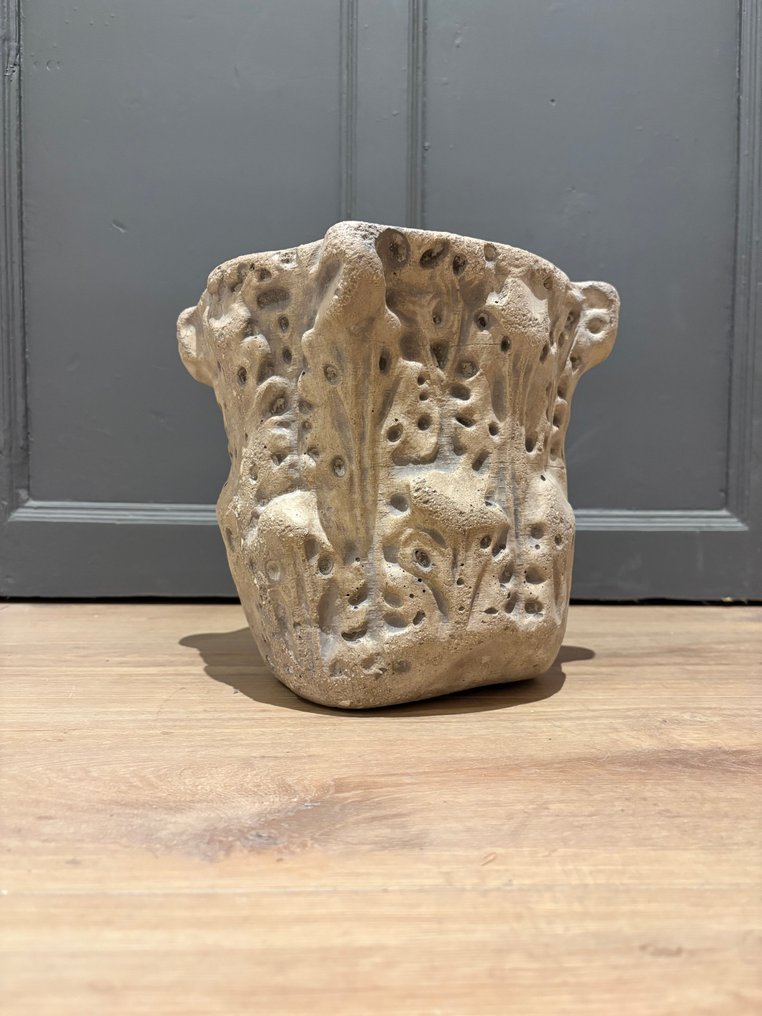
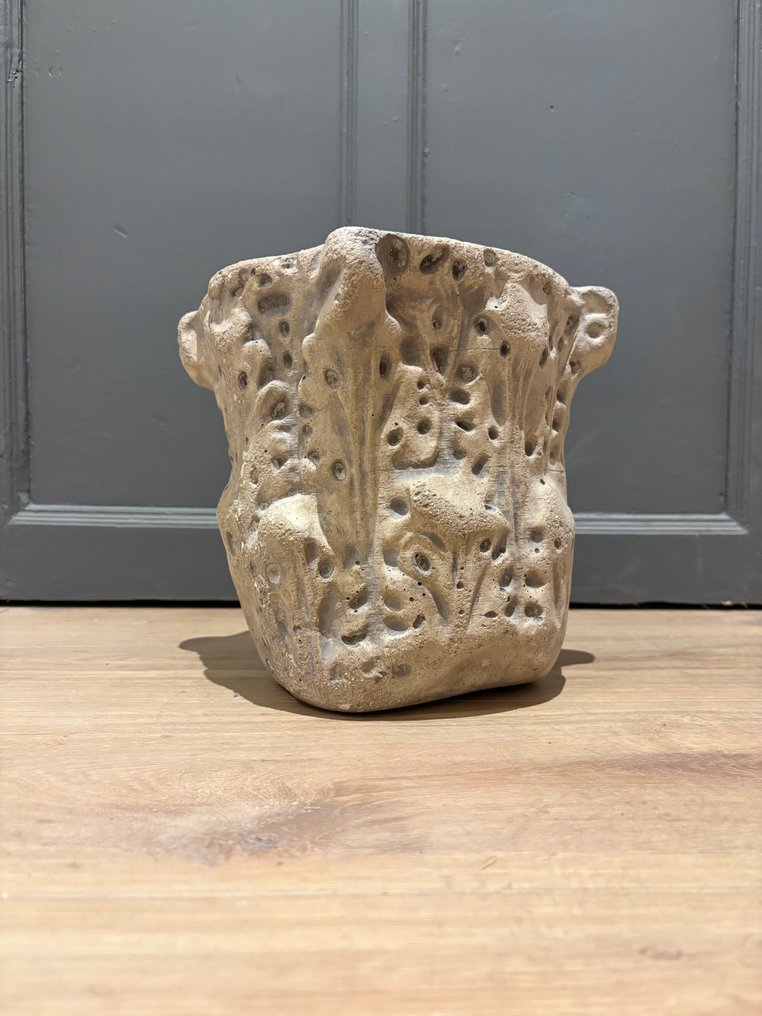
Replica of a Corinthian composite capital, carved entirely in natural white quartzite with a lime finish, in excellent condition, measuring 26 x 23 x 22 cm.
AI-assisted summary
Description from the seller
Masterpiece of applied sculpture that merges the sophistication of the Corinthian order, Greco-Roman classical techniques, and noble materials of exceptional durability.
This exceptional artisanal reproduction of a composite Corinthian capital, made entirely from natural white quartzite with a traditional lime finish, represents the perfect synthesis between classical Greco-Roman elegance and the aesthetic sophistication of architectural art. The piece embodies a living testament to the evolution from the pure Corinthian order to its refined composite variant, reflecting centuries of creative dialogue between Hellenistic sensitivity and Roman authority.
Technical and Artistic Characteristics
Noble Material: White Cuarcita
Entirely crafted from natural white quartzite, an exceptional metamorphic material that reaches over 7 points on the Mohs scale. Quartzite offers superior advantages over other traditional materials: exceptional mechanical resistance to pressure, abrasion, and high temperatures; natural impermeability that prevents moisture absorption; and proven durability that guarantees the piece's longevity over decades.
The piece stands out for its exceptional work of trepanado, texturizing, and aging applied through traditional sculpture techniques, faithfully recreating the methods used in Greco-Rroman workshops and inherited by stonemasons throughout antiquity. Trepanado, a technique widely used in classical Roman sculpture to create effects of light and shadow with extraordinary depth, allows for modeling the scrolls (volutes), bifid acanthus leaves, and tiny decorative elements characteristic of the Corinthian order.
This method, especially suitable for the execution of complex plant elements and refined negative spaces, achieves the distinctive chiaroscuro effect that gives the capital its monumental character and dynamic visual presence. The enveloping acanthus leaves, modeled using a trepan, create a vibrant visual pattern where each projected shadow enhances the volumetry of the composition. In the composite variant, the trepanning further emphasizes the transition between the lower Corinthian capitals and the upper abacus volutes, generating the characteristic stepped composition that defines the composite order.
The lime finish is a key element of the highest quality that imparts unique properties to the piece. This 100% natural finish, free of resins and chemical additives, is completely sustainable and eco-friendly. Natural lime offers exceptional benefits: natural breathability that regulates humidity, superior durability demonstrated in ancient structures like the Pantheon in Rome, and natural antibacterial properties.
The present capital corresponds to the typology of the composite Corinthian order, the most sophisticated variant of the classical orders, which combines the characteristic elements of the Corinthian (bifid acanthus leaves at the lower part of the capital, decorative fleurons at the corners) with the angular volutes typical of the Ionic order, forming a composition of extraordinary compositional elegance.
This typology reached its peak in the Roman Empire, particularly during the Julio-Claudian and late imperial periods, with paradigmatic examples found in monuments such as the Arch of Titus, the Colosseum, the Temple of Vespasian in the Roman Forum, and the Pantheon of Agrippa. The composite order represents the culmination of the Greco-Roman tradition, a synthesis of constructive wisdom that was later revived during the Renaissance and adopted as a standard in European neoclassical architecture.
The Corinthian capitals of this scale and proportion were used in both monumental contexts and in more intimate architectural applications: portals of patrician villas, private atriums, libraries, scholarly chambers, and government spaces. Their presence conferred solemnity and authority to any environment, functioning simultaneously as a structural element and as a symbol of power and culture.
The acanthus leaves (Acanthus mollis) possess a profound symbolism that goes beyond their purely decorative function. The name derives from the Greek akantha (thorn), representing life's difficulties and triumph over adversity. In classical tradition, the acanthus symbolized strength, perseverance, and the ability to thrive even in adverse conditions. According to legend, the architect Calímaco of the Peloponnese was inspired to create the Corinthian capital after observing how a funerary basket, covered with a tile, encouraged the growth of acanthus leaves that curled around the ceramic, creating an effect of extraordinary natural elegance.
By being carved in stone using the technique of trépano, these leaves become immortal, revealing that difficulties transform into steps toward excellence and enduring beauty.
Measurements: 26 x 23 x 22 cm, providing a balanced sculptural presence with versatile placement options.
Classical proportion that respects the Greco-Roman standards of symmetry and visual harmony.
New, with a museum-quality finish.
This exceptional piece is suitable for outdoor use thanks to the inherent properties of quartzite and the lime finish. Its resistance to weather agents, thermal changes, and humidity makes it ideal for decorating diverse spaces: monumental lobbies and entrances, galleries and porticoes, private offices, historic gardens, libraries, collection rooms, balconies, or contemplative corners. Its manageable size allows for integration in both classic environments and contemporary spaces with a historical sensibility.
The quality of the carving follows the Greco-Roman classical line, respecting the principles of symmetry, proportion, and compositional clarity that characterized ancient sculptor workshops. Through examples like this, one can see how master stonemasons of the classical and imperial eras created model types that served as references for carving similar capitals with minor personal variations. This system of work allowed maintaining quality standards while preserving the artisan's individual imprint.
Sustainability and Ecological Commitment
Material 100% Natural
The combination of natural quartzite and lime finish represents an absolute commitment to sustainability. Lime, as a natural-mineral material, does not emit volatile organic compounds (VOCs) and maintains a positive ecological footprint. During its lifecycle, lime absorbs CO₂ from the atmosphere, contributing to a favorable environmental balance.
Archaeological References and Reference Collections
Similar specimens to the present are preserved in prestigious international institutions.
- National Museum of Rome (Palazzo Altemps and Palazzo Massimo): composite capitals from the Julio-Claudian period.
Vatican Museums, Rome: specimens from excavations at the Roman Forum
British Museum, London: composite capitals from the imperial period.
National Archaeological Museum of Naples: capitals from Pompeii and Herculaneum
Metropolitan Museum of Art, New York: collection of composite order
Louvre Museum, Paris: exceptionally refined Greco-Roman capitals
These collections demonstrate the historical and artistic importance of this type of capitals within the architectural heritage of Greco-Roman civilization.
Quality Guarantees
Specialized Protected Shipping
The piece includes protected shipping with specialized packaging for artworks and valuable architectural elements. The system guarantees complete integrity during transport, using shock-resistant materials and professional packing techniques for sculptural pieces.
This exceptional reproduction of a composite Corinthian capital presents a unique opportunity to acquire a piece that combines Greco-Roman artisanal tradition, noble materials of proven durability, historical techniques of trepanado, and absolute ecological commitment. The fusion of natural white quartzite, traditional trepanado techniques, and lime finishing creates a functional work of art that dignifies any space with the timeless elegance of classical architecture.
This piece, crafted with traditional artisanal techniques on noble material and finished entirely naturally, is a lasting acquisition that aesthetically enriches any environment while maintaining a firm commitment to sustainability and environmental respect. For the collector of Greco-Roman art, the historian of classical architecture, the architecture history professor, or the lover of Western architectural heritage, this reproduction offers the opportunity to own an object that directly dialogues with the great capitals preserved in international museums and with the monumental ruins of Rome, Pompeii, and Herculaneum.
A piece of this nature constitutes an investment in historical beauty and artisanal sustainability, perfect for enriching private collections as well as public spaces with cultural, educational, or institutional prestige. Its presence confers authority and elegance to any environment, functioning simultaneously as an object of aesthetic contemplation and as a living reference to the technical and artistic sophistication of Greco-Roman civilization.
A unique opportunity to own a tangible fragment of classical excellence!
Seller's Story
We sell works of art and collectibles carefully selected by our experts and put up for sale at the best possible price so that collecting is accessible to everyone. You can follow us on Instagram: thaddeus_antiques
Translated by Google TranslateMasterpiece of applied sculpture that merges the sophistication of the Corinthian order, Greco-Roman classical techniques, and noble materials of exceptional durability.
This exceptional artisanal reproduction of a composite Corinthian capital, made entirely from natural white quartzite with a traditional lime finish, represents the perfect synthesis between classical Greco-Roman elegance and the aesthetic sophistication of architectural art. The piece embodies a living testament to the evolution from the pure Corinthian order to its refined composite variant, reflecting centuries of creative dialogue between Hellenistic sensitivity and Roman authority.
Technical and Artistic Characteristics
Noble Material: White Cuarcita
Entirely crafted from natural white quartzite, an exceptional metamorphic material that reaches over 7 points on the Mohs scale. Quartzite offers superior advantages over other traditional materials: exceptional mechanical resistance to pressure, abrasion, and high temperatures; natural impermeability that prevents moisture absorption; and proven durability that guarantees the piece's longevity over decades.
The piece stands out for its exceptional work of trepanado, texturizing, and aging applied through traditional sculpture techniques, faithfully recreating the methods used in Greco-Rroman workshops and inherited by stonemasons throughout antiquity. Trepanado, a technique widely used in classical Roman sculpture to create effects of light and shadow with extraordinary depth, allows for modeling the scrolls (volutes), bifid acanthus leaves, and tiny decorative elements characteristic of the Corinthian order.
This method, especially suitable for the execution of complex plant elements and refined negative spaces, achieves the distinctive chiaroscuro effect that gives the capital its monumental character and dynamic visual presence. The enveloping acanthus leaves, modeled using a trepan, create a vibrant visual pattern where each projected shadow enhances the volumetry of the composition. In the composite variant, the trepanning further emphasizes the transition between the lower Corinthian capitals and the upper abacus volutes, generating the characteristic stepped composition that defines the composite order.
The lime finish is a key element of the highest quality that imparts unique properties to the piece. This 100% natural finish, free of resins and chemical additives, is completely sustainable and eco-friendly. Natural lime offers exceptional benefits: natural breathability that regulates humidity, superior durability demonstrated in ancient structures like the Pantheon in Rome, and natural antibacterial properties.
The present capital corresponds to the typology of the composite Corinthian order, the most sophisticated variant of the classical orders, which combines the characteristic elements of the Corinthian (bifid acanthus leaves at the lower part of the capital, decorative fleurons at the corners) with the angular volutes typical of the Ionic order, forming a composition of extraordinary compositional elegance.
This typology reached its peak in the Roman Empire, particularly during the Julio-Claudian and late imperial periods, with paradigmatic examples found in monuments such as the Arch of Titus, the Colosseum, the Temple of Vespasian in the Roman Forum, and the Pantheon of Agrippa. The composite order represents the culmination of the Greco-Roman tradition, a synthesis of constructive wisdom that was later revived during the Renaissance and adopted as a standard in European neoclassical architecture.
The Corinthian capitals of this scale and proportion were used in both monumental contexts and in more intimate architectural applications: portals of patrician villas, private atriums, libraries, scholarly chambers, and government spaces. Their presence conferred solemnity and authority to any environment, functioning simultaneously as a structural element and as a symbol of power and culture.
The acanthus leaves (Acanthus mollis) possess a profound symbolism that goes beyond their purely decorative function. The name derives from the Greek akantha (thorn), representing life's difficulties and triumph over adversity. In classical tradition, the acanthus symbolized strength, perseverance, and the ability to thrive even in adverse conditions. According to legend, the architect Calímaco of the Peloponnese was inspired to create the Corinthian capital after observing how a funerary basket, covered with a tile, encouraged the growth of acanthus leaves that curled around the ceramic, creating an effect of extraordinary natural elegance.
By being carved in stone using the technique of trépano, these leaves become immortal, revealing that difficulties transform into steps toward excellence and enduring beauty.
Measurements: 26 x 23 x 22 cm, providing a balanced sculptural presence with versatile placement options.
Classical proportion that respects the Greco-Roman standards of symmetry and visual harmony.
New, with a museum-quality finish.
This exceptional piece is suitable for outdoor use thanks to the inherent properties of quartzite and the lime finish. Its resistance to weather agents, thermal changes, and humidity makes it ideal for decorating diverse spaces: monumental lobbies and entrances, galleries and porticoes, private offices, historic gardens, libraries, collection rooms, balconies, or contemplative corners. Its manageable size allows for integration in both classic environments and contemporary spaces with a historical sensibility.
The quality of the carving follows the Greco-Roman classical line, respecting the principles of symmetry, proportion, and compositional clarity that characterized ancient sculptor workshops. Through examples like this, one can see how master stonemasons of the classical and imperial eras created model types that served as references for carving similar capitals with minor personal variations. This system of work allowed maintaining quality standards while preserving the artisan's individual imprint.
Sustainability and Ecological Commitment
Material 100% Natural
The combination of natural quartzite and lime finish represents an absolute commitment to sustainability. Lime, as a natural-mineral material, does not emit volatile organic compounds (VOCs) and maintains a positive ecological footprint. During its lifecycle, lime absorbs CO₂ from the atmosphere, contributing to a favorable environmental balance.
Archaeological References and Reference Collections
Similar specimens to the present are preserved in prestigious international institutions.
- National Museum of Rome (Palazzo Altemps and Palazzo Massimo): composite capitals from the Julio-Claudian period.
Vatican Museums, Rome: specimens from excavations at the Roman Forum
British Museum, London: composite capitals from the imperial period.
National Archaeological Museum of Naples: capitals from Pompeii and Herculaneum
Metropolitan Museum of Art, New York: collection of composite order
Louvre Museum, Paris: exceptionally refined Greco-Roman capitals
These collections demonstrate the historical and artistic importance of this type of capitals within the architectural heritage of Greco-Roman civilization.
Quality Guarantees
Specialized Protected Shipping
The piece includes protected shipping with specialized packaging for artworks and valuable architectural elements. The system guarantees complete integrity during transport, using shock-resistant materials and professional packing techniques for sculptural pieces.
This exceptional reproduction of a composite Corinthian capital presents a unique opportunity to acquire a piece that combines Greco-Roman artisanal tradition, noble materials of proven durability, historical techniques of trepanado, and absolute ecological commitment. The fusion of natural white quartzite, traditional trepanado techniques, and lime finishing creates a functional work of art that dignifies any space with the timeless elegance of classical architecture.
This piece, crafted with traditional artisanal techniques on noble material and finished entirely naturally, is a lasting acquisition that aesthetically enriches any environment while maintaining a firm commitment to sustainability and environmental respect. For the collector of Greco-Roman art, the historian of classical architecture, the architecture history professor, or the lover of Western architectural heritage, this reproduction offers the opportunity to own an object that directly dialogues with the great capitals preserved in international museums and with the monumental ruins of Rome, Pompeii, and Herculaneum.
A piece of this nature constitutes an investment in historical beauty and artisanal sustainability, perfect for enriching private collections as well as public spaces with cultural, educational, or institutional prestige. Its presence confers authority and elegance to any environment, functioning simultaneously as an object of aesthetic contemplation and as a living reference to the technical and artistic sophistication of Greco-Roman civilization.
A unique opportunity to own a tangible fragment of classical excellence!
Seller's Story
We sell works of art and collectibles carefully selected by our experts and put up for sale at the best possible price so that collecting is accessible to everyone. You can follow us on Instagram: thaddeus_antiques
Translated by Google TranslateDetails
Culture
Ancient Roman
Century/ Timeframe
Réplica
Name of object
Ancient Rome column capital
Acquired from
Private collection
Year acquired
2025
Material
Stone
Country acquired from
Spain
Condition
Excellent
Previous owner acquired from
Gallery / Antique dealer
Previous owner - year acquired
2000
Previous owner - country acquired from
Spain
I verify that I have obtained this object legally and that I am allowed to sell it
Yes
Sold by
Disclaimer
The seller was informed by Catawiki about documentation requirements and guarantees the following: - the object was legally obtained, - the seller has the right to sell and/or export the object, as relevant, - the seller will provide the necessary provenance information and arrange required documentation and permits/licenses, as applicable and as per local laws, - the seller will notify the buyer of any delays in obtaining permits/licenses. By bidding, you acknowledge that import documentation may be required depending on your country of residence and that obtaining permits/licenses may cause delays in the delivery of your object.
The seller was informed by Catawiki about documentation requirements and guarantees the following: - the object was legally obtained, - the seller has the right to sell and/or export the object, as relevant, - the seller will provide the necessary provenance information and arrange required documentation and permits/licenses, as applicable and as per local laws, - the seller will notify the buyer of any delays in obtaining permits/licenses. By bidding, you acknowledge that import documentation may be required depending on your country of residence and that obtaining permits/licenses may cause delays in the delivery of your object.
