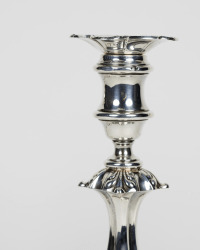
Tea service (3) - .925 silver


03
days
18
hours
42
minutes
24
seconds
Current bid
€ 200
Reserve price not met

Expert
Selected by Inés Fernández
Specialised in Spanish and Portuguese silver with over 10 years in galleries and auctions.
Estimate € 2,000 - € 2,200
14 other people are watching this object
 Bidder 8186 Bidder 8186 | €200 | |
|---|---|---|
| Bidder 8186 | €190 | |
| Bidder 8186 | €180 | |
Catawiki Buyer Protection
Your payment’s safe with us until you receive your object.View details
Trustpilot 4.4 | 122630 reviews
Rated Excellent on Trustpilot.
English sterling silver tea set (.925) dated 1866 by John Sherwood & Sons, comprising teapot, milk jug and sugar basin, total weight 1.152 kg, Birmingham, Victorian design.
AI-assisted summary
Description from the seller
English Sterling Silver Tea Set (Brand J.S&S)
Detailed Analysis
Manufacturer identification and year of the marks.
The 'J.S&S' punch mark corresponds to the manufacturer John Sherwood & Sons, a Birmingham-based goldsmith firm active between 1858 and 1913.
Total weight of the game: 1,152 kg.
The teapot features classic British hallmarks: the lion passant, certifying sterling silver (.925), Queen Victoria's head (duty mark, used on pieces marked before 1890), and a letter 'R'. This letter is the date mark: in the case of Birmingham, the uppercase 'R' corresponds to the year 1866, which aligns with the presence of Queen Victoria's seal.
Therefore, the game was dated to 1866. Each piece of the set (teapot, creamer, and sugar bowl) should bear matching punch marks (same letter and city) if they are part of the original set, which appears to be the case. Additionally, the Birmingham anchor symbol on the punch marks is expected, since John Sherwood sent his pieces to be tested in that city.
Design style
The design of the set is distinctly Victorian (mid-19th century). The teapot from 1866 displays typical features of the Victorian era: elegant lines, with ornamental decoration on the handle and lid. The highlight is the fruit-shaped knob on the lid, a naturalistic motif frequently used in Victorian silverware.
These fused fruits or berries as a decorative finish reflect the Victorian taste for ornamentation inspired by nature. Likewise, the scrollwork and leaf embellishments on the handle or rim are characteristic of the late Rococo style or 'Rococo revival,' popular in the mid-19th century, mixed with naturalistic touches. Many Victorian pieces feature repoussé surfaces with floral motifs or scalloped edges, and this piece probably follows that trend. Overall, the style could be described as classic Victorian, with formal elegance and exuberant yet balanced details—far from the later geometric sobriety of Art Deco or the Edwardian simplicity, and closer to the ornamental splendor of the Victorian era. Sources: 1872 auction with Victorian teapot including a fruit knop.
Rococo/naturalist characteristics in 19th-century English silverware.
Historical overview of the manufacturer (John Sherwood & Sons)
John Sherwood & Sons was a silverware company established in Birmingham, England, in the second half of the 19th century. Its founder, John Sherwood, was active from 1839; around 1858, he officially registered the J.S&S trademark after partnering with his sons, operating from the 'Regent Works' workshop in Birmingham.
The company specialized in the production of silver-plated (electroplate) items for domestic use—trays, cutlery, tea sets, and other decorative table objects—although it occasionally also manufactured pieces in contrasted sterling silver, such as the set we are discussing.
John Sherwood & Sons is remembered for its beaver trademark: many of its pieces featured a small emblem shaped like a beaver, which was its distinctive mark.
In fact, at the end of the 19th century, the company caused some controversy for using punches on its silver-plated objects that imitated sterling silver punches. For example, the use of a crown (similar to the Sheffield contrast) and Gothic letters has been documented, which simulated Victorian date marks on pieces that were actually only silver-plated.
This practice, common at the time to enhance the appearance of inexpensive silverware, led to legal changes in 1897 prohibiting the use of symbols such as the crown on objects that were not pure silver.
Despite this, John Sherwood & Sons enjoyed a good reputation for the quality of their silver products, which supplied the growing Victorian middle class with elegant tableware at an affordable price. They partnered with other businesses (for example, Maxfield & Sons) and marketed under names like 'Regent Plate,' indicating their line of electroplate.
The company remained active during the Edwardian era (early 20th century); pieces have been verified with J.S&S until around 1913, the year it ceased activity (according to other sources, the company may have already closed by 1896).
Currently, pieces by John Sherwood & Sons – both in solid silver and silver-plated – are appreciated by Victorian silverware collectors. While they do not reach the high values of aristocratic London firms, they offer a tangible testimony to Birmingham's industrial peak during the Victorian era and to the aesthetic trends of that time. The tea set analyzed here, with its careful handcrafted work from 1866, is a representative example of this firm's legacy in the history of English silverware.
English Sterling Silver Tea Set (Brand J.S&S)
Detailed Analysis
Manufacturer identification and year of the marks.
The 'J.S&S' punch mark corresponds to the manufacturer John Sherwood & Sons, a Birmingham-based goldsmith firm active between 1858 and 1913.
Total weight of the game: 1,152 kg.
The teapot features classic British hallmarks: the lion passant, certifying sterling silver (.925), Queen Victoria's head (duty mark, used on pieces marked before 1890), and a letter 'R'. This letter is the date mark: in the case of Birmingham, the uppercase 'R' corresponds to the year 1866, which aligns with the presence of Queen Victoria's seal.
Therefore, the game was dated to 1866. Each piece of the set (teapot, creamer, and sugar bowl) should bear matching punch marks (same letter and city) if they are part of the original set, which appears to be the case. Additionally, the Birmingham anchor symbol on the punch marks is expected, since John Sherwood sent his pieces to be tested in that city.
Design style
The design of the set is distinctly Victorian (mid-19th century). The teapot from 1866 displays typical features of the Victorian era: elegant lines, with ornamental decoration on the handle and lid. The highlight is the fruit-shaped knob on the lid, a naturalistic motif frequently used in Victorian silverware.
These fused fruits or berries as a decorative finish reflect the Victorian taste for ornamentation inspired by nature. Likewise, the scrollwork and leaf embellishments on the handle or rim are characteristic of the late Rococo style or 'Rococo revival,' popular in the mid-19th century, mixed with naturalistic touches. Many Victorian pieces feature repoussé surfaces with floral motifs or scalloped edges, and this piece probably follows that trend. Overall, the style could be described as classic Victorian, with formal elegance and exuberant yet balanced details—far from the later geometric sobriety of Art Deco or the Edwardian simplicity, and closer to the ornamental splendor of the Victorian era. Sources: 1872 auction with Victorian teapot including a fruit knop.
Rococo/naturalist characteristics in 19th-century English silverware.
Historical overview of the manufacturer (John Sherwood & Sons)
John Sherwood & Sons was a silverware company established in Birmingham, England, in the second half of the 19th century. Its founder, John Sherwood, was active from 1839; around 1858, he officially registered the J.S&S trademark after partnering with his sons, operating from the 'Regent Works' workshop in Birmingham.
The company specialized in the production of silver-plated (electroplate) items for domestic use—trays, cutlery, tea sets, and other decorative table objects—although it occasionally also manufactured pieces in contrasted sterling silver, such as the set we are discussing.
John Sherwood & Sons is remembered for its beaver trademark: many of its pieces featured a small emblem shaped like a beaver, which was its distinctive mark.
In fact, at the end of the 19th century, the company caused some controversy for using punches on its silver-plated objects that imitated sterling silver punches. For example, the use of a crown (similar to the Sheffield contrast) and Gothic letters has been documented, which simulated Victorian date marks on pieces that were actually only silver-plated.
This practice, common at the time to enhance the appearance of inexpensive silverware, led to legal changes in 1897 prohibiting the use of symbols such as the crown on objects that were not pure silver.
Despite this, John Sherwood & Sons enjoyed a good reputation for the quality of their silver products, which supplied the growing Victorian middle class with elegant tableware at an affordable price. They partnered with other businesses (for example, Maxfield & Sons) and marketed under names like 'Regent Plate,' indicating their line of electroplate.
The company remained active during the Edwardian era (early 20th century); pieces have been verified with J.S&S until around 1913, the year it ceased activity (according to other sources, the company may have already closed by 1896).
Currently, pieces by John Sherwood & Sons – both in solid silver and silver-plated – are appreciated by Victorian silverware collectors. While they do not reach the high values of aristocratic London firms, they offer a tangible testimony to Birmingham's industrial peak during the Victorian era and to the aesthetic trends of that time. The tea set analyzed here, with its careful handcrafted work from 1866, is a representative example of this firm's legacy in the history of English silverware.
Details
Era
1400-1900
Gross weight
1.15 kg
Silver type
.925 silver
No. of items
3
Country of Origin
United Kingdom
Material
Silver
Condition
Good condition - used with small signs of ageing
Height
10 cm
Width
10 cm
Depth
12 cm
Estimated period
1850-1900
Sold by