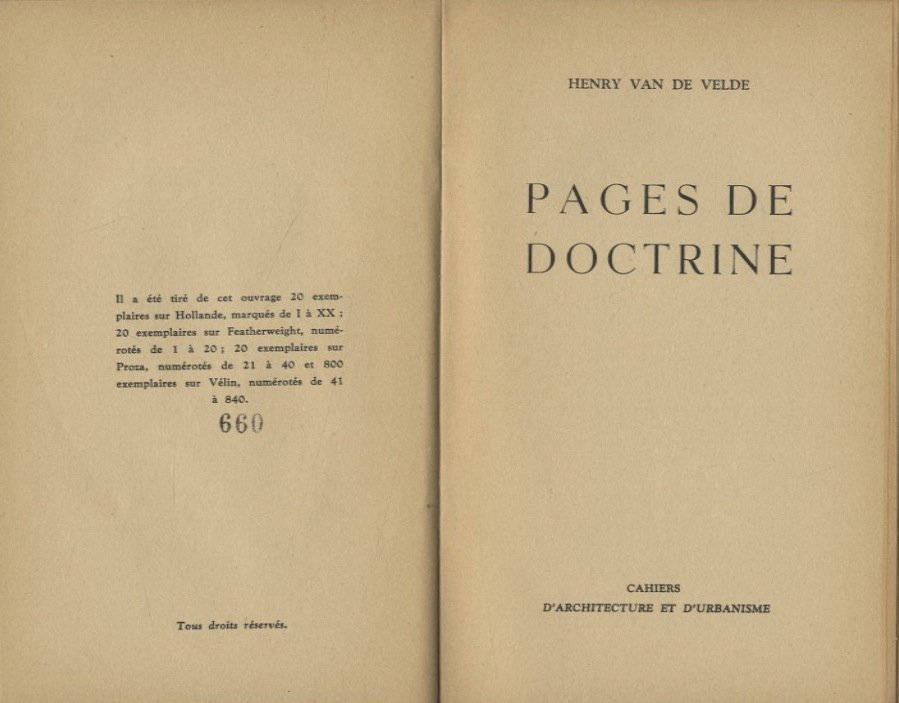
Van de Velde, Henry. - Pages de doctrine. - 1942




13
days
08
hours
02
minutes
57
seconds
Starting bid
€ 1
Reserve price not met

Expert
Selected by Tom Hopman
Studied history and managed a large online book catalogue with 13 years' antiquarian bookshop experience.
Estimate € 150 - € 200
No bids placed
Catawiki Buyer Protection
Your payment’s safe with us until you receive your object.View details
Trustpilot 4.4 | 122385 reviews
Rated Excellent on Trustpilot.
Pages de doctrine by Henry Van de Velde, first French edition, 122 pages, 19 × 13 cm, softcover, in very good condition.
AI-assisted summary
Description from the seller
Henry Van de Velde as a designer and architect
From 1892, Van de Velde left painting and focused on applied arts: (goldsmithing, porcelain and cutlery, fashion design, carpet and fabric design) and also architecture, including the construction of his own house in Ukkel, House Bloemenwerf. In his house, the interior and design formed an organic whole. In 1895, he designed interiors and furniture for the influential art dealership L'Art Nouveau, run by gallery owner Samuel Bing in Paris. Van de Velde's work was also featured in Bing's pavilion at the 1900 World's Fair in Paris. Van de Velde was influenced by the English Arts and Crafts movement with John Ruskin and William Morris, and was one of the first architects and furniture designers to work in an abstract style with curved lines. He opposed copying historical styles and decisively chose an original design approach. He aimed to eliminate the banality and ugliness from the human spirit.
In 1899, he settled in Germany. He received several commissions there, including for the Museum Folkwang and the villa Hohenhof in Hagen, as well as for the Nietzsche House in Weimar. Together with Harry Kessler, he became one of the founders of the Kunstgewerbeschule and the academy in Weimar, the predecessor of the Bauhaus that was further developed by Walter Gropius in Dessau. He also maintained a close connection with the Deutscher Werkbund.
Portrait of Maria Sèthe, the later wife of Van de Velde, 1891, by Théo Van Rysselberghe. It was through the painter that Van de Velde and Maria Sèthe met each other.
During the First World War, Van de Velde stayed in Switzerland and the Netherlands. On behalf of Helene Kröller-Müller, he designed a caretaker's house and a worker’s house in Schipborg (building permits are dated 1921), next to the farm De Schepbord, designed in 1914 by architect Hendrik Petrus Berlage. Van de Velde ultimately designed the Kröller-Müller Museum in Otterlo, which opened in 1938. In 1925, he was appointed to the Higher Institute for Art History and Archaeology at Ghent University, where he taught architectural art and applied arts from 1926 to 1936. In 1933, he was commissioned to design the university library; the Boekentoren. Construction began in 1936, but the finishing was only completed after World War II and, for budgetary reasons, not entirely according to the original plans. For example, the floor of the reading room was made of marble and not black rubber, as Van de Velde had actually wanted. Van de Velde was also involved in the construction of the University Hospital Ghent.
Henry Van de Velde as a designer and architect
From 1892, Van de Velde left painting and focused on applied arts: (goldsmithing, porcelain and cutlery, fashion design, carpet and fabric design) and also architecture, including the construction of his own house in Ukkel, House Bloemenwerf. In his house, the interior and design formed an organic whole. In 1895, he designed interiors and furniture for the influential art dealership L'Art Nouveau, run by gallery owner Samuel Bing in Paris. Van de Velde's work was also featured in Bing's pavilion at the 1900 World's Fair in Paris. Van de Velde was influenced by the English Arts and Crafts movement with John Ruskin and William Morris, and was one of the first architects and furniture designers to work in an abstract style with curved lines. He opposed copying historical styles and decisively chose an original design approach. He aimed to eliminate the banality and ugliness from the human spirit.
In 1899, he settled in Germany. He received several commissions there, including for the Museum Folkwang and the villa Hohenhof in Hagen, as well as for the Nietzsche House in Weimar. Together with Harry Kessler, he became one of the founders of the Kunstgewerbeschule and the academy in Weimar, the predecessor of the Bauhaus that was further developed by Walter Gropius in Dessau. He also maintained a close connection with the Deutscher Werkbund.
Portrait of Maria Sèthe, the later wife of Van de Velde, 1891, by Théo Van Rysselberghe. It was through the painter that Van de Velde and Maria Sèthe met each other.
During the First World War, Van de Velde stayed in Switzerland and the Netherlands. On behalf of Helene Kröller-Müller, he designed a caretaker's house and a worker’s house in Schipborg (building permits are dated 1921), next to the farm De Schepbord, designed in 1914 by architect Hendrik Petrus Berlage. Van de Velde ultimately designed the Kröller-Müller Museum in Otterlo, which opened in 1938. In 1925, he was appointed to the Higher Institute for Art History and Archaeology at Ghent University, where he taught architectural art and applied arts from 1926 to 1936. In 1933, he was commissioned to design the university library; the Boekentoren. Construction began in 1936, but the finishing was only completed after World War II and, for budgetary reasons, not entirely according to the original plans. For example, the floor of the reading room was made of marble and not black rubber, as Van de Velde had actually wanted. Van de Velde was also involved in the construction of the University Hospital Ghent.
Details
Number of Books
1
Subject
Architecture
Book Title
Pages de doctrine.
Author/ Illustrator
Van de Velde, Henry.
Condition
Very good
Publication year oldest item
1942
Height
19 cm
Edition
1st Edition
Width
13 cm
Language
French
Original language
Yes
Publisher
Éditions de "La Maison du poète"
Binding/ Material
Softback
Number of pages
122
Sold by