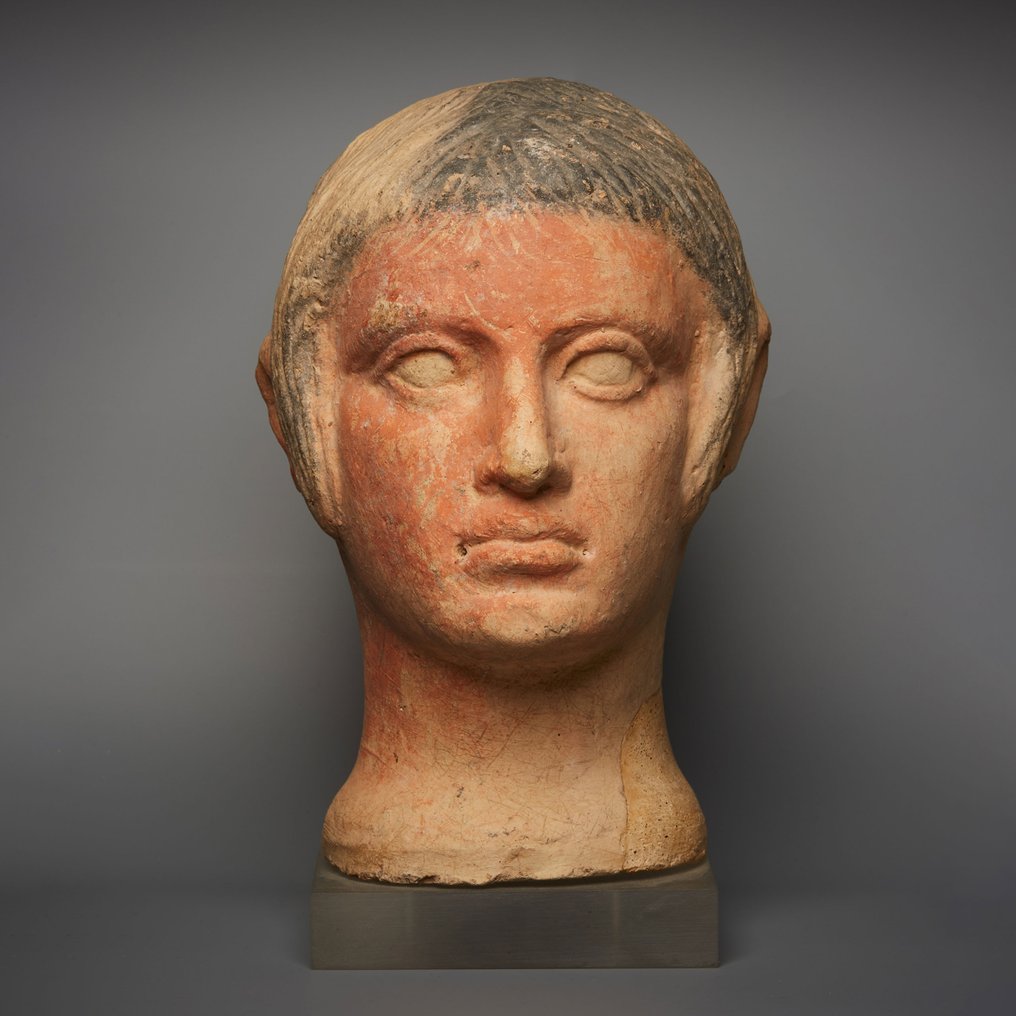
Etruscan Terracotta Votive Head of a Man. 24 cm H. 3rd-2nd century BC. TL Test.




08
days
03
hours
00
minutes
43
seconds
Current bid
€ 2,200
Reserve price not met

Expert
Selected by Ruth Garrido Vila
Directed the Ifergan Collection Museum, specialising in Phoenician and Mediterranean archaeology.
Estimate € 15,000 - € 17,000
7 other people are watching this object
 Bidder 5937 Bidder 5937 | €2,200 | |
|---|---|---|
 Bidder 3854 Bidder 3854 | €2,000 |
Catawiki Buyer Protection
Your payment’s safe with us until you receive your object.View details
Trustpilot 4.4 | 122986 reviews
Rated Excellent on Trustpilot.
Etruscan votive head of a man in terracotta, 24 cm high, dating to the 3rd–2nd century BC, with original polychrome and good condition, TL test attached, provenance from a private collection (Bergerac, France, 1970), and includes authenticity certificate and Spanish export license.
AI-assisted summary
Description from the seller
Votive Head of a Man.
- Thermoluminescence test attached -
Etruscan, 3rd-2nd century BC.
Terracotta and pigments.
Height 24 cm
PROVENANCE: Private collection, Bergerac, France. 1970.
CONDITION: Good condition. An area of the back of the neck is missing, visibly reconstructed. Maintains the original polychrome.
DESCRIPTION:
Etruscan male head, made of molded and fired terracotta. It represents a young man with an idealized face, with a straight mouth and thick lips, perfectly combed with his hair collected in thick locks regularly arranged around the face. It should be noted that the piece has been modeled in its entirety, since many Etruscan heads are smooth on the back, this is complete. Furthermore, the other characteristic that makes this head an important piece is the conservation of the original polychrome.
The Etruscans produced heads, profiles of faces, hands, feet and other body parts as accompanying votive offerings in fired clay for votive use.
Etruscan art is often religious in nature and is therefore related to the demands of the Etruscan religion. The Etruscan afterlife was negative, unlike the positive point of view of ancient Egypt where it was a continuation of earthly life, or the relationships of trust with the gods typical of ancient Greece. The Etruscan gods were indifferent and tended to bring good luck, so Etruscan religion was centered on their veneration and the adoration of the dead. Most of the remains of Etruscan art are found in cemetery excavations (such as at Cerveteri, Tarquinia, Populonia, Orvieto, Vetulonia, Norchia), which means that we see Etruscan art dominated by representations of religion and in particular cult funeral.
In the clay urns in which the remains of the deceased were kept, sculptural elements appear representing anatomical elements of the deceased, for example, the head-shaped lid. In a later phase, life-size human figures appear reclining on the lid as if it were a bed. The faces denote the influence of archaic Greek sculpture. In opposition to Greek stone sculpture, Etruscan sculpture takes shape in softer materials that enable a more elastic, fluid and rounded modulation, imbuing the figures with a natural spontaneity.
Notes:
The piece includes authenticity certificate.
The piece includes Spanish Export License.
THE MINISTRY OF CULTURE FROM SPAIN ASKS ALL SELLERS FOR INVOICES OR OTHER DOCUMENTATION ABLE TO PROVE THE LEGALITY OF EACH ITEM BEFORE PROVIDING AN IMPORT OR EXPORT LICENSE.
#MWFINDS
Seller's Story
Gallery of Ancient Art - Archeology based in Barcelona with more than fifteen years of experience. Specialized in classical art, Egyptian art, Asian art and pre-Columbian art. It guarantees the authenticity of all its pieces. It participates in the most important art fairs in Spain, such as Feriarte, as well as in fairs abroad, BRAFA, Parcours des Mondes, Cultures Brussels.
All the pieces are sent with an Export Permit issued by the Spanish Ministry of Culture.
We are quick to ship via DHL Express or Direct Art Transport.
Translated by Google TranslateVotive Head of a Man.
- Thermoluminescence test attached -
Etruscan, 3rd-2nd century BC.
Terracotta and pigments.
Height 24 cm
PROVENANCE: Private collection, Bergerac, France. 1970.
CONDITION: Good condition. An area of the back of the neck is missing, visibly reconstructed. Maintains the original polychrome.
DESCRIPTION:
Etruscan male head, made of molded and fired terracotta. It represents a young man with an idealized face, with a straight mouth and thick lips, perfectly combed with his hair collected in thick locks regularly arranged around the face. It should be noted that the piece has been modeled in its entirety, since many Etruscan heads are smooth on the back, this is complete. Furthermore, the other characteristic that makes this head an important piece is the conservation of the original polychrome.
The Etruscans produced heads, profiles of faces, hands, feet and other body parts as accompanying votive offerings in fired clay for votive use.
Etruscan art is often religious in nature and is therefore related to the demands of the Etruscan religion. The Etruscan afterlife was negative, unlike the positive point of view of ancient Egypt where it was a continuation of earthly life, or the relationships of trust with the gods typical of ancient Greece. The Etruscan gods were indifferent and tended to bring good luck, so Etruscan religion was centered on their veneration and the adoration of the dead. Most of the remains of Etruscan art are found in cemetery excavations (such as at Cerveteri, Tarquinia, Populonia, Orvieto, Vetulonia, Norchia), which means that we see Etruscan art dominated by representations of religion and in particular cult funeral.
In the clay urns in which the remains of the deceased were kept, sculptural elements appear representing anatomical elements of the deceased, for example, the head-shaped lid. In a later phase, life-size human figures appear reclining on the lid as if it were a bed. The faces denote the influence of archaic Greek sculpture. In opposition to Greek stone sculpture, Etruscan sculpture takes shape in softer materials that enable a more elastic, fluid and rounded modulation, imbuing the figures with a natural spontaneity.
Notes:
The piece includes authenticity certificate.
The piece includes Spanish Export License.
THE MINISTRY OF CULTURE FROM SPAIN ASKS ALL SELLERS FOR INVOICES OR OTHER DOCUMENTATION ABLE TO PROVE THE LEGALITY OF EACH ITEM BEFORE PROVIDING AN IMPORT OR EXPORT LICENSE.
#MWFINDS
Seller's Story
Gallery of Ancient Art - Archeology based in Barcelona with more than fifteen years of experience. Specialized in classical art, Egyptian art, Asian art and pre-Columbian art. It guarantees the authenticity of all its pieces. It participates in the most important art fairs in Spain, such as Feriarte, as well as in fairs abroad, BRAFA, Parcours des Mondes, Cultures Brussels.
All the pieces are sent with an Export Permit issued by the Spanish Ministry of Culture.
We are quick to ship via DHL Express or Direct Art Transport.
Translated by Google TranslateDetails
Culture
Etruscan
Century/ Timeframe
3rd-2nd century BC
Name of object
Votive Head of a Man. 24 cm H. 3rd-2nd century BC. TL Test.
Acquired from
Private collection
Material
Terracotta
Condition
Good
Disclaimer
The seller was informed by Catawiki about documentation requirements and guarantees the following: - the object was legally obtained, - the seller has the right to sell and/or export the object, as relevant, - the seller will provide the necessary provenance information and arrange required documentation and permits/licenses, as applicable and as per local laws, - the seller will notify the buyer of any delays in obtaining permits/licenses. By bidding, you acknowledge that import documentation may be required depending on your country of residence and that obtaining permits/licenses may cause delays in the delivery of your object.
The seller was informed by Catawiki about documentation requirements and guarantees the following: - the object was legally obtained, - the seller has the right to sell and/or export the object, as relevant, - the seller will provide the necessary provenance information and arrange required documentation and permits/licenses, as applicable and as per local laws, - the seller will notify the buyer of any delays in obtaining permits/licenses. By bidding, you acknowledge that import documentation may be required depending on your country of residence and that obtaining permits/licenses may cause delays in the delivery of your object.
